






Description
Overview
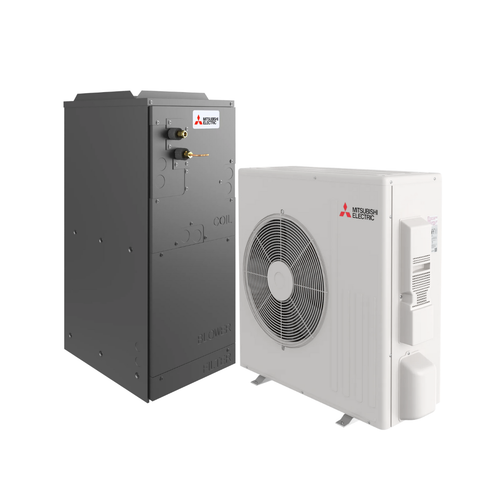
This system the Mitsubishi Electric SVZ-AP18NL indoor unit with the outdoor heat pump to deliver single-zone comfort in a vertical-ducted air handler indoor unit configuration. The combination is rated at 18,000 BTU/h cooling and is designed for efficient heating and cooling operation in residential and light commercial spaces. Published efficiency ratings include 16.2 SEER2, 12.0 EER2, and 9.8 HSPF2 (IV), helping buyers compare seasonal energy performance. Because this is a , key electrical and piping details are coordinated for proper compatibility. It’s a fit for projects where you want Mitsubishi comfort controls and inverter-driven capacity modulation in a compact, packaged selection.
Performance
The outdoor unit uses an inverter-driven compressor to modulate output and maintain setpoint with fewer temperature swings. Cooling capacity ranges from 5,700 to 18,000 BTU/h (rated 18,000), supporting part-load operation for shoulder seasons. At 47°F heating conditions, the system is rated at 20,000 BTU/h heating (maximum 23,800). At 17°F, rated heating capacity is 12,800 BTU/h for cold-weather planning. Listed COP at 47°F is 3.8, providing a reference point for efficiency in mild heating conditions. The outdoor section includes a Blue Fin coating and grooved piping features noted in the to support heat exchanger performance and durability. For designers, the published voltage is 208/230V single-phase, with a recommended 30A fuse/breaker size shown in the data.
Smart Features
Control flexibility is built into the through multiple controller and interface options documented for these units. Published data includes system electrical and performance values for the SVZ-AP18NL and ; control options are dependent on selected Mitsubishi controller/interface for the SVZ air handler family. Wi‑Fi-enabled configurations can with the Comfort app where listed, supporting remote temperature changes, fan adjustments, and scheduling. These control options can support single-zone living areas, offices, or supplemental conditioning zones where dependable setpoint control matters. If your project requires integration, the also reference third‑party interfaces as an available option depending on the installed controller package. For buyers, this translates into easier day‑to‑day management and fewer manual thermostat adjustments.
Comfort & Noise
Comfort performance is influenced by airflow range, discharge control, and sound output, all of which are documented in the for this match. Indoor airflow is listed at 471–675 (cooling/heating dry) CFM (depending on fan speed and mode). Indoor sound pressure levels are listed at 36–45 (cooling/heating) dB(A) across fan speeds. Available external static pressure settings are listed at 0.30, 0.50, 0.80 in. w.g. for ducted applications. External static pressure settings are listed up to 0.80 in. w.g., supporting ducted distribution designs with higher resistance. The result is controllable air delivery that can be tuned for steady circulation or faster pull‑down/warm‑up using the system’s available modes. When with proper sizing and layout, this helps maintain even temperatures without over-conditioning a space.
Use Case Fit
This is well suited for projects that need a dedicated single-zone heat pump with a vertical-ducted air handler indoor unit indoor unit format. It fits concealed or ducted layouts where you want conditioned air delivered through short duct runs or distribution trunks. With documented operation across common indoor temperature ranges, it can support year-round comfort in many U.S. regions. Use it in homes, multi-family units, small retail, or office suites where zoning a single area improves comfort control and operating costs. For HVAC replacement projects, the pairing simplifies specifying compared with mixing components across families.
Value & Reliability
The call out durability and service-oriented design elements intended to support long-term ownership. Outdoor unit features listed include Blue Fin coating, inverter-driven compressor, and automatic restart after power returns. Indoor dimensions are listed as 17 x 21-5/8 x 39-13/16 in (W x D x H), which helps plan clearances and fit for retrofit or new construction. The outdoor unit directed-power concept and automatic restart behavior are also described, supporting resilience after power interruptions. Standardized 208/230V electrical and published wiring guidance help installers plan materials and circuits. For buyers comparing bundles, the combination of documented efficiency ratings and Mitsubishi control options supports a strong total-cost-of-ownership profile.
Summary Wrap-Up
Choose the -SVZ-AP18NL when you want a Mitsubishi Electric single-zone heat pump pairing SVZ-AP18NL with for predictable compatibility. With listed efficiency (16.2 SEER2 and 9.8 HSPF2 IV where published) and documented airflow/noise data, it’s straightforward to size and specify for comfort-driven projects. The indoor-unit form factor supports the layout needs of modern remodels and new builds, while inverter modulation supports steadier temperatures. If you’re sourcing equipment for a homeowner, contractor, or property manager, this keeps the selection simple while retaining Mitsubishi control flexibility. It’s a practical choice for single-room conditioning, additions, or dedicated zones that need reliable heating and cooling from a single system.
Key Features
- : SVZ-AP18NL with for a coordinated single-zone heat pump system.
- Efficiency ratings: Listed at 16.2 SEER2 and 9.8 HSPF2 (IV) for seasonal energy comparisons.
- Airflow range: Indoor airflow is listed at 471–675 (cooling/heating dry) CFM across fan settings for controllable air delivery.
- Sound performance: Indoor sound pressure levels are listed at 36–45 (cooling/heating) dB(A) depending on fan speed.
- Static pressure capability: External static pressure options listed at 0.30, 0.50, 0.80 in. w.g. for duct design flexibility.
- Control options: Controller options vary by selected Mitsubishi control/interface package.
- Installation/service feature: External static pressure settings up to 0.80 in. w.g. are listed for duct design flexibility.
Replaces Discontinued Models
- SUZ-AA18NL replaces: SUZ-KA18NA, SUZ-KA18NA2, SUZ-KA18NAR1
- SVZ-AP18NL replaces: MVZ-A18AA4, MVZ-A18AA7, SVZ-KP18NA
Replacement matches are based on unit type, capacity and features. Verify line set, electrical supply and controls before ordering. See the discontinued Mitsubishi model cross-reference for details and original manuals.
White Paper