
null
Indoor Air Quality

Indoor Air Quality

Poor indoor air quality shows up in real ways: allergy flare-ups, persistent musty odors, moisture damage behind walls, and energy bills that creep up as HVAC systems work harder than they should. Getting it right means matching the right equipment to the right space, and HVAC365 stocks the capacity and application options to do that for a single room or an entire building. Indoor air quality equipment is the category that covers filtration, air cleaning, humidity control, and ventilation, each solving a different piece of the same problem: making the air inside a building healthier, cleaner, and more comfortable. That need runs across residential homeowners replacing aging equipment, commercial building operators dealing with code compliance or occupant complaints, professional contractors and installers spec-matching for specific job requirements, and distributors stocking inventory for volume resale or fleet jobs. Whoever is buying, the questions that drive a good decision are roughly the same: what is the problem, what space does it cover, and what equipment is the right fit for that combination.

Choosing the Right IAQ Equipment

Before anything else, identify the actual problem. Filtration and air cleaning address particulates, allergens, and airborne contaminants. Dehumidifiers and humidifiers address moisture, which is a separate issue that filtration alone cannot fix. Ventilation equipment addresses fresh air exchange and indoor pollutant dilution. These product types overlap in the same category because they all improve indoor air quality, but they are not interchangeable, and buying the wrong type is the most common mistake buyers make at this stage.

Once you have confirmed the problem type, sizing becomes the central question. Capacity in this category depends on the size of the space being served, the construction type, the existing HVAC system's airflow, and in the case of humidity control, the local climate. A unit sized for a small apartment will be inadequate in a whole-home application, and a commercial-grade unit in a small residential space will short-cycle or over-process, wasting energy and wearing the equipment faster. Sizing should be based on a real assessment of the space, not a guess, whether that is a Manual J-style load calculation for humidity or a measured square footage and ceiling height for filtration coverage. The manufacturer's application guide will state the method they recommend; use it.

Application fit is the next decision. Residential and light commercial applications often call for equipment that integrates with an existing forced-air HVAC system, either as an in-duct solution or as a standalone unit for a specific area. Heavier commercial applications may require higher-capacity standalone units, dedicated ventilation systems, or commercial-rated dehumidifiers built for continuous-duty cycling. The use case matters because equipment designed for one application may not carry the ratings or duty cycle required for another, even if the footprint looks similar.

Efficiency is worth thinking about early, especially if a utility rebate or local energy code is in play. Higher-efficiency equipment typically costs more upfront and may recover that cost over time through operating savings, but the break-even point depends on runtime, local utility rates, and how long the equipment will stay in service. Check your local utility's rebate thresholds and local energy codes before finalizing a selection; the answers will narrow the field without you having to compare every available efficiency tier manually. For distributors or contractors spec-matching across multiple jobs, volume pricing and lead time availability are worth verifying directly, since those factors can affect project scheduling as much as the technical specs do. The installation-readiness factors, including electrical supply, drainage, and airflow compatibility, are covered further down on this page.

Buying Tips

  • Do not confuse filtration with humidity control. A high-MERV air filter will catch particulates but will not reduce relative humidity, and a dehumidifier will not clean the air. If you have both problems, you need both solutions. Buying one expecting it to handle both is a common and avoidable mistake.
  • Portable does not mean temporary. Some buyers default to portable units as a short-term fix, then live with them for years. If the problem is ongoing, a whole-home or in-duct solution is almost always more cost-effective and less intrusive over time. Factor in that comparison before defaulting to portable.
  • Check the existing system's filter slot and airflow specs before buying an in-duct air cleaner. Not every air handler can accept a thicker media filter or an electronic air cleaner without airflow restriction. Installing a high-efficiency filter in a system not designed for the added resistance can reduce airflow enough to cause problems elsewhere. This is cheap to check up front and expensive to diagnose after the fact.
  • Warranty terms vary more than buyers expect in this category. Some units carry multi-year parts and labor coverage; others cover the unit only, not the media or consumables. Read the warranty before purchase, especially for commercial or continuous-duty applications where replacement media costs add up. If you are also sourcing humidifiers and dehumidifiers or thermostats and controls for the same project, confirm compatibility and warranty alignment across products before ordering.

IAQ Equipment Types and When Each One Fits

This category covers several distinct product types, and the right one depends almost entirely on the problem being addressed and the space being served.

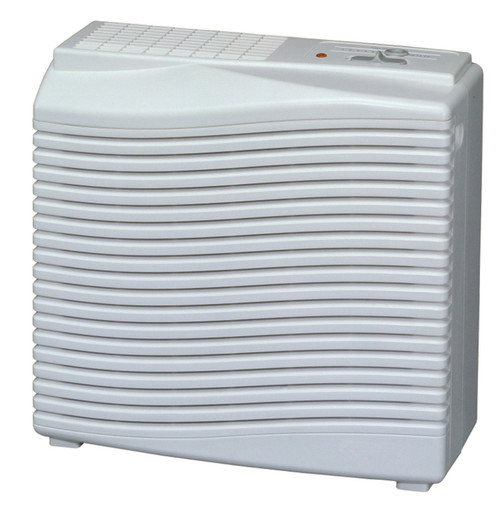
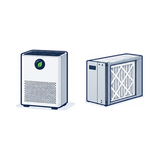
  • Air cleaners and purifiers. These range from media-based systems that mechanically filter particulates to electronic and UV-based systems that target biological contaminants and volatile organic compounds. In-duct air cleaners integrate with a forced-air system and treat all the air passing through it. Standalone portable units serve individual rooms or areas without a duct connection. The right choice depends on the contaminant type, the square footage, and whether a central HVAC system is available to work with.
  • HEPA filtration systems. True HEPA filtration captures a very high percentage of airborne particles at small sizes. These are commonly specified for applications where filtration efficiency is critical, such as households with serious allergy or asthma concerns, medical offices, or cleanroom-adjacent environments. Not every forced-air system can accommodate true HEPA media without additional airflow considerations; verify compatibility before specifying.
  • Dehumidifiers. Whole-home dehumidifiers connect to the existing HVAC system's ductwork or operate as standalone units in a basement or crawl space. Portable dehumidifiers serve smaller areas. The right capacity depends on the space size, existing moisture load, and climate. Continuous-duty ratings matter for commercial or basement applications where the unit runs frequently.
  • Ventilation and energy recovery equipment. Energy recovery ventilators (ERVs) and heat recovery ventilators (HRVs) bring fresh air into a tightly sealed building while recovering a portion of the conditioned air's energy. These are increasingly relevant in new construction and retrofit projects where tight building envelopes limit natural air exchange. The right choice between an ERV and an HRV generally depends on climate and whether humidity transfer is desirable.

What Installation Actually Requires

IAQ equipment spans a wider range of installation complexity than almost any other HVAC category. A portable air purifier plugs into a standard outlet and requires nothing else. A whole-home dehumidifier integrated into a ducted system requires a condensate drain line, an electrical circuit sized to the unit's requirements, and ductwork connections on both the supply and return sides. Verify each of these against the specific unit's installation documentation before the job starts, not after the equipment arrives on site.

For in-duct solutions, check the existing air handler's specifications for maximum allowable filter resistance (measured in inches of water column or Pascals, depending on the manufacturer). A filter or air cleaner that exceeds that resistance will reduce system airflow, which can cause comfort complaints, coil freezing, or compressor stress in the connected cooling equipment. Measure the existing filter slot dimensions before ordering, since in-duct units are typically sized to fit specific opening dimensions and are not field-adjustable.

Electrical requirements vary by product type. Portable units typically run on standard household circuits, but whole-home dehumidifiers and some electronic air cleaners require a dedicated circuit. Pull the spec sheet for the specific unit and look up the voltage, amperage, and circuit protection requirements before scheduling the electrical work. Do not assume the existing panel has a suitable open breaker at the right amperage; verify it against the unit's nameplate before the install date.

For dehumidifiers with continuous drainage, the condensate line needs to route to a floor drain, a utility sink, or a condensate pump, depending on the installation location. Gravity drainage requires the drain to be below the unit's drain port; if it is not, a condensate pump is required. Ask about the site's drain options before specifying the unit, since adding a condensate pump after the fact adds cost and a potential failure point.

ERVs and HRVs require dedicated fresh-air and exhaust duct runs to the exterior, separate from the main supply and return system. The exterior penetrations need to be properly flashed and screened. Operating temperature range matters here as well: some units have limitations in extreme cold, which is relevant in northern climates where the ventilator may run through deep winter. Check the manufacturer's rated operating range against the expected minimum outdoor temperature for the installation location.

Controls integration is worth addressing at the install stage. Some IAQ equipment runs independently on its own controls; other units can integrate with a communicating thermostat or building automation system for coordinated operation. If the project spec calls for integrated controls, verify compatibility between the IAQ equipment and the thermostat or BAS before purchase, not after, since compatibility is not universal and adapters are not always available.

Things You Should Know

Q: How do I know what capacity of IAQ equipment my space needs?

A: For air cleaners and purifiers, match the stated square footage or air changes per hour rating to your actual room dimensions. For dehumidifiers, capacity is rated in pints per day and depends on square footage, ceiling height, moisture load, and local climate; use the manufacturer's sizing guide or a humidity load calculation to get a defensible number. Oversizing causes short-cycling and premature wear; undersizing means the unit runs continuously without solving the problem. Neither is acceptable, so do the math before ordering.

Q: Can I add an in-duct air cleaner to any forced-air HVAC system?

A: Not automatically. High-efficiency in-duct air cleaners add resistance to the airflow path, and whether your air handler can handle that depends on its rated static pressure capacity. Exceeding it reduces airflow and creates secondary problems in the heating and cooling equipment. Check the air handler's specs and the air cleaner's rated pressure drop before selecting a model — the installation section above covers the full range of site checks involved.

Q: What is the difference between an ERV and an HRV, and which one do I need?

A: Both bring fresh outdoor air in while recovering energy from the outgoing exhaust, but they handle moisture differently. An HRV transfers heat only and exhausts the moisture to the outside. An ERV transfers both heat and moisture, which helps maintain indoor humidity in cold, dry climates. In humid climates, an HRV is often preferred to avoid transferring outdoor moisture back inside. Local climate data and the building's humidity profile drive this decision — the equipment type descriptions above explain how each one works in context.

Q: Do I need a dedicated electrical circuit for a whole-home dehumidifier?

A: Most whole-home dehumidifiers require a dedicated circuit. The specific voltage, amperage, and circuit protection requirements are on the unit's nameplate and in the installation documentation. Pull those specs before scheduling electrical work and compare them against what the existing panel can provide — the installation section above walks through what to verify on site.

Q: Can a portable dehumidifier handle a whole basement?

A: It depends on the basement size and moisture load. A unit rated for a smaller space will run continuously and may not keep up with a large or heavily humid basement. If the problem is significant, a whole-home or large-capacity standalone unit connected to a continuous drain is usually the better long-term answer. The sizing factors that determine which way to go are explained in the dehumidifier equipment type section above.

Q: How often do IAQ filters and media need to be replaced?

A: Replacement intervals vary by product type, media efficiency rating, and the actual particulate load in the space. The manufacturer's documentation will state a recommended interval, but heavily used systems or environments with high dust or allergen loads may require more frequent changes. Budget for replacement media as part of the total cost of ownership before selecting a system, and confirm availability of the specific replacement media for the unit you are buying.

Q: Is IAQ equipment eligible for utility rebates?

A: Some high-efficiency IAQ equipment qualifies for utility rebates or tax credits, but eligibility depends on the specific product, your utility, and your state or local program. Check your utility's rebate portal and any applicable federal or state energy incentive programs before finalizing your selection. Rebate terms change frequently, so confirm current eligibility rather than relying on older information.

HVAC365 ships IAQ equipment nationwide, with a stocked selection broad enough to cover single-room portable units through whole-home and commercial-grade systems. Whether you are a homeowner dealing with a moisture problem that cannot wait, or a contractor who needs the right unit on site before the job can close out, having the equipment actually in stock matters as much as the selection itself. Orders are available for residential replacements through distributor volume orders, and the catalog is built to support the full range of jobs that come up, not just the common ones.

Compare
Show: 12 24 48

Fast Shipping

Easy Returns

Warranty Coverage

Financing Available