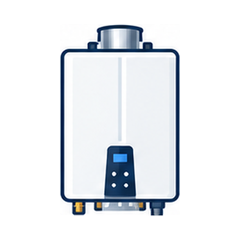
Hot water is one of those things nobody thinks about until it stops working, and when it does, the pressure to get the right replacement in fast is real. Whether a household is waking up to cold showers or a commercial kitchen has gone down mid-service, the call is the same: get the correct unit matched to the application and get it moving. HVAC365 stocks a broad selection of water heaters across fuel types, capacities, and configurations so you are not hunting across multiple distributors to find what the job actually calls for. Part of the broader heaters catalog, this category covers standalone water heating equipment from straightforward residential replacements to commercial-grade installs.
Water heaters are the equipment that heat and, depending on the type, store domestic hot water for sinks, showers, dishwashers, laundry, and process applications. The category spans a wide range: homeowners doing a straight tank swap, light-commercial property managers upgrading to a tankless system, professional plumbers and HVAC contractors sourcing equipment for a specific job, and distributors or fleet buyers purchasing in volume for resale or project stock. Each of those buyers is looking at the same core product category, but with very different selection criteria, quantities, and lead-time needs, so the information below is written to be useful across all of them.
The single biggest mistake buyers make is treating a water heater replacement as a straight size-for-size swap without checking whether the existing unit was actually right for the load. Start with demand, not with what was there before. How many fixtures or end-points will the heater serve simultaneously? Is this a residential home, a multi-unit building, a restaurant, or a light-commercial facility? Those questions determine the category of equipment you need before you get into fuel type or efficiency tier.
Fuel type is usually constrained by what the site already has. A gas line, an electric service panel, a propane tank, or in some cases a heat-pump-ready location each points toward a different product family. Where there is flexibility, it is worth thinking through the tradeoffs: electric resistance units tend to be simpler and cheaper to install but carry higher operating costs in most utility markets; gas units have lower operating costs in many regions but require venting; heat pump water heaters deliver strong efficiency but need adequate ambient air volume and temperature to work as designed. None of those tradeoffs has a universal right answer. They depend on local utility rates, available infrastructure, and the installation environment, which is covered in more detail further down.
For tank-style units, first-hour rating (FHR) is the spec that actually predicts real-world performance for residential applications. A 50-gallon tank with a strong burner can outperform a 75-gallon tank with a weak one during a morning demand spike. Verify the FHR against the actual peak-hour demand at the site rather than sizing purely by gallons. For tankless units, the key figure is flow rate at a required temperature rise: the colder the incoming water in your region, the larger the unit you need to hit the target output temperature. Neither of those figures should be guessed; pull them from a load estimate or from the existing unit's rating plate and measure actual site conditions.
Efficiency tier affects both operating cost and rebate eligibility. Most utilities and some state programs offer rebates for units that meet or exceed a specific Uniform Energy Factor (UEF) threshold. Look up your local utility's current rebate schedule before you commit to a unit, because the difference in upfront cost between an entry-level unit and a qualifying high-efficiency unit is sometimes smaller than the rebate itself. Professionals speccing equipment for a client should factor this in when presenting options. Distributors buying in volume may also want to verify that the units they are stocking meet the efficiency standards required in the territories they serve, since federal minimum standards have shifted over time and vary by product class.
The most fundamental configuration split in this category is storage versus on-demand. Tank water heaters hold a reservoir of pre-heated water and deliver it immediately when a fixture opens. Tankless units heat water as it flows through, eliminating the standby heat loss of a storage tank but requiring adequate gas supply or electrical capacity to fire a full heating element on demand. Neither is universally superior; the right choice depends on the demand pattern at the site, the available utilities, and the physical space.
Point-of-use electric units are worth noting for applications where a single remote fixture needs hot water quickly and running a long supply line from a central heater is impractical. They are not a whole-building solution but a practical supplement for a remote bathroom, break room, or lab sink.
Installation requirements vary significantly by unit type, and getting them wrong is the most common source of callbacks on a water heater job. Work through the site conditions before the unit arrives on a truck.
For electric units, check the panel for available amperage and the correct breaker size for the specific unit. A standard electric storage water heater typically requires a dedicated double-pole circuit; a high-capacity or whole-home electric tankless unit may require a load that exceeds what a residential panel can realistically add without an upgrade. Pull the spec sheet for the specific unit and compare it against the actual panel capacity and available slots before the equipment is ordered.
For gas units, measure the existing gas line diameter and verify it can deliver adequate BTU supply at the required flow rate. Undersized gas supply is a common cause of poor performance on a new install, and it is often misdiagnosed as a faulty unit. Also verify the venting pathway: the type, diameter, and length of flue run must match what the unit's installation manual specifies. A condensing unit that terminates through PVC is incompatible with an existing B-vent flue; this is a planning item, not a field adjustment.
Water connections and supply shutoffs should be inspected at the same time. Look at the condition of the supply and discharge lines, the temperature and pressure relief (T&P) valve and its discharge pipe, and (as noted in the buying tips above) whether a thermal expansion tank is required under the local code for a closed system. The T&P discharge must terminate at a safe location per code; it is not optional and is not the buyer's judgment call.
Heat pump water heaters need adequate cubic footage of unconditioned or semi-conditioned air around them to draw heat from. Check the manufacturer's minimum air volume requirement for the specific unit. A closet that looks large enough on the floor plan may not provide sufficient air volume once the equipment is inside. These units also produce condensate that must drain; verify there is a floor drain or condensate line nearby.
For all unit types, look up the local permit requirements before the job starts. Water heater replacements require a permit in most jurisdictions, and inspectors are looking at venting, seismic strapping (in applicable regions), the T&P valve and discharge, and the expansion tank situation. A job that skips the permit is a liability the contractor carries on the property for as long as it operates.
A: For storage tank units, use first-hour rating (FHR) as your primary sizing metric rather than tank gallons, and for tankless units, size by maximum simultaneous flow rate and required temperature rise from your incoming groundwater temperature. The full sizing methodology is in the selection guidance above — the key point is that neither figure should be guessed from the existing tank size alone.
A: A power-vent unit uses a blower motor to push exhaust gases horizontally out through a PVC or ABS pipe, which lets it vent through a side wall rather than a vertical chimney. A direct-vent unit pulls combustion air from outside through one pipe and exhausts through a second, making it fully sealed from indoor air and a good fit for tight or unventilated spaces. An atmospheric-vent unit draws combustion air from the room and vents vertically through a B-vent flue. Each type requires different piping materials, termination clearances, and site conditions — the venting tip in the buying section covers why this matters before you order.
A: In most jurisdictions, yes. Inspectors typically check venting, the T&P valve and discharge piping, seismic strapping where required, and thermal expansion tank compliance on closed systems. Requirements vary by municipality, so check with the local building department before the job starts. Skipping the permit on a permitted job creates a liability that follows the property.
A: Often not without upgrades. Tankless gas units fire at a significantly higher BTU rate than storage tank units because they heat water on demand with no stored reserve. The existing gas line size and meter capacity may not support that demand — this is one of the site conditions covered in the installation section above. Measure the existing supply line diameter and have a plumber or gas technician verify available capacity before assuming it is a drop-in swap.
A: UEF is the current federal efficiency rating for water heaters, replacing the older Energy Factor (EF) system. It measures how efficiently a unit converts energy into hot water under a standardized usage pattern. A higher UEF means lower operating cost and determines rebate eligibility — most utility programs set a minimum UEF threshold for incentives. Check your local utility's current program before finalizing a unit selection, as noted in the efficiency discussion above.
A: When a water heater heats water in a closed plumbing system — one with a backflow preventer or check valve at the meter — the expanding water has nowhere to go, which builds pressure. A thermal expansion tank absorbs that fluctuation and protects the T&P valve and plumbing from repeated over-pressure events. Most codes now require one on any closed-system installation. If there is a backflow preventer at your meter, assume one is required and verify with your local code.
A: Not exactly. Commercial-rated water heaters are built for higher recovery rates, continuous-duty cycles, and in many cases higher water temperatures than residential units. They often carry different warranty terms and are listed under different efficiency standards. A large residential tank is not a substitute for a commercial unit in a restaurant or laundry application — as covered in the configuration breakdown above, the duty cycle and recovery demands will shorten the life of a residential unit significantly in those environments.
HVAC365 ships water heaters nationwide, stocking units across fuel types, configurations, and capacity ranges so residential replacements and volume commercial orders can be sourced from one place. Whether you are a homeowner sourcing a single replacement or a distributor managing project inventory, the catalog is built for the full range of water heating applications. If you have questions about matching a unit to a specific job, the technical support team is available to help work through the details.

Fast Shipping

Easy Returns

Warranty Coverage

Financing Available