null

Capacitors

The capacitor is the most commonly replaced part in residential air conditioning, and for good reason. It sits in a hot outdoor cabinet, it works every time the system runs, and it wears out slowly until one day the condenser hums and won't start. Fortunately, it's also one of the least expensive and most straightforward repairs, as long as you buy the correct capacitor.

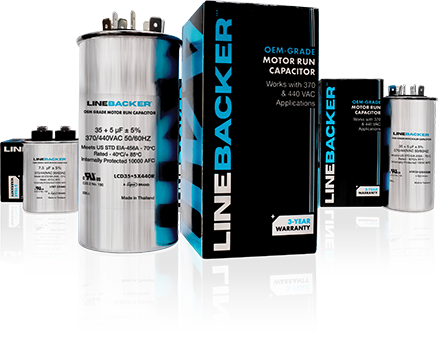
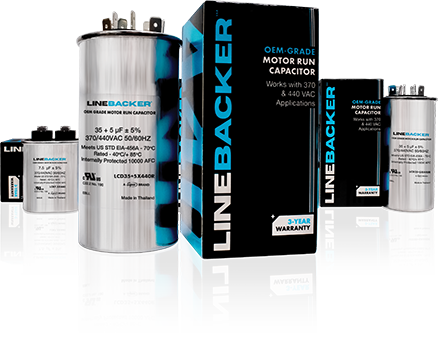
This category brings together every type of HVAC capacitor: single run capacitors for compressors and fan motors, dual run capacitors that serve both in one can, start capacitors for compressors and motors that need extra starting torque, compact capacitors for mini split fan and compressor circuits, and the accessories that make capacitor work safer and faster, including testers, discharge tools, mounting straps and terminal hardware. Most of the line is from Supco, which has been supplying replacement capacitors and electrical parts to the trade since 1945.

Use this guide to understand the differences between capacitor types, recognize when one is failing and choose a replacement that matches the original.

How HVAC Capacitors Work

A capacitor stores and releases electrical energy. In a single-phase motor, that action creates a second, out-of-phase current in the motor's start or auxiliary winding. The phase difference produces a rotating magnetic field, which is what gets the motor turning and keeps it running efficiently.

Run capacitors

Run capacitors stay in the circuit the whole time the motor operates. They're built for continuous duty, typically using metallized polypropylene film in an oil-filled metal case. Values for compressors are generally in the tens of microfarads, and values for fan motors are usually in the single digits.

Dual run capacitors

A dual capacitor is two run capacitors in one case, sharing a common terminal. One side, marked HERM, serves the compressor; the other, marked FAN, serves the condenser fan motor; and C is common. It saves space in the control panel and is the standard in most residential condensers.

Start capacitors

Start capacitors provide much higher capacitance for a moment at startup, then a relay or other switching device removes them from the circuit. They're electrolytic, rated for intermittent duty only, and usually come in a black plastic case. They're found on hard start kits, some compressors and some single-phase motors.

Mini split capacitors

Ductless systems with fixed-speed components or PSC fan motors use small, compact run capacitors, often rated at 450 volts. Many modern mini splits use inverter-driven compressors and electronically commutated fan motors that don't use a run capacitor at all, so check the unit before you order.

Signs a Capacitor Is Failing

  • The outdoor unit hums but the compressor or fan won't start.
  • The condenser fan won't start or starts slowly, even though the blade turns freely by hand with the power off.
  • The compressor trips on its overload repeatedly, or starts slowly.
  • The top of the capacitor is domed or bulging, or there's oil on the case.
  • Measured microfarads fall outside the tolerance printed on the label.
  • Higher than normal running amps on the compressor or fan motor.
  • A start capacitor has a cracked, swollen or burned case, or a vent that has blown.

Capacitors don't always look bad when they fail. The only reliable way to know is to discharge and test it with a meter that reads capacitance, or test it under load and calculate microfarads from current and voltage.

How to Choose the Right Capacitor

Microfarads must match

The MFD (µF) rating must match the original within its stated tolerance. A run capacitor rated 45 MFD with a ±6% tolerance should read between about 42.3 and 47.7 MFD. A dual rated 45/5 MFD needs both values to match. Start capacitors are labeled with a range, such as 88-108 MFD, and the replacement should cover the same range.

Voltage can be equal or higher

A 440-volt run capacitor can replace a 370-volt one in the same application, but a 370-volt capacitor should never replace a 440-volt one. The same rule applies to start capacitors: you can go up in voltage, never down.

Case size and shape matter for fit

Run capacitors come in round and oval cases in several diameters and heights. The electrical rating is what matters for operation, but the replacement still has to fit the bracket and leave room for wiring and the panel cover.

Cross-reference the OEM number

Many OEM capacitors carry only the equipment maker's part number. Read the MFD and voltage on the label, then compare those ratings and the OEM number to the cross-reference data on the product page.

TypeDutyTypical voltage ratingsTypical useCase
Run capacitorContinuous370V, 440VCompressor or single fan motorMetal, round or oval
Dual run capacitorContinuous370V, 440VCompressor and condenser fanMetal, round or oval, three terminals
Start capacitorIntermittent110-330V, depending on modelHard start kits, start assistPlastic, usually black
Mini split capacitorContinuousCommonly 450VDuctless fan or fixed-speed compressorCompact, wire lead or terminal

Replacing a dual with two singles

If you can't find the exact dual capacitor, two single run capacitors can do the same job: one with the HERM value for the compressor and one with the FAN value for the fan motor. Wire the commons together and keep the voltage rating equal to or higher than the original.

Installation and Safety Tips

  • Turn off power and verify: Shut off the disconnect and confirm zero voltage at the contactor.
  • Discharge before touching: Capacitors can hold a charge long after power is removed. Use an insulated discharge tool with a resistor across the terminals. Shorting with a screwdriver can damage the capacitor, your tools and you.
  • Photograph the wiring: Note which wire goes to HERM, FAN and C before removal. Many terminals have several tabs; any tab on a given terminal is the same connection.
  • Secure the new capacitor: Use the correct size strap or bracket. A loose capacitor vibrates, wears through wire insulation and fails early.
  • Check for the cause: Repeated capacitor failures can point to high heat, voltage problems, a failing motor or a lightning-damaged system.
  • Know your limits: Condenser panels carry 240 volts and stored energy. If you're not trained for line-voltage electrical work, have a qualified HVAC technician do the replacement.

Part Details & Shipping

Supco has been building replacement capacitors since 1945, and its universal line covers a wide range of OEM ratings and case sizes. Every product page lists MFD, voltage, dimensions and cross-reference information so you can confirm the match before you buy, and items in this category ship in 3-5 business days.

Because capacitor work usually calls for more than the capacitor itself, HVAC365 keeps testers, discharge tools, straps and terminal hardware in the same category, so you can order the part and everything needed to install it at one time.

Frequently Asked Questions

Can I use a higher MFD capacitor than the original?

No. Run capacitor MFD should match the original within its tolerance. Too much or too little capacitance changes current through the motor's start winding, raises operating temperature and shortens motor life.

Is a 440V capacitor better than a 370V capacitor?

A 440V capacitor has a higher voltage margin and can replace a 370V capacitor with the same MFD rating. It isn't required, but it's a common choice in areas with high line voltage or heat.

How long do HVAC capacitors last?

Service life varies with heat, voltage quality and run hours. Capacitors in hot climates and in direct sun tend to wear out sooner. Testing them during annual maintenance catches weak ones before they fail.

What's the difference between a run and a start capacitor?

Run capacitors stay in the circuit continuously and have lower MFD values. Start capacitors provide a short burst of much higher capacitance at startup and must be switched out of the circuit within moments.

Does it matter if the replacement is round or oval?

Not electrically. Shape only matters for physical fit in the bracket and control panel. Match the MFD and voltage first, then pick a case that fits the space.

How do I test a capacitor?

Turn off power, discharge the capacitor, disconnect the wires and measure across the terminals with a meter or dedicated tester that reads microfarads. Compare the reading to the label. On a dual capacitor, test HERM to C and FAN to C separately.

Compare
Show: 12 24 48

Fast Shipping

Easy Returns

Warranty Coverage

Financing Available