null

Terminals, Connectors & Wire

Most electrical callbacks on HVAC and appliance work do not come from a failed motor or a bad board. They come from a loose spade, a crimp that never bit into the copper, or a terminal that cooked itself next to a heating element. A connection is only as good as the terminal on the end of the wire, and the wrong terminal in the wrong spot will eventually show up as an intermittent no-heat, a burned wire, or a melted plug on a compressor.

This category covers the connection hardware that techs burn through every week: insulated and non-insulated quick disconnects, ring and spade (fork) terminals, high-temperature terminals for ovens and dryers, closed-end connectors, 450°C appliance wire, and pre-assembled electrical whips for condensers and heat pumps. Most of it is Supco stock, packed in counter-friendly quantities, and built to match the terminal styles OEMs use on the equipment you service.

Techs restock trucks here and maintenance staff keep spares for coolers and rooftop units. The rule is always the same: right size, right temperature rating, solid crimp.

How Terminals and Connectors Work

A crimp terminal is a metal barrel that is mechanically deformed around a stripped conductor. Done right, the crimp cold-forms the barrel and the copper strands into a nearly solid mass with low resistance and high pull-out strength. Done wrong, you get air gaps, which mean heat, oxidation, and eventually failure.

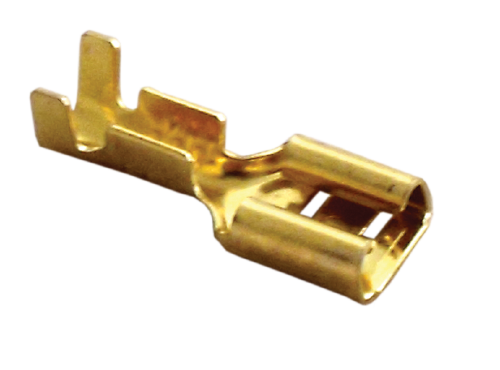
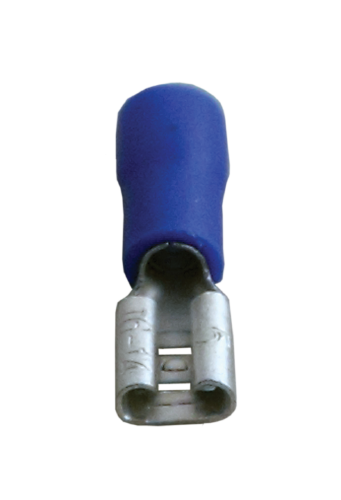
  • Quick disconnects (female and male tabs) slide onto flat blade terminals on switches, capacitors, contactors, thermostats, motors, and appliance controls. The two sizes you will see most are 0.187 in. and 0.250 in. (1/4 in.) tab widths.
  • Ring terminals go under a screw or stud and cannot slip off even if the screw loosens slightly. They are the right choice on terminal blocks, ground lugs, and anything subject to vibration.
  • Spade or fork terminals slide under a screw without fully removing it. They are faster to install but can back out if the screw loosens.
  • Closed-end connectors are crimp-style splice caps that join two or more conductors in a single pigtail. They are common in appliance harnesses because they resist vibration better than a twist-on connector.
  • High-temp terminals are uninsulated, typically plated steel or brass, and are designed for heating element and igniter connections where vinyl or nylon insulation would melt.
  • Appliance wire rated 450°C uses high-temperature insulation (typically fiberglass or mica-based) for oven, range, and dryer element leads where standard building wire would degrade quickly.
  • Electrical whips are pre-assembled lengths of flexible conduit with conductors and fittings, used to run power from an outdoor disconnect to a condenser or heat pump.

Signs a Terminal or Wire Is Failing

Bad connections usually announce themselves before they fail completely. Watch for these on every call:

  • Discoloration or bluing on the metal of a terminal, or browned and brittle insulation near it. Heat is the enemy, and color change means the connection has been running hot.
  • Melted or deformed insulation sleeves on a quick disconnect, especially on compressor, fan motor, or heating element circuits.
  • Loose fit. A female quick disconnect that slides off a tab with almost no resistance has lost its spring tension. Re-squeezing it with pliers is a temporary fix at best.
  • Intermittent operation, such as a dryer that heats only sometimes, a condenser fan that cycles oddly, or a control board that resets. A wiggle test with the power safely off and then a voltage-drop test under load will often find the culprit.
  • Voltage drop across a connection. Under load, a good terminal should show close to zero volts across it. Any meaningful reading points to resistance at that joint.
  • Cracked or crumbling oven wire insulation near bake and broil elements, which is a common find on older ranges.
  • Damaged whips: split liquid-tight jacket, a fitting pulled out of the condenser panel, or conduit that has been crushed or chewed.

If one terminal on a circuit is burned, inspect the mating component too. A cooked quick disconnect on a capacitor or element usually means the tab on the part is damaged as well, and putting a new terminal on an oxidized tab will fail again.

How to Choose the Right Replacement

Match the wire gauge

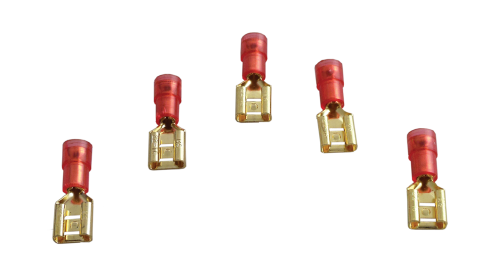
Insulated terminals follow an industry color code tied to the wire size range they are designed to crimp. Using a terminal that is too large for the wire is one of the most common causes of a weak crimp.

Match the tab size and stud size

Measure the male tab before you order quick disconnects. A 0.187 in. terminal will not fit a 0.250 in. tab, and a 0.250 in. terminal on a 0.187 in. tab will be loose. For ring terminals, match the stud or screw size (for example #8, #10, 1/4 in.) so the ring sits flat and fully under the screw head.

Match the temperature

Standard vinyl-insulated terminals are fine for most control and motor wiring. Nylon-insulated terminals handle more heat and abrasion. Anywhere near a heating element, igniter, or oven cavity, use uninsulated high-temp terminals and high-temp appliance wire. Never put a vinyl-insulated terminal on a bake element.

Match the current

Terminal current capacity is tied to wire size and terminal design. On high-amp circuits like dryer elements, compressor leads, and electric heat strips, use a terminal rated for the conductor, and do not downsize the wire to make a terminal fit.

Whips: match the equipment

For electrical whips, confirm conduit size, length, conductor gauge, and fitting style against the unit's minimum circuit ampacity (MCA), the run from the disconnect, and local code. The unit nameplate gives you MCA and maximum overcurrent protection; the whip conductors must be sized for that circuit.

Terminal type Typical use Insulation / temp Selection note
Red insulated Thermostat, control, small motor leads Vinyl or nylon 22–18 AWG wire
Blue insulated Most motor, capacitor, contactor leads Vinyl or nylon 16–14 AWG wire
Yellow insulated Heavier power leads, heat strips Vinyl or nylon 12–10 AWG wire
Non-insulated quick disconnect Inside enclosed controls, where a boot is used Bare metal Add heat-shrink or boot where exposed
High-temp terminal Bake/broil elements, dryer elements, igniters Uninsulated, plated Pair with high-temp wire
Ring terminal Terminal blocks, grounds, studs Insulated or bare Match stud size and wire gauge
Closed-end connector Harness splices, pigtails Nylon or vinyl cap Check combined wire range

Installation and Safety Tips

  • Kill the power and verify. Turn off the breaker or disconnect, lock it out where possible, and confirm zero voltage with a meter you have tested on a known live source. Remember that capacitors can hold a charge; discharge them safely before handling leads.
  • Strip to the correct length. The conductor should fill the barrel without bare copper showing past the insulation sleeve, and the strands should not be nicked or cut.
  • Use a ratcheting crimper with the right die. Pliers-style crimpers and side cutters flatten the barrel instead of forming it. A ratcheting tool will not release until a full crimp is made, which removes guesswork.
  • Pull test every crimp. A firm tug should not move the wire. If it does, cut it off and redo it.
  • Clean or replace damaged tabs. A new terminal on a pitted, oxidized tab will overheat again. Replace the component if the tab is burned.
  • Keep high-temp wire high-temp all the way. If you splice standard wire to an oven element lead inside the hot zone, the splice will fail. Run high-temp wire from the element to a cooler area of the cabinet.
  • Follow code on whips and line voltage. Condenser whips, disconnects, and branch circuits must meet the NEC and local requirements. Line-voltage work on HVAC equipment belongs with a qualified technician or licensed electrician.

Part Details & Shipping

Supco has been making replacement parts for the HVAC, refrigeration, and appliance trade since 1945, and its terminal and wire assortments are built around the connection styles found on real equipment. On HVAC365 product pages you will find specs and, where available, spec sheets so you can confirm wire range, tab size, and temperature rating before ordering. These items ship in 3-5 business days, which makes it easy to restock the truck before you run out of the one size you always need.

Frequently Asked Questions

What do the red, blue, and yellow terminal colors mean?

The color identifies the wire gauge range the terminal is designed to crimp: red for 22–18 AWG, blue for 16–14 AWG, and yellow for 12–10 AWG. Always confirm the range listed on the specific product, but matching the color to the wire size is the first step to a reliable crimp.

How do I tell a 0.187 in. tab from a 0.250 in. tab?

Measure the width of the male blade with calipers or a ruler. A 1/4 in. tab is noticeably wider and is common on contactors, capacitors, and appliance elements. A 0.187 in. tab is narrower and shows up on smaller switches, thermostats, and controls.

Can I use a regular insulated terminal on an oven element?

No. Vinyl and nylon insulation will soften, melt, or char at oven element temperatures. Use uninsulated high-temp terminals with high-temperature appliance wire rated for the location.

What is 450°C appliance wire used for?

It is used for heating element leads and internal wiring in ovens, ranges, and similar appliances where conductors run close to very hot surfaces. 450°C is roughly 842°F, well beyond the rating of standard building wire.

Should I use spade or ring terminals on a terminal block?

Ring terminals are the more secure choice because they cannot slip off if the screw loosens. Spade terminals are faster to install and remove, so they are often used where a part is serviced frequently, but rings are preferred anywhere vibration is a factor.

Do I need to replace the whip when I replace a condenser?

Not always, but it is a good time to inspect it. A cracked jacket, a loose fitting, undersized conductors for the new unit's MCA, or a whip that does not reach the new connection location are all reasons to replace it. Have a qualified technician confirm that the whip and circuit meet code for the new equipment.

Compare
Show: 12 24 48

Fast Shipping

Easy Returns

Warranty Coverage

Financing Available