null

Run Capacitors

A run capacitor is a small part with a big job. It sits in the control panel of a condenser, air handler or furnace and stays in the motor circuit every second the motor runs. When it weakens, motors draw more current, run hotter and eventually refuse to start. When it fails outright, the outdoor unit hums and trips, or the blower simply sits there.

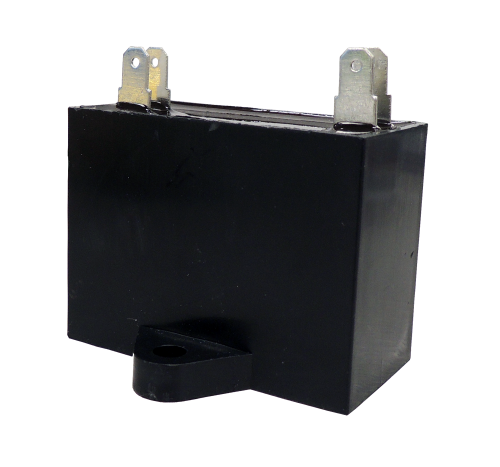
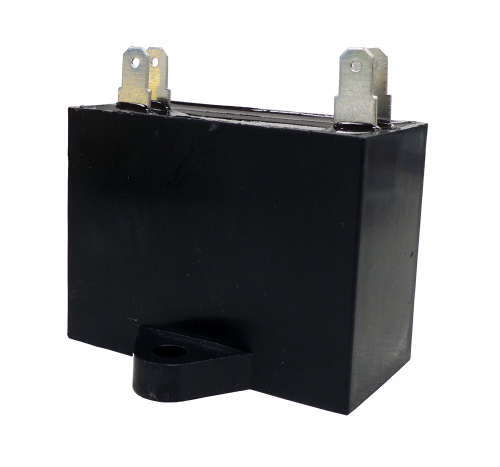
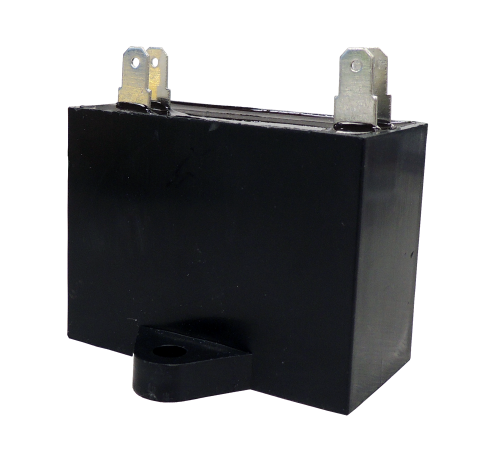
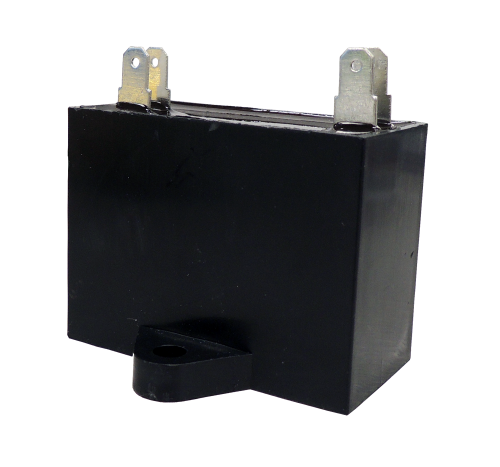
This category covers single-section run capacitors for compressors, condenser fan motors, blower motors and other PSC (permanent split capacitor) motors. You'll find round and oval cases, 370-volt and 440-volt ratings and a wide range of MFD values, including Supco's Linebacker line of run capacitors. Supco has been making replacement parts for the HVAC trade since 1945, and its capacitors are built to cover a broad range of OEM applications.

Run capacitors are the single most common replacement part in residential cooling. Service techs keep a stock of common values on the truck. Homeowners and property managers often buy one after a technician has diagnosed it. Either way, getting the rating right is the whole job.

How a Run Capacitor Works

A single-phase PSC motor has two windings: a run winding and a start (or auxiliary) winding. The run capacitor is wired in series with the start winding. Because a capacitor causes current to lead voltage, the current in the start winding is shifted out of phase with the current in the run winding. That phase shift creates a rotating magnetic field that starts the motor and keeps it turning efficiently.

The capacitor remains in the circuit continuously, so it's built for continuous duty. Most HVAC run capacitors are metallized polypropylene film wound into a cylinder and sealed in a metal can with insulating fluid. Many are designed with an internal pressure-sensitive interrupter that disconnects the capacitor if internal pressure builds, which is why a failed capacitor often has a domed top.

The MFD value is chosen by the motor manufacturer to give the right phase shift and running current. Compressors typically use values in the tens of microfarads. Condenser fan motors and blower motors typically use values in the single digits up to the low teens.

Signs a Run Capacitor Is Failing

  • Hum with no start: The compressor or motor hums, then trips on its internal overload.
  • Slow or hard starting: The motor takes several seconds to reach speed.
  • High running amps: Current draw is above the motor's nameplate rating.
  • Motor running hot: The motor shuts off on thermal overload and restarts after it cools.
  • Physical damage: A bulging or domed top, oil leaking from the case, or corroded terminals.
  • Out-of-tolerance reading: The measured MFD is outside the tolerance printed on the label.

A capacitor can look perfect and still be weak, so test it. With power off and the capacitor discharged, disconnect the wires and measure across the terminals with a meter that reads capacitance. You can also test under load by measuring the current through the capacitor's start winding lead and the voltage across the capacitor terminals. For 60 Hz power, microfarads equal 2,652 multiplied by amps, divided by volts.

How to Choose the Right Run Capacitor

1. Match the MFD rating

The microfarad rating must match the original within tolerance. Capacitors are commonly labeled ±5% or ±6%. A 35 MFD capacitor at ±6% should read about 32.9 to 37.1 MFD. Don't round up or down to a "close" value; the wrong capacitance changes current in the start winding and can overheat the motor.

2. Match or exceed the voltage rating

Run capacitors for HVAC are usually rated 370 VAC or 440 VAC. The rating is the maximum voltage the capacitor can withstand continuously, not the voltage it supplies. A 440V capacitor can replace a 370V capacitor of the same MFD. A 370V capacitor should never replace a 440V capacitor.

3. Choose a case that fits

Round and oval cases do the same job electrically. Shape and size matter only for fit. Measure the diameter (or the width and depth of an oval) and height, and check the mounting strap or bracket. Leave clearance for terminals, wires and the panel cover.

4. Cross-reference the OEM number

Equipment manufacturers often print their own part number on the capacitor. Read the MFD and voltage on the label, then check the cross-reference data on the product page. If the label is unreadable, the motor nameplate or the equipment wiring diagram usually lists the required capacitor value.

ApplicationTypical MFD rangeCommon voltageNotes
Residential compressorRoughly 20 to 60+ MFD370V or 440VUsually part of a dual cap; single caps used on some units
Condenser fan motorRoughly 3 to 10 MFD370V or 440VCheck motor nameplate for exact value
Indoor blower motor (PSC)Roughly 5 to 15 MFD370V or 440VOften mounted on the blower housing
Inducer and other small motorsLow single digits370V or 440VMany use compact cases

The ranges above are general guidance. Always use the value specified on the old capacitor, the motor nameplate or the wiring diagram.

Can you combine capacitors?

Run capacitors wired in parallel add their values together. Two 20 MFD capacitors in parallel equal 40 MFD. This is a legitimate field practice when an exact value isn't on hand, as long as each capacitor's voltage rating is equal to or higher than the original and both are securely mounted.

Installation and Safety Tips

  • De-energize and verify: Turn off the disconnect and breaker. Confirm zero voltage at the contactor or motor leads with a meter.
  • Discharge the old capacitor: Use an insulated discharge tool with a resistor. Don't short terminals with a screwdriver.
  • Document the wiring: Take a photo before you remove any wires. On a single run capacitor, the two terminals are not polarized, but the wires should go back to the same terminal groups they came from.
  • Use good terminals: Replace corroded or loose quick-connect terminals. A loose connection creates heat and can damage the new capacitor.
  • Mount it properly: Use a strap or bracket sized for the case. Don't let a capacitor hang by its wires.
  • Verify operation: After restoring power, check that the motor starts quickly and that running amps are at or below nameplate.
  • Get help when needed: HVAC control panels carry line voltage and stored energy. If you're not trained for electrical work, have a qualified HVAC technician install the capacitor.

Part Details & Shipping

Supco has supplied replacement capacitors to HVAC professionals since 1945. Each product page lists MFD, voltage, tolerance, case dimensions and cross-reference information, along with spec sheets, so you can confirm the match before you order. Items in this category ship in 3-5 business days.

HVAC365 carries run capacitors across a wide spread of MFD values, case styles and both common voltage ratings, which makes it easy to restock the values you use most and find the less common ones when a job calls for them.

Frequently Asked Questions

Can I use a 440V capacitor in place of a 370V?

Yes, as long as the MFD rating matches. The voltage rating is a maximum, so going higher adds margin. Going lower is not acceptable.

Can I use a capacitor with a slightly different MFD?

Stay within the tolerance of the original rating. A different value changes current in the start winding, which can cause the motor to run hot, draw high amps or fail to start.

Why do run capacitors fail?

Heat, voltage spikes, high line voltage and age are the main causes. The dielectric film slowly degrades, capacitance drops, and the motor works harder to compensate.

What does the bulging top mean?

Many run capacitors have an internal pressure interrupter. When the capacitor fails internally and pressure builds, the top domes and the interrupter disconnects the capacitor. A bulged capacitor should be replaced.

Does it matter which wire goes on which terminal?

A single run capacitor isn't polarized, so either terminal works electrically. Keep wires on the same terminal group they came from so the circuit stays as the manufacturer designed it.

Is a round capacitor interchangeable with an oval one?

Electrically, yes, if the MFD and voltage match. The only question is whether it fits the mounting bracket and the space inside the panel.

Compare
Show: 12 24 48

Fast Shipping

Easy Returns

Warranty Coverage

Financing Available