null

Capillary Tubing

A capillary tube is the simplest metering device in refrigeration: a length of small-bore copper tubing with no moving parts. Its length and inside diameter create a fixed restriction between the high side and the low side of the system, dropping pressure so refrigerant can boil in the evaporator. Refrigerators, freezers, dehumidifiers, water coolers, ice machines, window air conditioners, PTACs and many small commercial units rely on it. When a cap tube plugs or the wrong one is installed, the system either starves the evaporator or floods it, and no amount of charge adjustment will fix it.

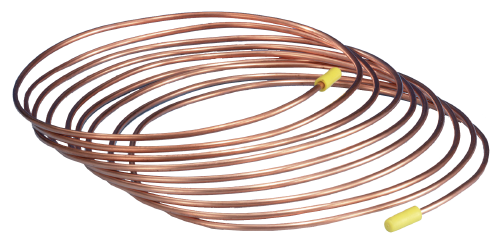
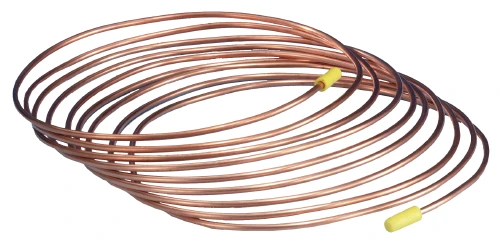
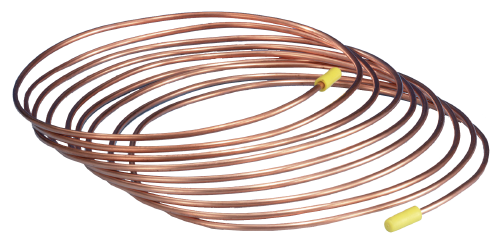
This category carries Supco capillary tubing, including Bullet and Restricto cap tube in a range of inside diameters and coil lengths, along with cap tube cutters that cut cleanly without crimping the bore. Appliance and refrigeration technicians buy cap tube when replacing a restricted tube, repairing a damaged section, or rebuilding a sealed system after a compressor or evaporator replacement.

How a Capillary Tube Works

High-pressure liquid refrigerant leaves the condenser, passes through a filter drier and enters the capillary tube. As refrigerant moves through the narrow bore, friction causes a steady drop in pressure. Partway along the tube, pressure falls low enough that some of the liquid flashes to vapor, which speeds up flow and increases the pressure drop further. By the outlet, refrigerant is a cold, low-pressure mix of liquid and vapor ready to absorb heat in the evaporator.

The amount of restriction depends on two things: inside diameter and length. Inside diameter has by far the greater effect. A small change in ID makes a large change in flow, while length changes flow more gradually. That is why cap tube is specified by ID to the thousandth of an inch, and why the right length for a given ID is set by the equipment manufacturer through testing.

Because the restriction is fixed, a cap tube system is critically charged. It does not adjust to load the way a TXV does, so refrigerant charge must be weighed in to the manufacturer's specification. Many appliance systems also solder or wrap the cap tube to the suction line to form a heat exchanger, which subcools the liquid and helps prevent liquid return to the compressor.

Signs a Capillary Tube Is Restricted or Wrong

  • Low suction pressure with a warm evaporator. The evaporator is starving. A partial restriction in the cap tube or drier is a common cause.
  • Frost or sweating at a single point on the cap tube or drier outlet. A sharp temperature drop at one spot usually marks a restriction.
  • Evaporator only partly frosted. Frost near the inlet but not across the coil suggests underfeeding.
  • Pressures do not equalize after shutdown. Cap tube systems normally balance high and low pressures within minutes of the compressor stopping. Slow or no equalization points to a restriction.
  • Floodback or frosted suction line. The tube may be too short or too large in ID, overfeeding the evaporator, or the system may be overcharged.
  • Moisture freeze-up. Intermittent cooling that comes back after the unit warms up suggests moisture freezing at the cap tube outlet.
  • Kinked or damaged tubing. Physical damage from shipping, moving the appliance or careless service creates a restriction.

How to Choose the Right Capillary Tube

Match the original specification

The best choice is always the original inside diameter and length from the equipment manufacturer's data or parts information. Cap tubes are sized for a specific compressor, refrigerant, evaporator and condenser combination.

Inside diameter

Cap tube is identified by ID in inches, such as .026, .031, .036, .042, .049 or .054. Measuring an existing tube's ID accurately in the field is difficult, so rely on equipment data when possible. A small error in ID has a large effect on flow.

Length

Cut the tube to the specified length. If you must substitute a different ID, the length must change to provide an equivalent restriction. A larger ID requires a substantially longer tube, while a smaller ID requires a much shorter one.

Restriction equivalence

Supco and other manufacturers publish capillary tube equivalence charts that show which length of one ID provides roughly the same restriction as a given length of another. Use those charts when the original ID is not available, then confirm performance by checking pressures, evaporator frost pattern and superheat after charging. Equivalence charts are a starting point, not a guarantee, because system conditions affect the result.

Cap tube cutters

Use a dedicated capillary tube cutter or a scoring tool that lets you snap the tube cleanly. Standard tubing cutters and side cutters crush the tiny bore and create a restriction at the cut.

Condition Effect on System Typical Symptoms
Tube too restrictive (ID too small or length too long) Evaporator underfed Low suction pressure, high superheat, partial frost, poor cooling
Tube not restrictive enough (ID too large or length too short) Evaporator overfed High suction pressure, low superheat, frosted suction line, risk of liquid floodback
Partial blockage (debris, wax or oil sludge) Restricted flow that may worsen over time Starved evaporator, frost at restriction, slow equalization
Moisture freeze-up Intermittent restriction at the outlet Cooling that stops and restarts as ice melts
Crimped cut or kink Fixed restriction at one point Frost or temperature drop at the damaged spot

Installation and Safety Tips

Capillary tube replacement is sealed-system work. Refrigerant recovery requires EPA Section 608 certification, and this job should be performed by a qualified technician.

  1. Recover the charge. Use a certified recovery machine and never vent refrigerant.
  2. Always replace the filter drier. Install a new drier at the cap tube inlet any time the system is opened. Debris and moisture are the main causes of cap tube restriction.
  3. Cut cleanly. Score the tube with a cap tube cutter and snap it. Check the end to confirm the bore is round and open.
  4. Insert to the correct depth. When brazing a cap tube into a drier, insert it far enough for a good joint but not so far that it touches the drier screen. Follow the drier manufacturer's guidance.
  5. Keep brazing alloy out of the bore. Use minimal alloy and heat, and flow dry nitrogen. Excess alloy or oxide scale can plug a cap tube instantly.
  6. Route and support the tubing. Avoid sharp bends and kinks, coil excess length neatly, and secure the tube so it cannot vibrate against metal.
  7. Restore the heat exchanger. If the original cap tube was bonded to the suction line, re-establish that contact as the manufacturer specifies.
  8. Pressure test, evacuate and weigh in the charge. Pressure test with nitrogen, evacuate to a deep vacuum and confirm it holds, then charge by weight to the nameplate amount.
  9. Verify performance. Run the system and check pressures, evaporator frost pattern, superheat and pressure equalization after shutdown.

Part Details & Shipping

Supco has supplied capillary tubing and sealed-system parts to refrigeration and appliance technicians since 1945. HVAC365 lists inside diameter, length and specifications on each product page, with equivalence and spec sheet information where available. Orders ship in 3-5 business days.

Frequently Asked Questions

Can I clean a restricted capillary tube instead of replacing it?

Cap tube cleaning tools and procedures exist, but results vary and restrictions often return. Replacing the tube and the filter drier is generally the more reliable repair.

How do I find the correct cap tube size?

Use the equipment manufacturer's specification for inside diameter and length. If it is not available, use a published restriction equivalence chart as a starting point and verify performance after charging.

Can I use a different ID cap tube than the original?

Yes, with an adjusted length that provides an equivalent restriction. Because ID has a large effect on flow, use an equivalence chart and confirm system performance afterward.

Why can't I cut cap tube with a regular tubing cutter?

A standard cutter rolls the tubing inward and narrows the tiny bore, creating a restriction. A cap tube cutter scores the tube so it snaps cleanly with the bore fully open.

Why is charge so critical on cap tube systems?

Cap tube systems have a fixed restriction and little or no refrigerant storage, so small charge errors noticeably change performance. Weigh the charge in to the nameplate specification.

What causes cap tubes to plug?

Common causes are moisture freezing at the outlet, debris from brazing or a failed compressor, wax or sludge from degraded oil, brazing alloy in the bore and crimped or kinked tubing.

Compare
Show: 12 24 48

Fast Shipping

Easy Returns

Warranty Coverage

Financing Available