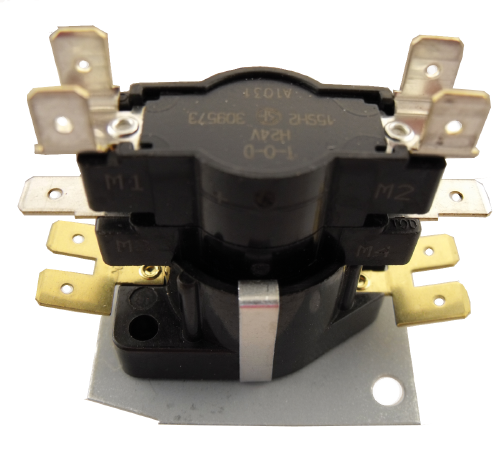
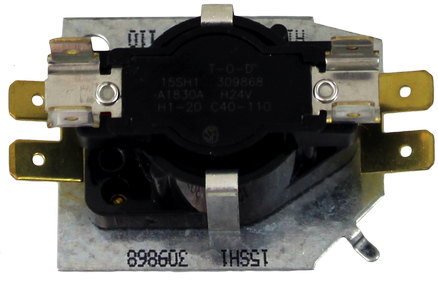
-
$21.56Ships in 3-5 Business Days
-
$18.18Ships in 3-5 Business Days
-
$16.18Ships in 3-5 Business Days
Sequencers control when electric heat strips come on and go off. Instead of slamming every element onto the line at once, a sequencer brings heaters on in stages, a few seconds apart, and shuts them off the same way. That staging keeps inrush current down, protects breakers and wiring and lets the blower get moving before full heat arrives. If a sequencer fails, you get either no heat, partial heat or heat strips that stay on when they should not.
This category covers electric heat sequencers for air handlers, electric furnaces and heat pump backup heat. You will find SPST and DPST contact configurations, single and multiple stage designs, a range of on and off timing values and 24-volt coils that match standard thermostat control circuits. Supco and other universal lines offer sequencers that cover many OEM part numbers when matched by contacts, timing and ratings.
Sequencers fail from heat, age and the steady current they carry. Contacts pit, heaters inside the sequencer burn open and terminals loosen from thermal cycling. On many older air handlers, a failed sequencer is one of the first suspects when a heat strip will not come on.
Most electric heat sequencers are thermal devices. When the thermostat calls for heat, 24 volts goes to a small internal heater inside the sequencer. That heater warms a bimetal element. After a set delay, the bimetal moves and closes the first set of contacts, energizing the first heat strip. Additional contacts close in sequence. When the call ends, the heater cools and the contacts open in sequence after their off delay.
Staged timing reduces the electrical surge and gives the blower time to start before significant heat builds up. The off delay lets the blower carry away residual heat. On many systems, one set of sequencer contacts is also used to bring on the blower.
A SPST (single pole, single throw) sequencer has one set of contacts per stage, used to switch one leg of a heater. A DPST (double pole, single throw) sequencer switches two circuits or both legs of a 240-volt heater. Multi-stage sequencers combine several sets of contacts with staggered on and off times to stage several heaters, and sometimes include a set of low-current contacts for a blower relay or another sequencer.
On a heat pump air handler, the electric strips provide auxiliary heat when the heat pump cannot keep up, backup heat during defrost and emergency heat if the outdoor unit is down. The thermostat or control board sends 24 volts to the sequencer on those calls. A failed sequencer may go unnoticed in mild weather and only show up on the first cold night or during defrost, when the supply air suddenly turns cool.
Most residential sequencers use a 24 VAC heater circuit that is controlled directly by the thermostat W terminal or by the air handler's control board. Some commercial models use other control voltages.
Check amp draw on each heater leg with a clamp meter during a heat call. A heater leg with no current may point to the sequencer, a heater element or a limit. Test each part before replacing.
Count the stages and contacts on the original. A sequencer controlling two heater elements on 240 volts may require DPST contacts or multiple SPST stages. Note any auxiliary contacts used for the blower or for another sequencer.
Sequencers are rated with on and off delay times, typically in seconds. Each stage may have different values. Match the original timing or follow the equipment manufacturer's specification. Faster on times can increase surge; slower off times affect blower operation.
Most residential sequencers use a 24 VAC heater circuit. Confirm before ordering.
Electric heaters draw heavy current. The sequencer's contacts must be rated for at least the amps and voltage of the heaters they switch. Check the heater kW rating and the sequencer's rating.
Confirm mounting hole spacing, terminal arrangement and size. A universal sequencer may include adapters.
The air handler model and OEM sequencer number are the most reliable guide. Product pages include cross-reference data and specifications.
| Configuration | What it switches | Typical use | Key specs to match |
|---|---|---|---|
| Single stage SPST | One leg of one heater | Small electric heat, single element | On and off delay, contact rating, 24V coil |
| Single stage DPST | Both legs of one heater | 240V heaters needing full disconnect | On and off delay, two-pole rating |
| Two stage | Two heaters, staggered | Residential air handlers, heat pump backup | Timing per stage, ratings, auxiliary contacts |
| Multi-stage | Several heaters plus blower or pilot contacts | Larger air handlers and electric furnaces | Stage count, timing, ratings, pilot contacts |
HVAC365 carries Supco sequencers because Supco has been serving the HVAC trade since 1945 and builds universal sequencers that match many OEM applications. Product pages list contact configuration, timing, coil voltage and cross-reference data so you can confirm the match, and these items ship in 3-5 business days.
Not directly. A relay closes immediately, so all heaters would come on at once, increasing surge and possibly tripping breakers. Some modern equipment uses relays with a control board providing the timing, but a replacement should match what the equipment was designed for.
SPST switches one leg of a circuit. DPST switches two circuits at the same time, such as both legs of a 240V heater.
A sequencer stage, a heater element or a limit may be open. Check voltage and amp draw for each heater circuit to find which part has failed.
Welded sequencer contacts are a common cause. Turn off power and replace the sequencer. Check for the cause, such as loose terminals or overcurrent.
It depends on the model. On and off delays are listed in seconds on the sequencer and in product specifications. Match the original timing.
Discolored terminals and heat-stained housings point to loose connections or contacts running hot. Even if it still works, a sequencer in that condition is near the end of its life, and the wiring connected to it should be inspected and repaired at the same time.
Most residential sequencers use a 24 VAC heater circuit controlled by the thermostat or air handler board. Check the label to confirm.

Fast Shipping

Easy Returns

Warranty Coverage

Financing Available