-
$33.27Ships in 3-5 Business Days
-
$29.09Ships in 3-5 Business Days
-
$73.44Ships in 3-5 Business Days
-
$74.84Ships in 3-5 Business Days
-
$74.84Ships in 3-5 Business Days
The control transformer is the small, often overlooked part that runs an entire HVAC system. It takes line voltage, typically 120, 208, 240 or 480 volts, and steps it down to the 24 volts AC that powers the thermostat, contactor coil, gas valve, ignition control, zone dampers and relay boards. When it dies, the equipment goes completely quiet even though there is still full power at the disconnect. That is why a failed transformer is one of the most common no-cool and no-heat calls a tech runs in a season.
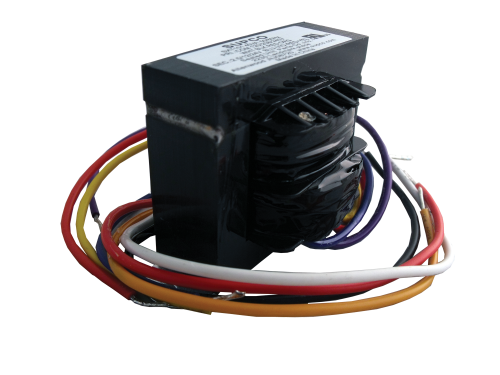
This category carries Supco 24VAC control transformers in common VA ratings, multi-tap primary models that cover several supply voltages with one part, and fan centers that combine a transformer and blower relay. Service techs keep a couple of multi-tap units on the truck because they fit almost any residential job. Homeowners and maintenance staff usually arrive with an OEM part number from a furnace or air handler and need a dependable equivalent.
A control transformer is two coils of copper wire wound on a laminated steel core. Line voltage feeds the primary winding, and the magnetic field it creates induces a lower voltage in the secondary winding. The ratio of turns between the two windings sets the output. On a typical HVAC unit the primary is wired to the line side of the equipment and the secondary delivers about 24 volts to the R and C terminals of the control board or terminal strip.
Multi-tap transformers have several primary leads, each matched to a different input voltage. A common color pattern is a black common lead with separate leads for 120V, 208V and 240V, and some models add a 480V tap. You connect the common and the one tap that matches your supply, then cap and insulate the unused leads individually. Always read the label on the transformer you are installing, because lead colors are not standardized across every manufacturer.
The VA (volt-amp) rating tells you how much load the transformer can carry. A 40VA transformer delivering 24 volts can supply roughly 1.67 amps on the secondary. Every device on the control circuit draws from that budget: the contactor coil, the gas valve, the inducer relay, the thermostat, any humidifier solenoid, zone panel or UV light that someone tied into R and C. Exceed the budget and the transformer runs hot, voltage sags, and eventually the winding opens or the internal thermal protection trips.
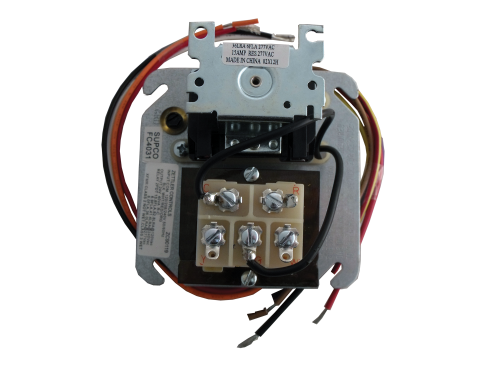
A fan center mounts a 24V transformer and a relay on one plate or box, so a thermostat signal on G can switch line voltage to the blower motor. They are common on older air handlers, electric furnaces and fan coils with no blower control board.
Transformers fail in a few predictable ways. Knowing the pattern saves time at the unit and helps you find the real cause instead of just swapping the part.
The most important rule: transformers rarely die on their own. A thermostat wire chewed by a weed trimmer, a failed contactor coil or a wire rubbed through on sheet metal are the usual culprits. Find the short before energizing the new part, or you will be replacing another one tomorrow.
Matching a control transformer is straightforward if you work through these specifications in order.
Match the supply voltage feeding the transformer. A single-voltage 120V transformer installed on a 240V circuit will fail immediately. Multi-tap models give you flexibility, which is why they work well as a universal truck stock part. On 208/230V equipment, use the 208V tap when the measured supply is near 208, and the 240V tap when it is near 240, so the secondary stays close to 24 volts.
Nearly all residential and light commercial HVAC controls run on 24VAC. Some refrigeration, commercial and specialty controls use other secondary voltages, so confirm what the equipment calls for before ordering.
Match or exceed the original VA rating. Never go lower. Going up one size, from 40VA to 50VA or 75VA for example, is common when accessories such as zone panels, humidifiers or air cleaners have been added to the control circuit. A larger VA rating does not force more current into the circuit; the load only draws what it needs.
Transformers come in foot-mount, plate-mount, dual-mount and junction-box styles. Plate-mount units often attach directly over a standard 4-inch electrical box knockout. Measure the existing mounting holes and the space available in the cabinet so the new part fits without modification.
Note whether the original used spade terminals, screw terminals or wire leads, and whether it had a built-in secondary breaker, a useful protection on long thermostat wire runs.
Most furnace and air handler manufacturers use generic transformers with their own part numbers. Supco publishes cross-reference data that maps those OEM numbers to its equivalents. Use the OEM number from the old transformer label or the unit's parts list, then confirm primary voltage, secondary voltage, VA and mounting style against the replacement before you order.
| VA Rating | Approx. Secondary Amps at 24V | Typical Application |
|---|---|---|
| 20VA | 0.83 A | Single controls, small relays, light-duty accessory circuits |
| 40VA | 1.67 A | Standard residential furnace, air handler or condensing unit |
| 50VA | 2.08 A | Residential systems with a humidifier, UV light or extra relay |
| 75VA | 3.13 A | Zoned systems, heat pumps with added controls, light commercial |
| 100VA and up | 4.17 A and up | Larger zone panels, multiple dampers, commercial control circuits |
Transformer replacement involves line voltage, so it should be handled by a qualified technician or electrician. These are the practices experienced techs follow on every job.
HVAC365 stocks Supco control transformers because Supco has been making dependable replacement parts for the HVAC and appliance trade since 1945. Each product page includes the specifications you need to match the part, including primary taps, VA rating and mounting style, along with cross-reference and spec sheet information where available. These items ship in 3-5 business days, so a tech can order for the next service call and a homeowner can get a replacement to their contractor without a long wait.
Yes. Going to a higher VA rating with the same primary and secondary voltages is acceptable and often a good idea when accessories have been added. The transformer will run cooler and supply voltage will stay more stable under load. The only limits are physical fit and the rating of any fuse or breaker on the control board, which protects the wiring and should not be oversized.
There is a short or an overload somewhere on the 24V circuit. Common causes include damaged thermostat wire, a shorted contactor coil, chewed wire at the outdoor unit and accessories that draw more than the transformer can supply. Disconnect loads one at a time and measure resistance to ground to locate the problem. Adding a fuse or a transformer with an integral breaker will protect the new part while you troubleshoot.
Cap each unused lead individually with an appropriately sized wire nut or insulated cap, and secure them so they cannot contact each other, the cabinet or any terminal. Never twist unused taps together. They carry voltage when the transformer is energized.
A transformer only provides 24V power. A fan center combines a transformer with a relay that switches line voltage to a blower motor when the thermostat calls for fan. If the equipment has no control board to run the blower, a fan center supplies both functions in one part.
Not necessarily. Transformers are rated at full load, so with little or no load on the secondary the voltage normally reads higher than 24. Check the reading again with the system running. If it is still high, confirm the correct primary tap is being used for your actual supply voltage.

Fast Shipping

Easy Returns

Warranty Coverage

Financing Available