null

Motors

Motors are the parts that move the air and keep everything else in a system working within its limits. A condenser fan motor pulls heat out of the outdoor coil so head pressure stays in range. An evaporator fan motor moves air across the cold coil in a walk-in, reach-in or refrigerator. When a motor slows down, overheats or seizes, the system around it suffers: compressors trip on overload, coils ice up and food or comfort is lost quickly.

This category covers replacement condenser fan motors, evaporator fan motors, shaded pole motors, PSC (permanent split capacitor) motors and unit bearing refrigeration motors. Supco and other universal motor lines are built to replace many OEM motors with a single part, provided the electrical ratings, physical dimensions and rotation are matched correctly.

Most motor failures come from age and heat: bearings dry out, windings break down, capacitors weaken. A motor that has been running for years in a hot condenser cabinet or a frosty evaporator section has earned its replacement. The key is getting the right one the first time, so the new motor spins the right direction, fits the mount and pulls the right amount of air.

How Fan Motors Work

Shaded pole motors

Shaded pole motors are the simplest type of single phase motor. A copper shading ring on part of each pole creates a delayed magnetic field that gets the rotor turning in one direction. They need no capacitor, are inexpensive and are common in small evaporator fans, condenser fans on refrigerators and other low wattage applications. They are less efficient than PSC motors and are generally rated in watts or very small fractions of horsepower.

PSC motors

PSC motors use a run capacitor permanently connected in series with an auxiliary winding. The capacitor shifts the current phase to create a rotating field, giving better efficiency and starting torque than a shaded pole design. Most residential condenser fan motors and many blower motors are PSC. The capacitor value, in microfarads (MFD), is specified by the motor manufacturer and should match the motor label.

Unit bearing refrigeration motors

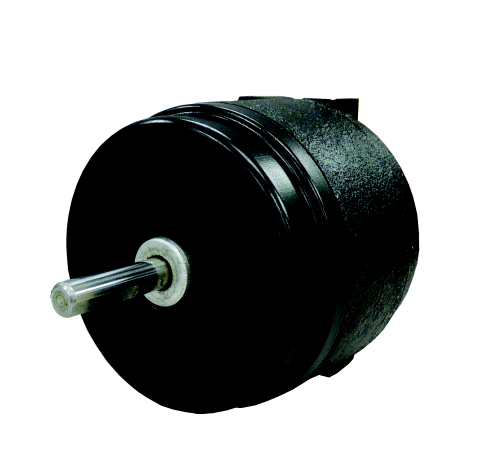
Unit bearing motors are small motors with a single long bearing, commonly used for evaporator and condenser fans in commercial refrigeration such as reach-ins, display cases and ice machines. They typically mount by a bracket or a face and drive a small fan blade directly off the shaft. They are rated in watts and come in shaded pole or other efficient designs depending on the model.

Rotation

Rotation is how the shaft turns. It is described as clockwise (CW) or counterclockwise (CCW) and is only meaningful if you know which end you are looking at. Most manufacturers describe rotation viewed from the lead end, which is the end where the wires come out, or from the end opposite the shaft. This matters: a motor that turns CW viewed from the shaft end turns CCW viewed from the lead end. Always confirm which reference the label uses. Some motors are reversible by swapping leads, while others are fixed and cannot be changed.

Signs a Fan Motor Is Failing

  • Motor hums but will not start. On a PSC motor, check the run capacitor first. On any motor, check for a seized bearing by spinning the blade by hand with power off.
  • Fan blade spins slowly or coasts to a stop quickly. Bearings may be dry or worn, or the capacitor may be weak.
  • Motor runs hot and shuts off, then restarts after cooling. The internal thermal protector is tripping, often from bearing drag or a failing winding.
  • Noise: grinding, squealing or rattling indicates bearing wear or a loose blade.
  • Shaft play. Excessive side-to-side or end play points to bearing failure.
  • High head pressure or compressor tripping on an AC or refrigeration system, often caused by a condenser fan that is not moving enough air.
  • Evaporator icing or warm box temperatures in a cooler or freezer with the evaporator fan not running.

Use a multimeter to check winding resistance with power off, a clamp meter to compare running amps with the nameplate FLA, and a capacitor tester to check the run capacitor. Readings well above nameplate amps usually mean the motor is struggling.

How to Choose the Right Replacement Motor

Match the electrical ratings

  • Voltage: 115, 208-230 or other. Never install a motor on a voltage it is not rated for.
  • Horsepower or watts: match the original. Slightly higher is sometimes acceptable on a universal motor; lower is not.
  • RPM: condenser fan motors commonly run at around 825, 1075 or 1625 RPM. Match the original speed so airflow and noise stay within design.
  • Phase and frequency: almost all of these are single phase, 60 Hz in the US.
  • Capacitor: for PSC motors, use the MFD rating specified on the new motor's label, and replace the capacitor if it is weak.

Match the physical dimensions

Check the frame or body diameter, shaft diameter, shaft length and mounting style: band mount, stud mount, bracket or face mount. Shaft diameter must fit the fan blade hub, commonly 1/4, 5/16 or 1/2 inch on smaller motors.

Match the rotation

Confirm rotation and which end it is viewed from. If a universal motor is reversible, set the rotation according to its wiring instructions before installing.

Match the environment

Outdoor condenser motors are typically totally enclosed and built to handle weather. Evaporator motors in freezers need to handle low temperatures and moisture. Use a motor intended for the location.

Cross-reference the OEM number

The OEM motor number or the equipment model number is the best starting point. Product pages list cross-reference data and specifications so you can compare before buying.

Motor typeTypical applicationCapacitor requiredKey specs to match
Shaded poleSmall evaporator and condenser fans, appliancesNoVoltage, watts, RPM, rotation, shaft and mount
PSCResidential condenser fans, blowersYes, run capacitorVoltage, HP, RPM, MFD, rotation, frame and shaft
Unit bearingCommercial refrigeration evaporator and condenser fansDepends on designVoltage, watts, RPM, rotation, mounting style, shaft length

Installation and Safety Tips

  • Lock out power and verify with a meter. Condenser fan motors are wired to line voltage, and capacitors can hold charge after power is removed.
  • Discharge the run capacitor with a bleed resistor before disconnecting wires.
  • Take photos and note wire colors and terminals before removing the old motor, especially for multi-speed or reversible motors.
  • Check blade position on the shaft. Mark the blade's location or measure its height before removal so airflow and clearance stay correct. A blade set too high or too low can reduce airflow and strike the shroud.
  • Tighten the set screw on the shaft flat and confirm the blade spins freely without wobble.
  • Insulate and secure wiring away from the blade, and use drip loops on outdoor motors so water does not run into the motor.
  • Verify operation. Check rotation direction, amp draw against nameplate and system pressures or temperatures. Sealed system and refrigerant work requires an EPA 608 certified technician.

Part Details & Shipping

HVAC365 carries Supco motors because Supco has been building replacement parts for HVAC, refrigeration and appliance service since 1945, and its universal motors are designed to cover many OEM applications. Product pages include specifications, rotation details and cross-reference numbers so you can confirm the match before ordering, and these items ship in 3-5 business days.

Frequently Asked Questions

How do I tell which way my motor rotates?

Look at the motor label first. If it is not marked, note which way the blade turns when the unit runs, and note which end you are viewing from. Then confirm whether the replacement's rotation is stated from the lead end or the shaft end. CW from one end is CCW from the other.

Can I use a higher RPM motor?

It is best to match the original RPM. A faster motor moves more air but draws more current and may be noisier. A slower motor may not move enough air to keep head pressure or coil temperature in range.

Do I need a new capacitor with a new PSC motor?

It is good practice. Use the MFD value on the new motor's label. A weak capacitor can shorten the life of a new motor and make it run hot.

What does lead end mean?

The lead end is the end of the motor where the electrical leads exit. Many manufacturers specify rotation as viewed from this end or from the end opposite the shaft. Always check which convention a label uses.

Can I replace a shaded pole motor with a PSC motor?

In some applications, yes, if the replacement is designed for it and comes with the proper capacitor and mounting. Match voltage, speed, rotation, shaft and airflow needs, and follow the replacement motor's wiring instructions.

Why is my new motor running hot?

Check the voltage, the capacitor value, the blade size and pitch, and whether the blade is rubbing or the coil is dirty. An oversized or wrong pitch blade overloads a motor, and restricted airflow raises its operating temperature.

Compare
Show: 12 24 48

Fast Shipping

Easy Returns

Warranty Coverage

Financing Available