null
Heat Pump Rooftop Units

Heat Pump Rooftop Units

Heat Pump Rooftop Units: Ratings, Balance Point, and Climate Fit

A heat pump rooftop unit is a packaged RTU that both cools and heats with the same refrigerant circuit. A reversing valve changes the direction of refrigerant flow, so in winter the outdoor coil absorbs heat from outside air and the indoor coil releases it into the building. Most units also carry an electric resistance heat kit for backup on the coldest days and to temper air during defrost. Because there is no gas burner, a heat pump RTU needs only electrical service, which simplifies roof work and eliminates combustion venting, gas piping, and carbon monoxide concerns.

Heat pump RTUs have become a larger share of the light commercial market as efficiency has improved and owners look at electrification. This guide explains how heating performance is rated, how to read COP at 47°F and 17°F, how to find the balance point, how to size supplemental heat, and which climates heat pump rooftop units suit best.

How does a heat pump rooftop unit work in heating mode?

In cooling, a heat pump RTU works like any packaged air conditioner. When the thermostat calls for heat, the reversing valve shifts, and the outdoor coil becomes the evaporator. Refrigerant absorbs heat from the outdoor air, even air well below freezing, the compressor raises its pressure and temperature, and the indoor coil becomes the condenser, releasing that heat into the supply air. The amount of heat moved is greater than the electrical energy used to run the compressor, which is why heat pumps can deliver two to four units of heat for each unit of electricity under typical conditions.

What do the 47°F and 17°F heating ratings mean?

Commercial heat pumps at 65,000 Btu/h and above are rated under AHRI Standard 340/360, which reports heating capacity and COP (coefficient of performance) at two outdoor temperatures: 47°F (high temperature heating) and 17°F (low temperature heating). Smaller three-phase units below 65,000 Btu/h are rated under AHRI 210/240 using HSPF2 as the seasonal heating metric, and they also publish 47°F and 17°F capacities.

The 17°F number is the one to watch. A heat pump's capacity falls as outdoor temperature drops, because there is less heat in the air to move and the compressor has to work across a larger pressure difference. A unit with a 120,000 Btu/h heating capacity at 47°F might deliver somewhere around 60 to 75 thousand Btu/h at 17°F, depending on the design. Always pull both numbers from the product data or the AHRI directory when comparing units.

What is a good COP for a commercial heat pump RTU?

COP is heat output divided by electrical input, in the same units. A COP of 3.3 means the unit delivers 3.3 units of heat per unit of electricity, compared with exactly 1.0 for electric resistance heat. Federal minimums for air-cooled commercial heat pumps from 65,000 to under 135,000 Btu/h are 3.4 COP at 47°F, and units in this size class typically fall in the low-to-mid 3 range at 47°F and roughly 2.0 to 2.5 at 17°F. Higher-efficiency and variable-speed models do better, particularly at part load and low ambient. Cooling efficiency on the same units is rated in IEER (65,000 Btu/h and up) or SEER2 (below).

Rating pointWhat it tells youWhere to find it
Heating capacity at 47°FOutput on a mild winter dayAHRI certificate, product data
COP at 47°FEfficiency on a mild winter dayAHRI 340/360 rating
Heating capacity at 17°FOutput on a cold day; drives backup heat sizingAHRI certificate, product data
COP at 17°FEfficiency on a cold dayAHRI 340/360 rating
HSPF2Seasonal heating efficiency, units under 65,000 Btu/hAHRI 210/240 rating

What is the balance point of a heat pump?

The balance point is the outdoor temperature at which the heat pump's heating capacity equals the building's heat loss. Above that temperature, the heat pump alone can carry the load. Below it, supplemental heat is needed to hold setpoint. To find it, plot the building heat loss line (zero at the indoor balance temperature, rising to the design heat loss at the winter design temperature) against the unit's capacity curve from the manufacturer's extended performance data. Where the lines cross is the balance point.

For many light commercial buildings with typical ventilation loads, the balance point falls somewhere in the 25 to 40°F range. A lower balance point means the compressor carries more of the winter, which saves energy. Variable-speed and cold-climate designs push the balance point lower.

How do I size the supplemental electric heat kit?

Supplemental heat kits for heat pump RTUs are typically offered from around 5 kW up to 40 kW or more depending on cabinet size, with each kilowatt providing about 3,412 Btu/h. Sizing usually follows one of two approaches:

  • Supplemental sizing: Provide enough electric heat to cover the gap between the building's design heat loss and the heat pump's capacity at the design temperature.
  • Emergency sizing: Provide enough electric heat to carry most or all of the design load if the compressor fails. This costs more in electrical infrastructure but protects occupants and pipes in cold climates.

Electric heat also matters during defrost, when the unit temporarily switches to cooling mode to melt ice off the outdoor coil. Energizing a stage of electric heat during defrost prevents cold air from blowing into the space. Remember that adding heat kit capacity raises the unit's MCA and MOP, which can drive larger wire and breakers.

How does defrost work on a heat pump rooftop unit?

When outdoor temperatures are roughly between 20 and 40°F with humidity, frost forms on the outdoor coil and reduces capacity. The control periodically reverses the unit into cooling mode, shuts off the outdoor fan, and sends hot gas through the outdoor coil to melt the frost. Demand defrost controls use coil temperature and other sensors to defrost only when needed, rather than on a fixed timer, which saves energy. Make sure the unit has good drainage beneath the outdoor coil so meltwater does not refreeze on the roof.

Which climates suit heat pump rooftop units?

Heat pump RTUs are a natural fit in the South, the Southeast, coastal California, and much of the mid-Atlantic, where winters are mild and cooling dominates. In Florida and the Gulf Coast, the heating side runs relatively few hours, and a heat pump often costs little more than a cooling-only unit with an electric strip while delivering much better heating efficiency. In moderate climates with design temperatures in the teens or twenties, heat pump RTUs work well with properly sized supplemental heat. In very cold climates, they can still be used, but compare low-ambient capacity carefully and expect electric backup to run more often; a gas/electric unit or a cold-climate heat pump design may be the better economic choice.

Other factors that favor heat pumps include no gas service on site, local electrification goals or codes, utility rebates for heat pumps, and owners who want to avoid combustion equipment on the roof.

What refrigerants do new heat pump RTUs use?

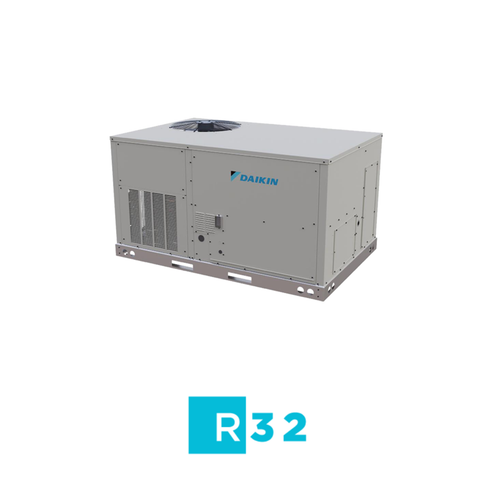
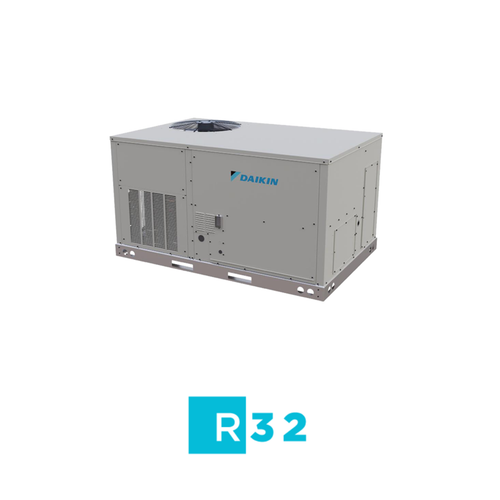
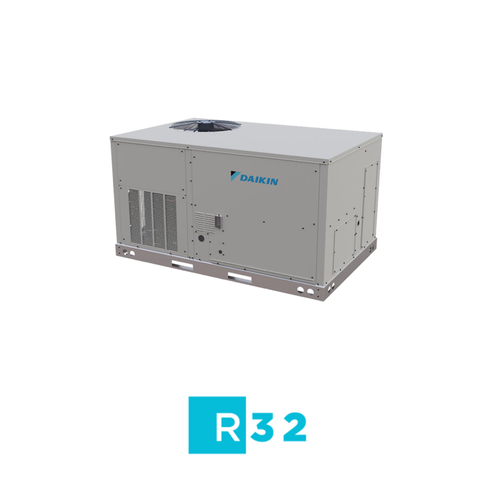
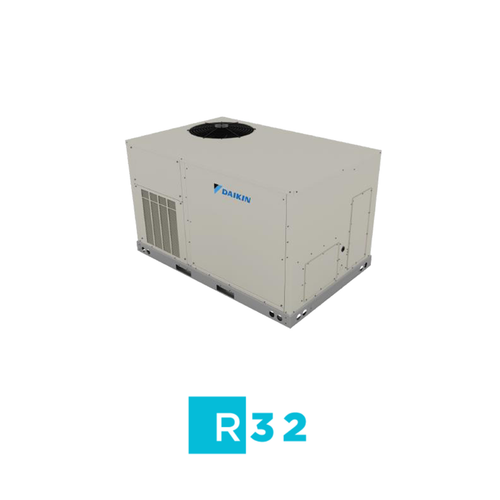
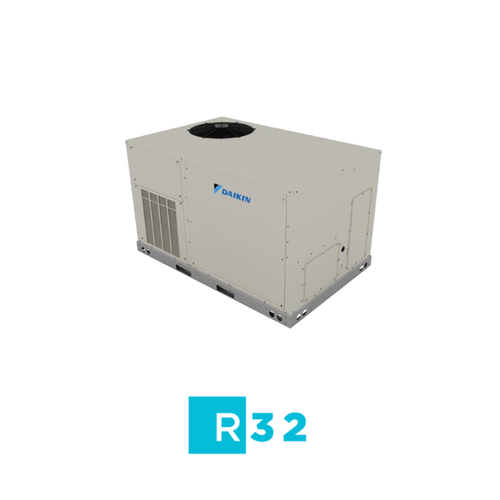
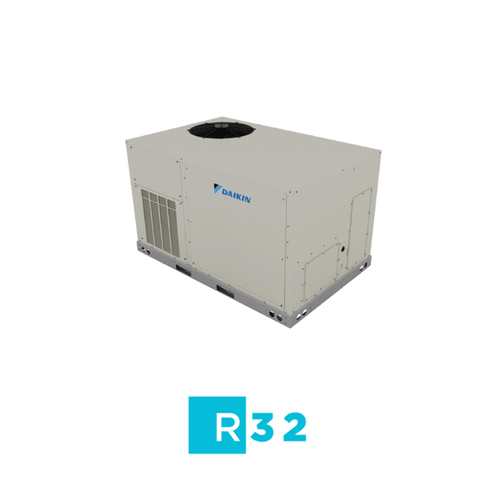
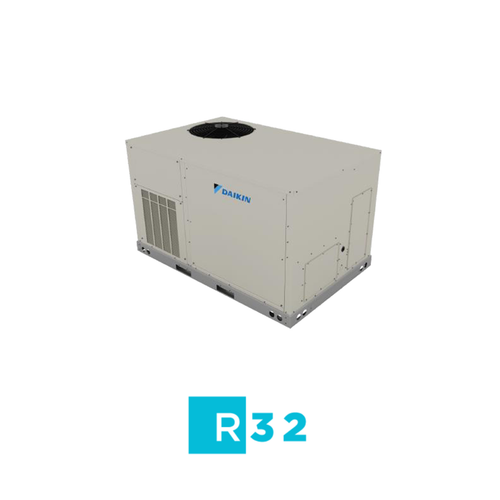
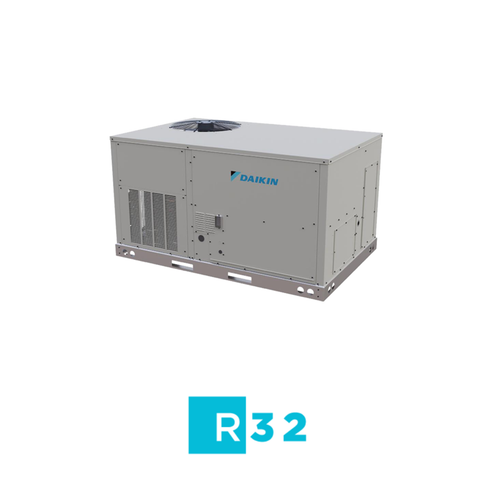
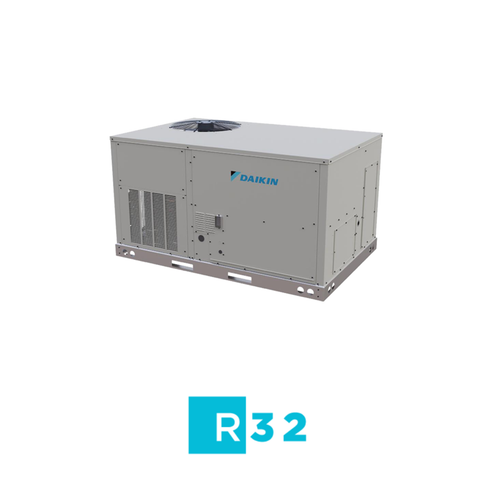
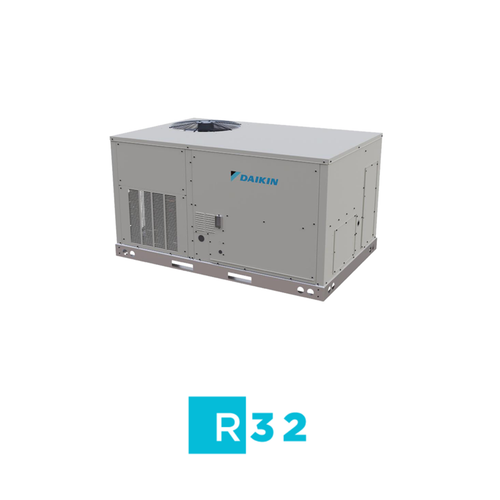
Following the EPA's GWP limit of 700 for new light commercial AC and heat pump equipment beginning January 1, 2025, current heat pump RTUs use A2L refrigerants. Rheem's RHPCYB and RHPDYB Commercial Renaissance Line Classic heat pumps use R-454B. Daikin's DSH and DHH rooftop heat pumps use R-32. Both refrigerants are mildly flammable (A2L), and units include safety features such as refrigerant detection sensors where required by UL 60335-2-40. Technicians servicing them should use A2L-rated recovery equipment and follow the manufacturer's procedures.

What heat pump rooftop units are offered in this category?

This category includes the Rheem RHPCYB and RHPDYB packaged heat pumps and Daikin DSH and DHH R-32 rooftop heat pumps, along with other Daikin light commercial heat pump packaged units. Each product page lists heating capacity and COP at 47°F and 17°F, cooling ratings, available voltages, and compatible heat kits. Match curbs, economizers, and electric heater kits from Rooftop Unit Accessories.

Heat Pump Rooftop Unit FAQ

Do heat pump rooftop units work below freezing?

Yes. Standard heat pump RTUs continue to produce heat well below 32°F, with capacity and COP declining as temperature drops. Supplemental electric heat covers the shortfall below the balance point.

Is a heat pump RTU more expensive to run than gas?

It depends on local energy prices and climate. In mild climates, heat pumps often cost less to operate. In cold climates with inexpensive gas, a gas/electric unit may cost less. Run a comparison using local rates and bin weather data.

What is a heat pump lockout temperature?

Some controls lock out the compressor below a set outdoor temperature and heat with electric strips only. Others lock out electric heat above a set temperature to prevent it from running when the compressor can handle the load. Both settings affect energy use and should be set deliberately at startup.

Can a heat pump RTU have an economizer?

Yes. Economizers are available for heat pump RTUs and are required by many energy codes on units of about 4.5 tons and larger outside the hottest, most humid climate zones.

Compare
Show: 12 24 48

Fast Shipping

Easy Returns

Warranty Coverage

Financing Available