null

Commercial Heat Pump Air Handlers

Commercial Heat Pump Air Handlers: Coils, Blowers, and Auxiliary Heat for Split Heat Pumps

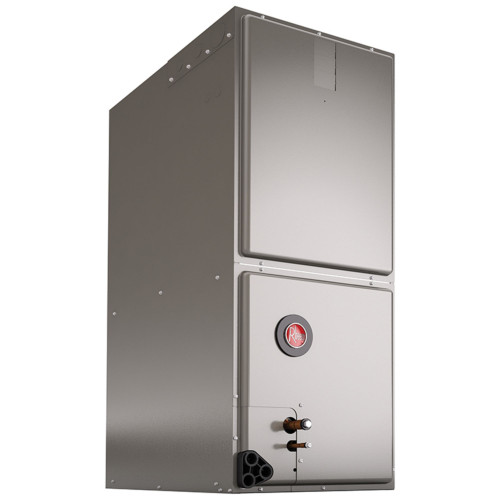
A commercial heat pump air handler is the indoor unit of a split heat pump system. It contains the indoor refrigerant coil, the supply blower, the filter section, the condensate pan, and, in almost every case, an electric heat section for auxiliary and emergency heat. In cooling, the coil works as an evaporator just like an air conditioning air handler. In heating, the same coil becomes the condenser, releasing the heat that the outdoor unit has pulled from outside air. Because it carries refrigerant in both directions and works alongside electric heat, a heat pump air handler has a few specific design requirements that a cooling-only air handler does not.

This guide covers what makes a heat pump air handler different, how belt-drive and VFD blowers apply, how auxiliary heat is sized and staged, and what A2L refrigerants mean for the indoor unit.

How is a heat pump air handler different from an AC air handler?

  • Two-way coil and metering. The indoor coil must work as an evaporator in cooling and as a condenser in heating. The metering arrangement, typically a TXV with a bypass check valve or a bidirectional expansion device, controls refrigerant flow in cooling and lets it bypass in heating, when metering happens at the outdoor unit.
  • Auxiliary heat integration. Electric heat must be controlled alongside the heat pump, including during defrost, when outdoor-temperature lockouts apply, and in emergency heat mode.
  • Airflow in heating. Supply air in heat pump heating mode is cooler than with gas heat, often around 90 to 105°F at the register, so airflow and diffuser selection affect comfort.
  • Controls. The air handler must accept heat pump thermostat signals for reversing valve, compressor stages, and auxiliary heat stages.

What is the RHCYP air handler?

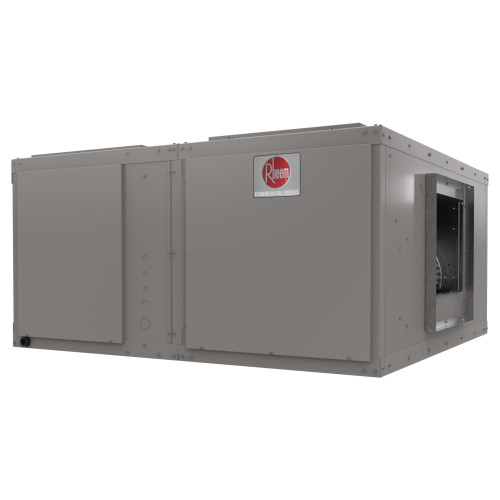
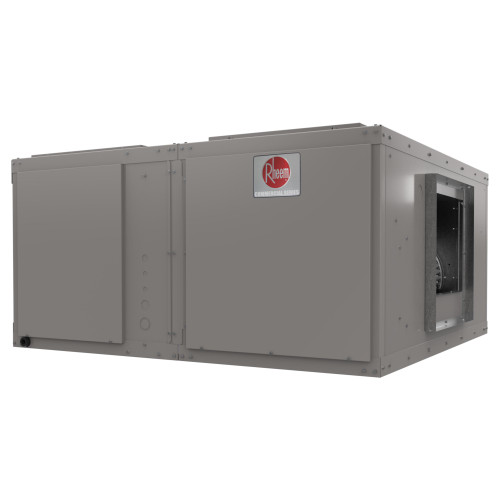
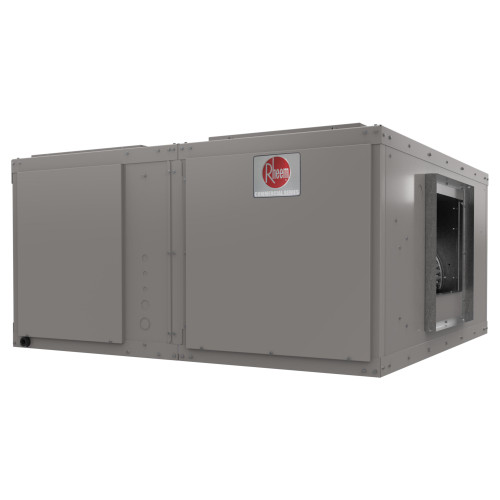
Rheem's RHCYP commercial air handlers are belt-drive units with a VFD on the supply blower, configured for heat pump duty and designed to match RPCY R-454B commercial heat pump condensers. The VFD lets the blower step down at low compressor stages and during ventilation-only operation, and the coil is designed for two-way refrigerant flow. Matched RHCYP and RPCY combinations are listed with AHRI ratings for both cooling and heating performance.

Why use a belt-drive air handler with a VFD on a heat pump system?

Belt-drive blowers can be set up to deliver design airflow against higher external static pressures, often 0.5 to 1.5 inches of water column or more in commercial duct systems, using adjustable sheaves and selectable motor horsepower. Adding a VFD gives electronic speed control. For heat pumps, that has several benefits:

  • Lower fan speed at part load in both heating and cooling improves comfort and cuts fan energy.
  • In cooling, reduced airflow at low stages improves dehumidification.
  • Airflow can be adjusted at the drive during commissioning instead of swapping pulleys.
  • Energy codes based on ASHRAE 90.1 generally require multi-speed fan control on DX systems of 65,000 Btu/h and larger, and a VFD meets that requirement.

Direct-drive ECM air handlers are common on smaller three-phase heat pump systems, such as those paired with Rheem RP14AY and RP15AY three-phase outdoor units, where static pressure requirements are lower.

How much airflow does a heat pump air handler need?

Heat pump systems are typically designed for about 350 to 450 CFM per ton, with 400 CFM per ton as the nominal value. Airflow affects both modes. Too little airflow in heating raises head pressure and can trip high-pressure controls; too little in cooling can freeze the coil. Too much airflow in heating produces lukewarm supply air that occupants describe as drafty. Set airflow to the manufacturer's recommendation for the matched outdoor unit, and confirm it at the measured external static pressure.

How is auxiliary electric heat sized for a heat pump air handler?

Auxiliary heat kits for commercial heat pump air handlers are typically available from about 5 kW to 40 kW or more, depending on cabinet size, with each kilowatt providing about 3,412 Btu/h. There are two common sizing approaches:

ApproachSizing basisWhen it fits
SupplementalHeat loss at design temperature minus heat pump capacity at that temperatureMild and moderate climates; lower electrical cost
EmergencyMost or all of the design heat lossCold climates or buildings that cannot tolerate a heating outage

Also consider defrost tempering: even in warm climates, a small stage of heat during defrost keeps supply air from turning cold. Remember that a 240V-rated heater delivers roughly 75 percent of its output on 208V, and that the heat kit raises the air handler's MCA and MOP, which affects wire and breaker sizing.

How is auxiliary heat staged and controlled?

Auxiliary heat is usually divided into one or two stages controlled by the thermostat or building automation system. Common control strategies include:

  • Second-stage heat: Electric heat energizes when the heat pump cannot keep up and space temperature falls a set amount below setpoint.
  • Outdoor temperature lockout: An outdoor sensor prevents electric heat from running above a set temperature, near the balance point, so the compressor carries the load.
  • Compressor lockout: In some cold-climate setups, the compressor is locked out below a very low outdoor temperature and electric heat carries the load.
  • Emergency heat: A manual mode that runs electric heat only, used if the outdoor unit fails.
  • Defrost heat: A stage of electric heat energizes during defrost to temper supply air.

Getting these settings right at startup has a large effect on operating costs, because electric resistance heat costs roughly two to three times as much to run as the heat pump in moderate weather.

What coil and filter specifications should I look for?

Commercial heat pump air handler coils commonly use three to four rows of copper tube with aluminum fins at about 12 to 15 fins per inch. Coil coatings are available for corrosive environments. Filter racks typically accept 2-inch or 4-inch filters; MERV 8 is a common baseline and MERV 13 is increasingly specified, but higher-MERV filters add pressure drop that the blower must overcome. Include a secondary drain pan or condensate overflow switch when the unit is installed above a finished ceiling.

What do A2L refrigerants mean for heat pump air handlers?

Air handlers matched with R-454B or R-32 outdoor units must be listed for that refrigerant under UL 60335-2-40. Depending on system charge and the size of the space served, they may include a refrigerant detection sensor that starts the blower to dilute any leaked refrigerant, and they may lock out electric heat while the leak mitigation sequence runs. Field-made indoor refrigerant joints must be brazed or made with listed mechanical connectors. An R-410A air handler cannot be reused with a new R-454B heat pump condenser.

What heat pump air handlers are offered here?

This category includes Rheem RHCYP belt-drive VFD air handlers matched to RPCY commercial heat pump condensers, Rheem air handlers matched to three-phase RP14AY and RP15AY heat pumps, and similar commercial heat pump air handlers from Daikin. Product pages list tonnage, motor and drive options, fan performance at various static pressures, coil specifications, compatible heat kits, and matched outdoor units.

How should a commercial heat pump air handler be installed and commissioned?

Install the air handler level, or pitched slightly toward the drain as the manufacturer directs, with a properly sized and trapped condensate drain. Because heat pump air handlers carry refrigerant in both directions, verify that the metering device is correct for the matched outdoor unit and that the liquid and suction (vapor) line connections are made to the right ports. Leave service clearance on the filter, blower, and electrical sides. During commissioning, measure external static pressure and set airflow at the VFD or drive to the design CFM. Confirm temperature rise across the coil in heating and temperature drop in cooling. Then test each stage of auxiliary heat, verify that the outdoor temperature lockout works, force a defrost cycle and confirm that defrost heat energizes, and test emergency heat mode. If the unit has a refrigerant detection sensor, confirm it is connected and that the blower responds to a test signal per the installation instructions. Record all settings for the owner and service records.

Commercial Heat Pump Air Handler FAQ

Can I use a cooling-only air handler with a heat pump?

Generally no. Heat pump air handlers have coils and metering devices designed for two-way refrigerant flow and controls for auxiliary heat. Use the air handler listed for the outdoor unit.

Why does heat pump supply air feel cooler than gas heat?

Heat pumps deliver larger volumes of moderately warm air rather than smaller volumes of hot air. The space still reaches setpoint; diffuser selection and airflow settings affect how it feels.

How many kW of electric heat do I need?

It depends on the building heat loss, the heat pump's capacity at design temperature, and whether you want supplemental or emergency backup. Start with a load calculation.

Does the air handler need its own circuit?

Usually yes. The air handler and outdoor unit have separate electrical data, and the air handler's MCA rises substantially with electric heat installed.

Compare

Fast Shipping

Easy Returns

Warranty Coverage

Financing Available