null
Commercial Air Conditioner Air Handlers

Commercial Air Conditioner Air Handlers

Commercial Air Conditioner Air Handlers: Blowers, Coils, Static Pressure, and Options

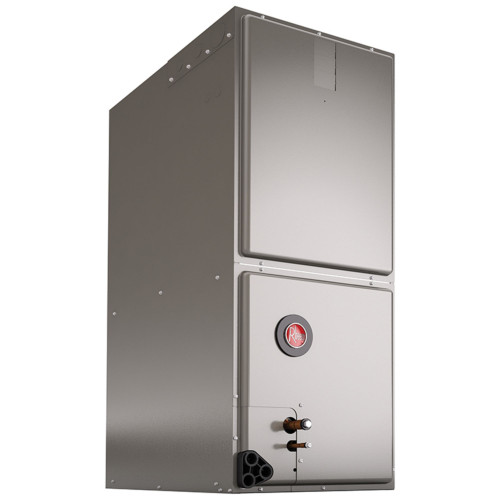
A commercial air handler is the indoor half of a split-system air conditioner. It contains the evaporator coil, the supply blower and motor, a filter section, a condensate drain pan, and usually space for electric heat. It is paired with an outdoor condensing unit through refrigerant piping, and it connects to the building's supply and return ductwork. In light commercial buildings, air handlers sit in mechanical rooms, mezzanines, above-ceiling platforms, closets, and attics, serving offices, retail, schools, medical spaces, and multi-story buildings where packaged rooftop units are not practical.

This guide explains the decisions that matter when selecting a commercial air handler: belt drive versus direct drive, VFDs, static pressure capability, coil rows and fin density, electric heat, filter racks, and A2L refrigerant requirements.

What is the difference between belt-drive and direct-drive air handlers?

In a belt-drive air handler, the blower motor turns the fan wheel through a belt and pulleys (sheaves). Changing the pulley ratio or adjusting a variable-pitch motor sheave changes fan speed, which lets the unit deliver its rated airflow against a wide range of duct system pressures. Belt drives are the traditional choice in commercial work because they can be set up for higher static pressures and larger airflows, and the motor can be replaced with a standard NEMA frame motor.

In a direct-drive air handler, the fan wheel mounts directly on the motor shaft, often with an ECM (electronically commutated) motor. Speed is adjusted electronically. Direct-drive units have no belts to wear or adjust, fewer moving parts, and good efficiency, but they are typically limited to lower static pressure ranges and smaller sizes than belt-drive designs.

FeatureBelt driveDirect drive (ECM)
Typical size range3 to 20+ tonsMostly smaller commercial sizes
Static pressure capabilityHigher; drive packages selected for duct systemLower to moderate
Airflow adjustmentPulleys, sheaves, or VFDElectronic speed settings
MaintenanceBelt inspection, tension, and replacementMinimal; no belts
Motor replacementStandard NEMA frame motorsManufacturer-specific motor and module

Why do commercial air handlers use a VFD?

A variable frequency drive changes the speed of a belt-drive blower motor electronically. With a VFD, the air handler can run at reduced airflow when the condensing unit is on a low compressor stage or when the system is only ventilating, then ramp up for full cooling. Fan power drops sharply as speed decreases, so the energy savings at part load are significant. ASHRAE 90.1 and the IECC generally require multi-speed or variable fan control on DX systems of 65,000 Btu/h and larger, and a VFD is the common way to meet that requirement on belt-drive units.

VFDs also simplify commissioning. The technician can fine-tune airflow at the drive rather than swapping pulleys, and soft-start reduces belt and bearing wear. Rheem's RHCYA belt-drive air handlers include a VFD on the supply blower for staged operation with matched RACY condensers.

What static pressure should a commercial air handler be rated for?

External static pressure (ESP) is the resistance the blower works against from everything outside the air handler cabinet: supply and return ducts, grilles, diffusers, dampers, external filters, and any coils or accessories in the duct. Light commercial duct systems commonly operate between 0.5 and 1.5 inches of water column, and longer or more complex systems can exceed that. Manufacturers publish fan tables that show airflow at various ESPs for each motor and drive combination.

When selecting an air handler, calculate or measure the system's ESP at design airflow, then pick a motor horsepower and drive package that delivers the design CFM at that pressure, ideally with some margin. The cooling coil, internal filters, and electric heater are inside the cabinet and are usually accounted for in the manufacturer's fan table, but check the footnotes. Undersized drives lead to low airflow, frozen coils, and poor heat transfer; oversized drives waste energy and can cause noise.

How much airflow does a commercial air handler need per ton?

Most DX cooling systems are designed for roughly 350 to 450 CFM per ton, with 400 CFM per ton as the typical nominal value. In humid climates, designers often lower airflow toward 350 CFM per ton to improve moisture removal. In dry climates, higher airflow improves sensible capacity. Keep coil face velocity within the manufacturer's limit, commonly around 500 feet per minute or less, to avoid blowing condensate off the coil and into the ductwork.

What do coil rows and fins per inch mean?

The evaporator coil's depth is measured in rows of tubes, and its fin density in fins per inch (FPI). Commercial DX coils commonly use three to four rows and about 12 to 15 FPI.

  • More rows increase contact time between air and coil, which improves dehumidification and allows lower leaving air temperatures, but adds air pressure drop.
  • Higher FPI adds surface area in the same face area, but makes the coil harder to clean and more prone to fouling, and raises pressure drop.
  • Coil coatings are an option for corrosive environments, such as coastal buildings, pools, and some industrial spaces.

Coil design must match the condensing unit and refrigerant. In matched systems, the coil is engineered for the condenser's capacity, refrigerant, and metering device (typically a TXV on commercial systems).

Can a commercial air handler include electric heat?

Yes. Most commercial air handlers accept electric heat kits in the supply section, typically from about 5 kW up to 40 kW or more depending on cabinet size. Each kilowatt equals about 3,412 Btu/h. Heat kits are often staged and must have minimum airflow to prevent limit trips. Adding electric heat changes the air handler's MCA and MOP, and 240V-rated heaters deliver roughly 75 percent of nameplate output on 208V. Where hot water is available, some air handlers accept a hot water coil instead.

What filter options do commercial air handlers offer?

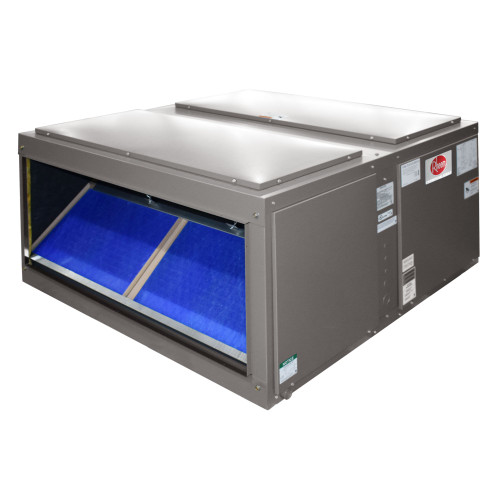
Commercial air handlers usually include a built-in filter rack that accepts standard 2-inch or 4-inch filters. Deeper filters offer more media area and lower pressure drop at the same efficiency. MERV 8 is a common baseline for light commercial buildings, and MERV 13 is increasingly specified for improved indoor air quality, though it adds pressure drop that must be accounted for in the fan selection. Make sure the filter rack is accessible for service and seals well so air does not bypass the filters.

What configurations do commercial air handlers come in?

  • Vertical upflow: Return at the bottom or side, supply at the top. Common in mechanical rooms and closets.
  • Horizontal: For above-ceiling platforms and attics, with return and supply at opposite ends.
  • Convertible: Field-convertible between vertical and horizontal orientations, which simplifies stocking.
  • Discharge options: Some units allow changing the blower discharge position to suit duct layout.

Always install a secondary drain pan or overflow switch when the air handler is above a finished ceiling, as required by the mechanical code.

What do A2L refrigerants mean for air handlers?

New air handlers paired with R-454B or R-32 condensers are designed and listed for A2L refrigerants under UL 60335-2-40. Depending on the system charge and the space served, they may include a refrigerant detection sensor that starts the blower to dilute any leaked refrigerant. Do not install an R-410A air handler with an A2L condensing unit. Indoor refrigerant connections should be brazed or made with listed mechanical fittings per the installation instructions.

What air handlers are offered in this category?

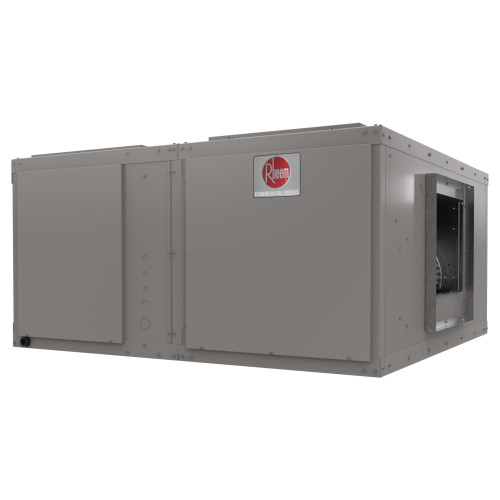
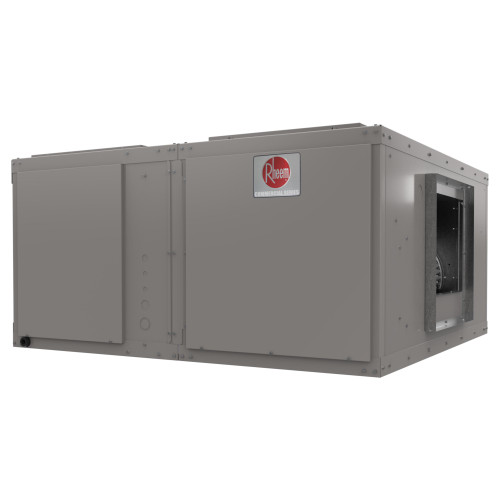
This category includes Rheem RHCYA belt-drive VFD commercial air handlers designed for R-454B systems with RACY condensers, and RHCYP models configured for heat pump systems with RPCY outdoor units, along with other commercial air handlers from Rheem and Daikin. Product pages list nominal tonnage, motor horsepower and drive options, fan performance tables, coil data, heat kit options, and matched condensers.

How should a commercial air handler be commissioned?

Measure external static pressure, set airflow at the drive or VFD to design CFM, check belt alignment and tension, verify drain trap operation, confirm electric heat stages and limits, and record motor amps and settings for future service. Those baseline readings make it much easier to spot a slipping belt, a loading filter, or a failing motor at later maintenance visits.

Commercial Air Handler FAQ

How often should belts be checked on a belt-drive air handler?

Check belt tension and condition at every scheduled maintenance visit, commonly quarterly or semiannually in commercial buildings, and replace belts showing cracking, glazing, or fraying.

Can I use a residential air handler on a commercial three-phase condenser?

Only if the combination is listed by the manufacturer. Commercial systems of 65,000 Btu/h and up must use the matched air handler to meet the AHRI rating and energy code.

What happens if airflow is too low?

Low airflow can cause the evaporator coil to freeze, reduce capacity, trip electric heat limits, and strain the compressor. Check filters, belts, drive settings, and duct restrictions.

Do commercial air handlers need a smoke detector?

The International Mechanical Code requires a return air smoke detector on air distribution systems over 2,000 CFM, which includes most commercial air handlers of about 5 tons and up.

Compare
Show: 12 24 48

Fast Shipping

Easy Returns

Warranty Coverage

Financing Available