null
Rooftop Unit Accessories

Rooftop Unit Accessories

Rooftop Unit Accessories: Curbs, Economizers, Exhaust, Sensors, and Heat Kits

A packaged rooftop unit is rarely installed by itself. Between the roof deck and the building's ductwork sits a roof curb. On the outdoor air side, there is an economizer or a fresh air damper. Many units need power exhaust or barometric relief to control building pressure, a smoke detector to shut down the fan in a fire, and an electric heater kit or other options that complete the system. Choosing the right accessories at the time of order prevents callbacks, avoids code issues at inspection, and keeps the unit operating the way its designer intended.

This guide gives an overview of the most common rooftop unit accessories, what each one does, when it is required, and how to make sure it matches the unit you are buying. Each accessory type has its own detailed category if you need to go deeper.

What accessories does a rooftop unit typically need?

AccessoryWhat it doesWhen it is needed
Roof curbSupports the unit and creates a weathertight, flashed opening for ductsNearly every roof-mounted downflow installation
Curb adapterTransitions a new unit to an existing curb with a different footprintReplacements where the old curb stays
EconomizerUses outdoor air for free cooling and handles ventilationRequired by many energy codes on units of about 4.5 tons and up
Fresh air damperAdmits a fixed or motorized minimum of outdoor airVentilation on units without an economizer
Barometric relief or power exhaustRelieves excess building pressureUnits with economizers or high outdoor air
Smoke detectorShuts down the supply fan when smoke is detected in the airstreamRequired by mechanical codes above certain airflow thresholds
Enthalpy or temperature sensorsTell the economizer when outdoor air is suitable for coolingAny economizer; type depends on climate and code
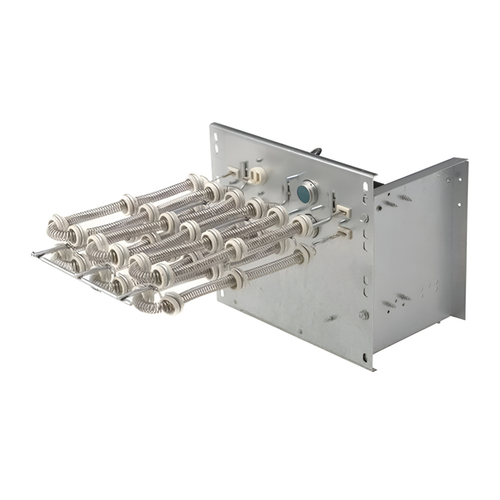
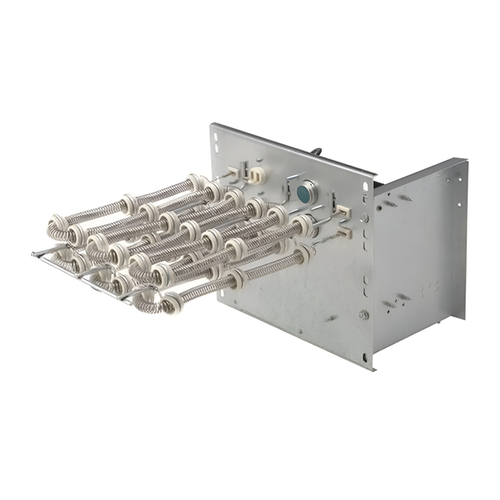
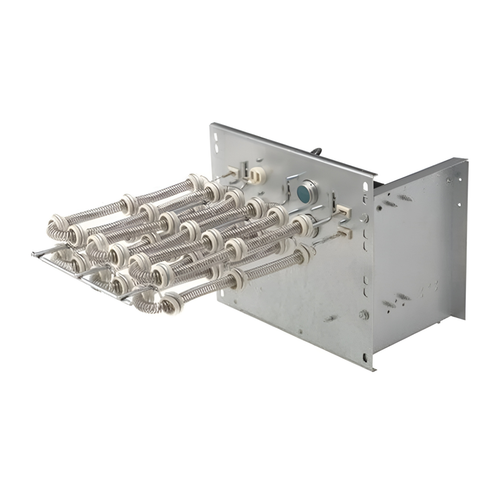
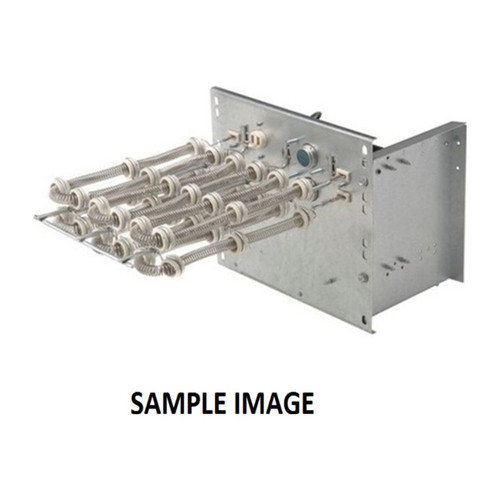
Electric heater kitAdds resistance heat to cooling-only and heat pump unitsPrimary or supplemental heat

Why does the roof curb have to match the unit?

Roof curbs are built to the footprint of a specific cabinet size, and the supply and return openings inside the curb line up with the duct openings on the bottom of the unit. A mismatched curb leads to air leaks, water leaks, and poor support. Standard curbs are commonly 14 inches tall, with 24-inch versions used in heavy-snow regions, to meet roofing flashing requirements, or to clear thick insulation. When replacing an older unit, a curb adapter can bridge the old curb to the new cabinet so the roofer does not have to remove and reflash a curb. See Rooftop Unit Roof Curbs for sizing and installation details.

What is a rooftop unit economizer?

An economizer is a set of motorized outdoor air and return air dampers with a controller. When outdoor air is cool and dry enough, the controller opens the outdoor damper to cool the building with outside air instead of running the compressor, or to supplement the compressor. When conditions are not favorable, it closes to the minimum ventilation position. Modern economizer controllers, such as the Honeywell JADE and similar controllers, include fault detection and diagnostics features that many energy codes now require.

Economizers use one of several changeover strategies: fixed dry-bulb (outdoor temperature only), differential dry-bulb (outdoor versus return temperature), single enthalpy (outdoor heat content), or differential enthalpy (outdoor versus return heat content). Humid climates usually benefit from enthalpy-based control. See Rooftop Unit Economizers for code requirements and controller choices.

When should I use a fresh air damper instead of an economizer?

Where an economizer is not required, such as on smaller units or in exempt hot and humid climate zones, a fresh air damper provides code-required ventilation at lower cost. Options include a manual damper set to a fixed position and a two-position motorized damper that opens during occupied hours and closes when the building is unoccupied. A motorized damper prevents unconditioned outdoor air from entering the building overnight, which matters for humidity control in climates like South Florida.

Why do economizers need power exhaust or barometric relief?

When an economizer brings in large volumes of outdoor air, that air has to leave the building somewhere. Without a relief path, the building becomes over-pressurized: doors stand open on their own, air whistles through gaps, and the economizer cannot deliver its full airflow. A barometric relief damper is a gravity damper that opens when building pressure pushes it open. Powered exhaust adds a fan that actively removes air when the economizer opens past a set point or when a building pressure sensor calls for it. See Rooftop Unit Power Exhaust for when each is appropriate.

Is a smoke detector required on a rooftop unit?

The International Mechanical Code requires a smoke detector in the return air of air distribution systems with a design capacity greater than 2,000 CFM, which covers most RTUs of about 5 tons and larger. When smoke is detected, the detector shuts down the supply fan to prevent smoke from being circulated through the building. Some jurisdictions and building types have additional requirements, and units serving systems over certain sizes may need supply-side detection as well. Factory-installed duct smoke detectors are available on many RTUs, and field-installed kits are available for others. Coordinate with the fire alarm contractor if the detector must report to a fire alarm panel.

What do enthalpy sensors and temperature sensors do?

The economizer controller needs to know whether outdoor air can cool the building effectively. A dry-bulb sensor reads temperature only, which works well in dry climates. An enthalpy sensor measures both temperature and humidity to calculate the heat content of the air, which avoids bringing in cool but very humid air. A differential setup uses a second sensor in the return air to compare the two airstreams. The sensor type should match the economizer controller and the changeover strategy allowed by your energy code for your climate zone.

How do I select an electric heater kit for a rooftop unit?

Heater kits are matched to a specific unit cabinet and voltage. Choose the kilowatt rating based on the heating load (each kilowatt equals about 3,412 Btu/h), then confirm the unit's MCA and MOP with that kit installed. Remember that 240V-rated heaters produce roughly 75 percent of their rated output on 208V service. On heat pump units, the kit serves as supplemental and defrost heat; on cooling-only units, it is the primary heat source.

What other rooftop unit accessories are common?

  • Hail guards protect condenser coils in hail-prone regions.
  • Low ambient kits allow cooling operation at low outdoor temperatures for spaces with year-round cooling loads.
  • Convenience outlets provide a 115V receptacle for service tools, which the National Electrical Code requires within 25 feet of rooftop HVAC equipment.
  • Disconnect switches, factory or field-installed, provide the required means of disconnect within sight of the unit.
  • Condensate overflow switches shut the unit down before a blocked drain floods the drain pan.
  • LP conversion kits convert gas/electric units from natural gas to propane.
  • CO2 sensors enable demand-controlled ventilation, reducing outdoor air when occupancy is low.

How do I make sure accessories match my rooftop unit?

Use the unit's full model number and cabinet size, not just tonnage. Two 10-ton units from the same manufacturer may sit on different cabinets, and accessories are often cabinet-specific. Also note the airflow configuration, because downflow and horizontal economizers are different products. Check whether an accessory is factory-installed only or available as a field kit. For Rheem Commercial Renaissance Line Classic units and Daikin light commercial packaged units, the product literature lists the accessory part numbers for each cabinet.

Do A2L refrigerant units need different accessories?

The curb, economizer, and exhaust accessories are not affected by the refrigerant. However, R-454B and R-32 units built to UL 60335-2-40 may include refrigerant detection sensors and mitigation controls, and the installation manual may specify how accessories interact with those controls, such as allowing the blower to run on a leak signal. Follow the unit's wiring diagram when adding field accessories.

Should accessories be factory or field installed?

Factory-installed accessories arrive wired, tested, and covered under the unit warranty, which saves labor on the roof. Field-installed kits suit replacement projects and units already set. Lead times can differ, so decide early.

Rooftop Unit Accessories FAQ

Can I install an economizer after the rooftop unit is set?

Many RTUs accept field-installed economizers that slide into the return air section. Confirm the economizer matches the cabinet size and airflow configuration.

Do I need a new roof curb when replacing a rooftop unit?

Not always. If the new unit shares the old footprint, the existing curb may be reused if it is in good condition. If the footprint differs, a curb adapter is usually less disruptive than a new curb.

What is the difference between barometric relief and power exhaust?

Barometric relief is a passive gravity damper that opens under building pressure. Power exhaust uses a fan to remove air and handles larger outdoor air volumes or buildings with high duct resistance in the relief path.

Are smoke detectors included with rooftop units?

They are usually an option, either factory-installed or as a field kit. Codes generally require them on systems over 2,000 CFM.

Compare
Show: 12 24 48

Fast Shipping

Easy Returns

Warranty Coverage

Financing Available