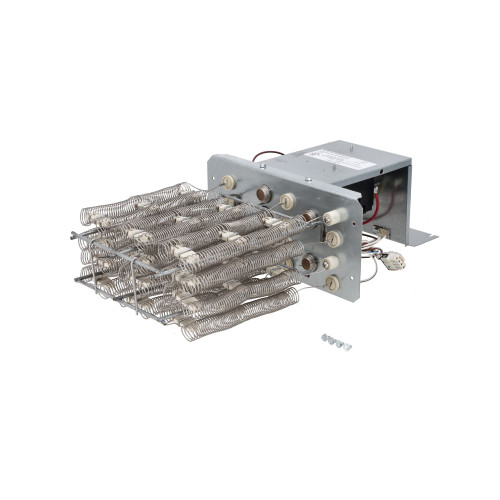
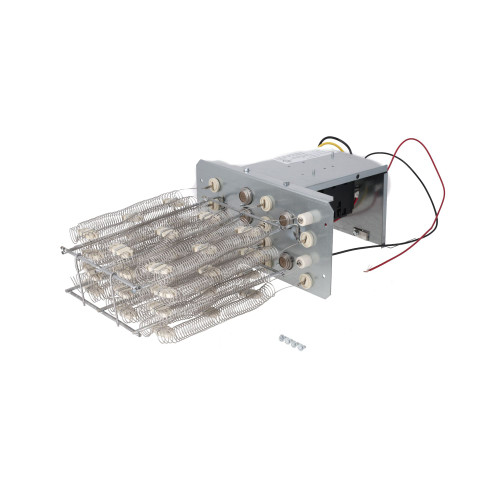
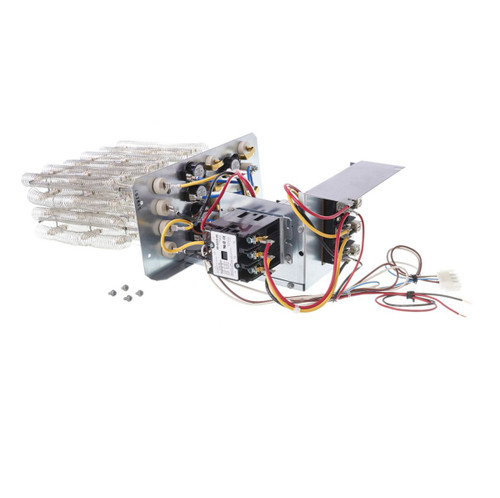
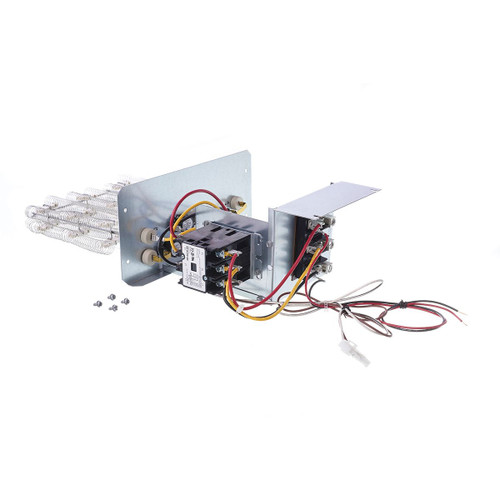
Commercial Electric Heat Kits Matched to the Rooftop Unit or Air Handler on Your Job
An electric heat kit on a commercial job is not a commodity part. It has to be listed for the exact cabinet it goes into, wired for the building's service, and sized so the unit's minimum circuit ampacity and overcurrent protection still work with the feeder that is already on the roof. This category collects field-installed electric heat for light commercial packaged rooftop units and commercial air handlers from Daikin, Rheem, Goodman, Comfortstar and Mitsubishi Electric, from small 3 kW strips up to 75 kW kits for 15 to 25 ton Daikin packaged units, in 208/230V single-phase, 208/230V three-phase, 460V three-phase and 575V three-phase versions.
Use this page when you already know the equipment model number and need the heater that belongs in it. If you are still choosing the rooftop unit itself, or you need a curb, economizer or other add-on for the same unit, those parts live under Rooftop Unit Accessories and its sub-categories.
What Is in This Category
- Daikin light commercial packaged unit kits – EHXD kits for DFC, DFG and DFH units and for 3 to 6 ton and 7.5 to 12.5 ton cabinets; EHK3 and EHK4 kits for DCC and DCH units; EHX staged kits and EHS SCR modulating kits for 15 to 25 ton large-chassis units.
- Rheem packaged unit heater kits – RXJJ kits for Renaissance Classic and Commercial Classic packaged air conditioners and heat pumps, including C-cabinet, D-cabinet and 15 to 20 ton G-cabinet models.
- Rheem commercial air handler heat – RXHE kits for RHCYA commercial air handlers and RXBH kits for RH2TY air handlers, several with an integral breaker.
- Goodman and Daikin air handler kits – HKTS kits for AMST multi-position air handlers (with and without circuit breaker), plus HKR and HKSC kits.
- Comfortstar and Mitsubishi Electric – Comfortstar EHK package unit strips from 5 to 20 kW, and Mitsubishi Electric EH strips for small and medium cabinets.
Start With the Unit Model Number, Not the kW
The fastest way to order the wrong heater is to shop by kW alone. Two 20 kW kits from the same manufacturer can be built for different cabinets, different voltages and different control schemes, and only one of them will be listed on your unit's rating plate. Work in this order:
- Pull the full model number off the rooftop unit or air handler data plate. The family prefix (for example DCC, DFG, RACDYB, RHPCYB or AMST) and the capacity digits tell you which accessory table applies.
- Find the approved heater table in the unit's installation instructions or product data. That table lists every heater the manufacturer has tested in that cabinet, with the resulting MCA and maximum overcurrent protection for each combination.
- Pick the kW from that list based on the heating load, not from what happens to be on the shelf.
- Match the heater voltage and phase to the unit, which should already match the building service.
- Check the circuit. Adding heat almost always raises the unit MCA. Confirm the existing conductors, disconnect and breaker or fuses are still adequate, or plan to upsize them.
Every product page here lists the compatible unit families, and many list specific model numbers. If your unit is not named, ask us before ordering. Accessory fit is cabinet-specific and a heater that physically fits is not necessarily approved.
Reading the Part Numbers
On the Daikin kits in this category, the digit after the prefix tracks the electrical supply: 1 for 208/230V single-phase, 3 for 208/230V three-phase, 4 for 460V three-phase and 7 for 575V three-phase. The letter that follows on many kits identifies the chassis (S, M or L for small, medium and large), and the final digits relate to the heater size. So an EHS-3L45 is an SCR modulating kit, 208/230V three-phase, for the large chassis, at 45 kW. An EHXD-4S17 is a 460V kit for the small chassis. Some sizes are offered with an A or B suffix, which means a different version for a different unit match, so treat the suffix as part of the part number.
Rheem kits encode the cabinet in the second block: RXJJ-DC kits are for C-cabinet units, RXJJ-DD kits for D-cabinet units and RXJJ-G kits for the G-cabinet 15 to 20 ton RACGYB line. The trailing letters indicate the voltage version. Always confirm against the Rheem heater table for the exact unit model.
kW Versus Unit Size
Heat output converts at roughly 3,412 Btu/h per kW, so a 15 kW kit is about 51,200 Btu/h and a 30 kW kit is about 102,400 Btu/h at its rated voltage. On a cooling-only rooftop unit, the heater is the primary heat source and should be sized to the space's design heating load. On a packaged heat pump, the heater is supplemental and emergency heat; size it for what the compressor cannot cover at design conditions and for what the occupants need if the compressor is locked out.
Larger kits are not automatically better. The manufacturer limits maximum kW in each cabinet based on airflow across the elements, so the biggest kits are only approved where the blower can move enough air. On older buildings, an oversized heater can also push the MCA past what the existing feeder can carry, which turns a heat kit swap into an electrical project.
Voltage, Phase and 208V Output
Resistance heaters are rated at a nominal voltage, and output drops with the square of the voltage. A kit rated at 240V will deliver roughly three-quarters of its nameplate kW on a 208V service. Several Rheem product pages here show both figures, for example 14.8 kW at 208V and 19.8 kW at 240V for the same kit. When the building is 208V three-phase, which is common in strip centers, schools and multi-tenant buildings, size from the 208V number.
460V and 575V kits do not derate this way when run on their own nominal service, but they must never be substituted across voltages. Ordering a 208/230V kit for a 460V unit, or the reverse, is an expensive and avoidable mistake. Confirm the unit nameplate voltage before ordering.
Staged Versus SCR Modulating Control
Most kits in this category are staged: the elements are switched on and off in one or more steps through contactors or sequencers, controlled by the unit's heating calls. That is the right choice for most retail, office and light industrial spaces where the thermostat controls space temperature directly.
The Daikin EHS kits are SCR modulating heaters for 15 to 25 ton large-chassis packaged units, offered from 30 to 75 kW. An SCR (silicon controlled rectifier) controller varies heater output continuously instead of cycling whole stages, which allows tighter discharge air temperature control. That matters on units that bring in a lot of outdoor air, on variable air volume and discharge-air-controlled systems, and in spaces where temperature swings from stage cycling cause complaints. SCR control also adds cost and requires a controls sequence that can use it, so confirm the unit's control board and the building's sequence of operation support modulating heat before choosing one. Where your project specification calls for discharge air control on a large-chassis Daikin unit, the EHS line is the place to start; otherwise the EHX staged kits for the same cabinets are usually the simpler fit.
Single-Point Power, Breakers and Wiring
How the heater is fed varies by kit, and only the product data tells you which options a given kit supports. A few examples from this category:
- The Daikin and Goodman HKTS kits for AMST air handlers include a circuit breaker service disconnect and support single-point or dual-circuit wiring.
- Several Rheem RXBH kits for RH2TY air handlers include a breaker and are sized from Rheem's single-point MCA and overcurrent values for that kit.
- Daikin AMST kits are also offered without a breaker for applications where the disconnect and overcurrent protection are provided elsewhere.
- Packaged rooftop unit kits typically feed through the unit's own power entry, and the unit nameplate or heater table gives the combined MCA and maximum overcurrent device with the heater installed.
Do not assume a kit can be converted between wiring arrangements unless the manufacturer's instructions say so, and always size the field wiring and overcurrent protection from the published values for the specific unit and heater combination, in line with the electrical code that applies to your project.
Installation Sequencing on a Rooftop Changeout
- Confirm the heater part number against the unit rating plate and heater table before the crane day, not after.
- Verify the field electrical: conductor size, disconnect rating and overcurrent device against the new MCA with the heater installed.
- Install the heater in the unit's heater compartment with power locked out, following the kit instructions for element orientation, limit switch placement and wire routing.
- Set blower speed or drive for the airflow the heater requires. Too little airflow trips the high limit and shortens element life.
- If the kit includes a heater label, apply it to the unit so the next technician can see what is installed.
- Run the unit in heat, verify each stage or the SCR output, and record amperage and temperature rise.
Lead Times and Ordering Tips
Commercial heat kits in the larger kW and 460V or 575V versions are not always stocked deep at the manufacturer, and availability can change through the season. Order the heat kit with the rooftop unit when possible so both ship together. Have the full unit model number, the building voltage and phase, and the heating load ready when you contact us. If you are replacing a failed heater in an existing unit, the old heater's label or part number is the quickest way to confirm a match.
For the rest of the rooftop package, see Rooftop Unit Roof Curbs, Rooftop Unit Economizers, Fresh Air Dampers and Commercial HVAC Controls and Sensors, which includes freeze protection and duct smoke detector kits for many of the same units.
Frequently Asked Questions
Can I use a residential heat strip in a light commercial packaged unit?
Only if it appears in that unit's approved heater table. Approval is by unit model number, not by whether the strip physically fits the opening. If it is not listed, do not install it.
How much heat will a 20 kW kit deliver on a 208V building?
Roughly three-quarters of its 240V rating, because resistance output falls with the square of the voltage. Check the product page or unit data for the published 208V figure and size from that.
Does adding a heat kit change the breaker size on the roof?
Usually, yes. The unit's MCA and maximum overcurrent protection change with the heater installed. Use the manufacturer's published values for that combination and confirm the existing feeder and disconnect can carry it.
When is an SCR modulating heater worth the extra cost?
When the project needs stable discharge air temperature, such as units with high outdoor air percentages or discharge-air-controlled sequences. For ordinary space-temperature control, a staged kit is typically sufficient.
Is the heat kit primary heat or backup on a packaged heat pump?
On a heat pump it serves as supplemental and emergency heat. On a cooling-only unit it is the primary heat source. Size it accordingly.
What do I need to give you to confirm the right kit?
The complete unit model number, the building voltage and phase, the kW you want, and whether the unit is a heat pump or cooling-only. A photo of the unit data plate helps.