The Brand Story
LG: From a Seoul Radio Workshop to the Quiet Hum on the Wall
In the autumn of 1958, a young electronics company called GoldStar set up shop in a South Korea still rebuilding from war. The country had no domestic radio industry, no homegrown refrigerators and no air conditioners of its own. A little more than a year later, GoldStar engineers held the first Korean-made radio in their hands, a small set called the A-501. That company would one day be known by two letters, and the slim wall units cooling bedrooms and offices across Florida trace their family tree back to that first workbench.
Chapter 1 · 1958
A company built on firsts
GoldStar was founded in October 1958 by Koo In-hwoi, within the same group that had launched Lucky Chemical, a cosmetics and plastics maker, in 1947. The new company's job was simple to describe and hard to do: build the electrical goods Korea had always imported. The A-501 radio arrived in November 1959. Transistor radios and the first Korean-made electric fans followed in 1960, an automatic telephone in 1961, and in 1962 GoldStar shipped 62 radios to the United States, its first exports to the American market.
In 1965 came Korea's first domestic refrigerator. The pattern was set early: learn a product, build it at home, then send it abroad.
Chapter 2 · 1968 to 1979
Cooling arrives
In March 1968 GoldStar produced a room air conditioner, the GA-111, recognized as the first air conditioner made in South Korea. Eleven years later, in 1979, the company introduced the GA-100SP, its first wall-mounted model. That split between a quiet indoor unit on the wall and a compressor somewhere outside is the same basic idea behind every ductless system sold today, and it became the center of LG's air conditioning business for the next four decades.
Chapter 3 · 1982 to 1995
Crossing the Pacific, changing the name
GoldStar opened its first overseas factory in 1982, and it chose Huntsville, Alabama. Microwave ovens started coming off the line there the following year. In the mid-1990s the company merged with its sister businesses and adopted the LG Electronics name and logo; it also acquired the American television maker Zenith in 1995. LG Electronics remains part of LG Corporation, its largest shareholder, and is headquartered in the LG Twin Tower in Seoul's Yeouido district.
Chapter 4 · 2004 to 2014
Learning the American job site
LG's push into the American heating and cooling market began in earnest in the mid-2000s. Its Multi V variable refrigerant flow system, first introduced in 2006, gave engineers a way to run many indoor units from a single outdoor unit in large buildings. To win over contractors who had grown up on ducted equipment, LG opened a 16,000-square-foot training academy in Alpharetta, Georgia, in December 2008, and within about a year more than a thousand people had been through it. Its Art Cool wall units, designed to look more like a framed panel than an appliance, became a calling card in the residential market.
The company broadened its reach in 2011 by buying a chiller business from LS Mtron. At the 2014 AHR Expo it introduced the Multi V IV and the Multi F Art Cool Gallery to American buyers.
Chapter 5 · 2024 to today
Into the ductwork
For most of its American history, LG was a ductless brand. That has changed. At the 2024 AHR Expo in Chicago, LG showed a multi-position air handler heat pump that can be installed upflow, downflow or horizontally, along with an inverter heat pump water heater that holds up to 80 gallons and reports to the LG ThinQ app. By 2026 the company was describing a full inverter unitary system for North American homes: a compact single-fan outdoor heat pump under 40 inches tall, a multi-position air handler with a slide-out blower, an all-aluminum A-coil, matching gas furnaces in the LNAVE and LNAEA series, and an LG-designed thermostat. In 2025 LG also agreed to acquire OSO, a Norwegian water heating company.
The Lineup
What LG builds today
LG Electronics makes everything from televisions and washers to commercial chillers, but its air solutions business is what matters on a job site: ductless mini splits, VRF systems, ducted heat pumps and air handlers, and heat pump water heaters. Here is what HVAC365 carries from the LG catalog:
- Single-zone wall-mounted systems: Standard and Extended Pipe models from 9,000 BTU up, including 115V options for rooms without a 230V circuit, with efficiencies from about 17 to 24 SEER2.
- Art Cool: LG's design-forward wall units, with a flat front panel meant to read as part of the room rather than an appliance.
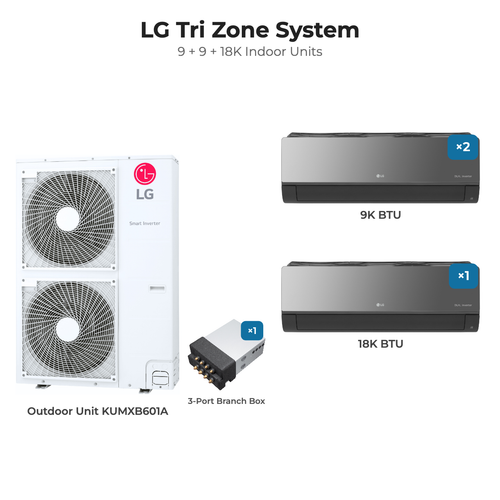
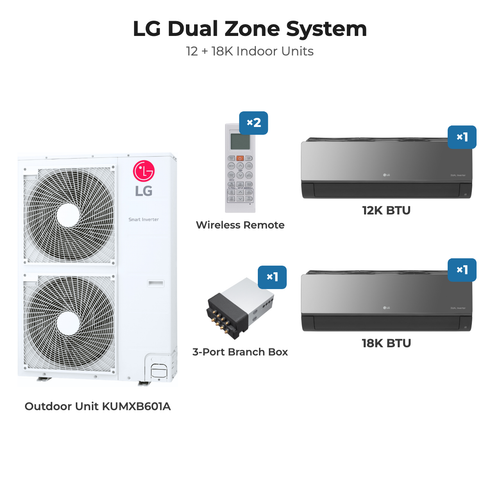
- Multi-zone systems: multi-zone outdoor condensers paired with wall, console and ducted indoor heads, with complete multi-zone system combinations matched by capacity.
- Low wall consoles: floor-level indoor units for rooms where a high wall is taken by windows or cabinets.
- Heat pump systems: every LG mini split we carry heats as well as cools, with larger 48,000 BTU multi-zone systems for whole-floor projects.
- Ducted unitary equipment: LG inverter heat pump split systems with KNUKE series air handlers and their matching electric heat strips.
- Water heating: the LG inverter heat pump water heater with ThinQ Wi-Fi control.
The Next Chapter
The move to R-32
Most of the LG equipment HVAC365 carries now uses R-32, a single-component refrigerant with a much lower global warming potential than R-410A, which is being phased down in new equipment. LG said in 2024 that its new residential compressors built for low-GWP refrigerants already met the new U.S. rules. R-32 is classified A2L, meaning mildly flammable, so it is installed with A2L-rated tools and the manufacturer's procedures, and it is never mixed into an R-410A system. A few older R-410A models remain in the lineup, labeled clearly in their names.
At a Glance
LG by the numbers
- Founded
- October 1958, as GoldStar
- Founder
- Koo In-hwoi
- Headquarters
- LG Twin Tower, Seoul, South Korea
- Parent company
- LG Corporation
- First air conditioner
- 1968, the GA-111
- First wall-mounted model
- 1979
- First U.S. factory
- Huntsville, Alabama, 1982
- Multi V VRF introduced
- 2006
- Current refrigerant
- R-32 on most new models
Questions
Frequently asked questions about LG
Who makes LG air conditioners?
LG air conditioners are made by LG Electronics, a South Korean company founded in 1958 as GoldStar and headquartered in Seoul. It is part of LG Corporation.
When did LG start making air conditioners?
GoldStar, the company that became LG Electronics, produced its first room air conditioner, the GA-111, in 1968. Its first wall-mounted model followed in 1979.
What does GoldStar have to do with LG?
GoldStar was the original name of LG Electronics. The company merged with its sister businesses and adopted the LG Electronics name in the mid-1990s.
What refrigerant do new LG mini splits use?
Most new LG mini splits use R-32, a lower-GWP A2L refrigerant that replaces R-410A. A small number of older R-410A models are still sold and are labeled as such.
What is LG Art Cool?
Art Cool is LG’s design-focused line of wall-mounted indoor units, built to look like a flat decorative panel rather than a traditional air conditioner.
Does LG make ducted systems as well as ductless?
Yes. Alongside its ductless and VRF lines, LG now offers inverter heat pumps, multi-position air handlers, A-coils and gas furnaces for ducted homes in North America.