The Brand Story
Pentair: From a Failed Balloon Company to the Machinery Behind the Backyard Pool
In the summer of 1966, five engineers who had left Litton Industries set up shop in Arden Hills, Minnesota, with an idea that had nothing to do with water. They wanted to build high-altitude research balloons. They named the company for themselves and their product: penta, the Greek root for five, and air. The balloons never sold the way they hoped. Within two years one founder had died, three had walked away, and the company was close to bankruptcy. What happened next is one of the stranger roads in American manufacturing, and it ends at the equipment pad beside millions of swimming pools.
Chapter 1 · 1966 to 1968
Five founders, one survivor
The balloon business gave way to vacuum forming, and vacuum forming gave way to canoes. Neither saved the company. By 1968 the last founder still standing, Murray Harpole, brought in an investor named Ben Westby and made a bet that looked reckless on paper: Pentair bought Peavey Paper Mills, a struggling mill carrying heavy debt. The bet paid. Paper became the first real business Pentair ever had, and through the 1970s it added Niagara Paper, Miami Paper and Flambeau Paper.
Chapter 2 · 1981 to 1988
A company that kept reinventing itself
Paper was only the beginning. In 1981 Pentair bought a Rockwell power tool factory, and in 1984 it took over the rest of Rockwell's power tool division, including the Delta line that woodworkers still recognize. In 1988 it agreed to acquire FC Holdings, which brought Federal Cartridge and Hoffman Engineering into the company. Hoffman made electrical enclosures, and that business would grow into a major division of its own. Pentair had become a collection of industrial businesses with a habit of buying its way into new markets and learning them from the inside.
Chapter 3 · 1995 to 1999
Turning toward water
The decisive turn came in the mid-1990s. Pentair bought Fleck Controls, a maker of water control valves, in November 1995, and the General Signal Pump Group in August 1997. That same year it sold its papermaking operations, closing the chapter that had rescued the company three decades earlier. In April 1999 Pentair paid about $312 million for Essef, a maker of composite water tanks along with pumps and filters for pools and spas. With Essef, Pentair was in the pool business for good.
The pool side was itself a family of older names. A Pentair sales leader who joined in 1993 later recalled starting at Pac-Fab, a small pump and filter factory, as it prepared to combine with Purex, a Southern California equipment maker whose plant built WhisperFlo pumps and heaters. Around them gathered Compool automation, Rainbow accessories, Kreepy Krauly cleaners and American Products, whose factory made the Spectrum Amerlite pool light and the Spectrum AquaLight spa light.
Chapter 4 · 2004
Sta-Rite joins, and the tools go
In July 2004 Pentair bought WICOR Industries from Wisconsin Energy for $850 million. The deal carried Sta-Rite, SHURflo and Hypro, brands with deep roots in pumps, filters and pool equipment components. A few months later Pentair sold its tool business, which had grown to roughly 40 percent of sales. It was a clean break: the company that once made table saws and cartridges would now be measured by how well it moved and treated water. After Sta-Rite arrived, Pentair engineers developed the ETi high-efficiency pool and spa heater.
Chapter 5 · The pump that changed the pad
From WhisperFlo to IntelliFlo
For most of the pool industry's history, a filter pump ran at one speed, usually far faster than the water needed. Around twenty years ago Pentair reworked its WhisperFlo pump into the IntelliFlo, a variable-speed design that could slow down for daily filtration and speed up only for cleaning, heating or water features. People inside the company credit it with putting Pentair on the map as a pool equipment leader. Pentair worked with electric utilities, starting in California, to back variable-speed pumps with rebates and contractor education, and the IntelliFlo has since gone through three generations.
Chapter 6 · 2012 to today
A global water company
In 2012 Pentair combined with Tyco's flow control business, creating a company with about 30,000 employees and 100 plants in 30 countries. It later sold the valves business to Emerson and, on April 30, 2018, spun off its electrical business as nVent. In 2022 it bought Manitowoc Ice for $1.6 billion. Today Pentair plc trades on the New York Stock Exchange as PNR, is incorporated in Ireland, keeps its main U.S. offices in the Minneapolis area, and reported about $4.08 billion in revenue for 2024 under CEO John L. Stauch.
The Lineup
What Pentair builds today
Pentair's business spans residential and commercial water treatment, pumps and filtration for homes and industry, and one of the broadest pool and spa equipment lines in the world. On the pool side it covers nearly everything on the equipment pad, from the pump and filter to the heater, the sanitizer, the lights and the automation that ties them together. HVAC365 carries a wide cross-section of it:
- Pool pumps: SuperFlo single-speed pumps for residential pools and EQ Series commercial pumps from 3 to 15 hp, built in a non-corrosive all-plastic design for three-phase power, with or without strainers.
- Filters and sanitizers: top-mount sand filters in 22.5-inch and 26-inch diameters, and IntelliChlor salt chlorine generators, including commercial systems for pools of 30,000 gallons and up.
- Pool heaters: UltraTemp high-performance heat pumps in sizes from roughly 125,000 to 145,000 BTU, some offered in an almond finish.
- Automation: IntelliCenter control systems, such as the i5PS pool and spa package with standard valve actuators, which run pumps, heaters, lights and valves from one panel.
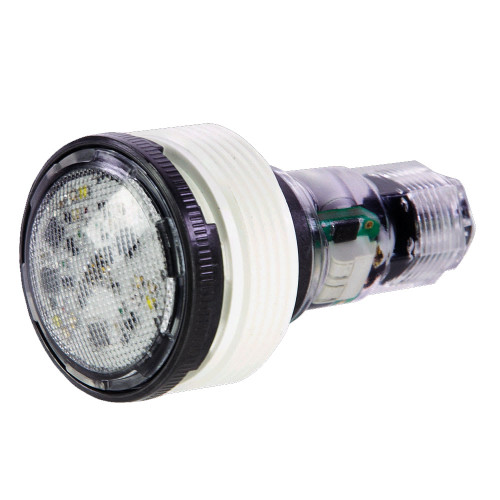
- In-ground pool lights and other pool lighting, continuing the line that began with the American Products lights.
- Drains, inlets and skimmers: the fittings that set how water leaves and returns to the pool.
The Next Chapter
The federal pool pump rule
On July 19, 2021, a U.S. Department of Energy efficiency standard for dedicated-purpose pool pumps took effect. Covered pumps are now rated by hydraulic horsepower and a Weighted Energy Factor, or WEF, a measure of gallons moved per kilowatt-hour, and that rating must appear on the pump label. A pump that misses its minimum cannot be sold. The rule does not literally require variable-speed pumps, and some small single-speed models still pass, but because the WEF score leans heavily on low-speed operation, it pushed the industry toward the kind of pump Pentair had been building since the IntelliFlo. Compliance is tied to the date a pump was assembled.
At a Glance
Pentair by the numbers
- Founded
- 1966, Arden Hills, Minnesota
- Founders
- Five former Litton Industries employees
- First product
- High-altitude research balloons
- Pool roots
- Essef (1999), Sta-Rite (2004)
- Stock listing
- NYSE: PNR
- Incorporated
- Ireland
- CEO
- John L. Stauch
- 2024 revenue
- About $4.08 billion
Questions
Frequently asked questions about Pentair
Who owns Pentair?
Pentair is an independent public company, Pentair plc, traded on the New York Stock Exchange under the symbol PNR. It is incorporated in Ireland and keeps its main U.S. offices in the Minneapolis area.
When was Pentair founded and where does the name come from?
Pentair was founded in 1966 in Arden Hills, Minnesota, by five former Litton Industries employees. The name joins penta, Greek for five, with air, for the research balloons they first set out to build.
How did Pentair get into pool equipment?
Pentair entered the pool business by acquiring Essef in 1999 and WICOR Industries, owner of Sta-Rite, in 2004. Older pool names such as Pac-Fab, Purex, Kreepy Krauly and Compool became part of the Pentair pool family.
Is Sta-Rite the same company as Pentair?
Sta-Rite has been part of Pentair since the 2004 acquisition of WICOR Industries. It is a Pentair brand of pumps, filters and pool equipment.
Do Pentair pool pumps meet the DOE pool pump rule?
Pool pumps built since July 19, 2021 must meet the Department of Energy's Weighted Energy Factor minimums and carry a WEF rating on the label. Pentair variable-speed pumps are built to run at the low speeds the rule rewards.