
null
Single Speed Pool Pumps

Single Speed Pool Pumps

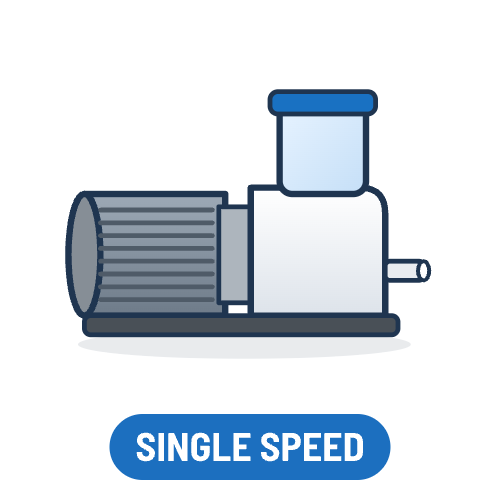
A single speed pool pump is the simplest pump on the pad. An induction motor spins the impeller at one fixed speed, close to 3,450 RPM on most models, and the pump moves water at that rate until the timer or switch turns it off. There is no drive, no keypad and no program to set. For decades that was what nearly every pool used, and plenty of single speed pumps are still running today on older pools, above-ground pools and small systems.

The rules have changed, though. Since July 2021, the U.S. Department of Energy's dedicated-purpose pool pump standard has required most standard-size inground filtration pumps to meet an efficiency level that, in practice, takes a variable speed design. Single speed pumps are still made and sold where they meet the rule or fall outside it: smaller self-priming pumps, many above-ground pumps, some pumps for commercial or export use, and replacement wet-end parts and components. This category covers those pumps from brands such as Hayward, Pentair, Waterway and others. Pool techs, above-ground pool owners and contractors looking for a simple, rugged pump for a specific job buy here. Any line-voltage wiring and bonding should be handled by a licensed electrician or qualified pool professional.

How Single Speed Pumps Work

A single speed pump has the same wet end as most pool pumps. Water enters the strainer pot, where a basket catches leaves and debris. It then passes into the eye of a spinning impeller, which flings it outward into the volute or diffuser and builds pressure to push water through the filter and back to the pool. A mechanical shaft seal keeps water out of the motor.

  • Motor. Most single speed pool motors are capacitor-start or capacitor-run induction motors. A start capacitor and centrifugal switch help the motor get up to speed, then drop out. Some motors also use a run capacitor for efficiency.
  • Self-priming vs non-self-priming. Inground pumps are self-priming. They can lift water from below the pump once the pot is filled. Above-ground pumps are often non-self-priming and rely on the pump sitting below the water line so water flows into it by gravity.
  • Full rated vs up-rated. You will see horsepower listed as nameplate HP plus a service factor. Total horsepower (THP) is HP times service factor. Two pumps with the same nameplate HP can have different THP and different flow.

Because the motor only knows one speed, flow is set by the impeller and the system's resistance, or head. More pipe, more fittings, a dirty filter or a heater in the line all raise head and drop the flow. That relationship is shown on the pump curve, which plots gallons per minute against feet of head.

Where Single Speed Pumps Still Fit

Single speed is not the right answer for every pool, but it still has real uses.

  • Above-ground pools. Many above-ground pumps are small, non-self-priming units in classes where single speed or two-speed models still comply. They are simple, light and easy to replace.
  • Small pools and small loads. Small self-priming pumps under the DOE's standard-size threshold can still be single speed if the model meets its class requirement. Small spas, ponds and fountain loops sometimes fall in this group.
  • Dedicated feature or booster jobs. Some waterfall, fountain and dedicated-feature applications use single speed pumps. Pressure cleaner booster pumps have their own DOE class and requirements, so check the listing.
  • Commercial and export uses. Larger commercial pumps above the residential rule's hydraulic horsepower range, and pumps built for export, may still be single speed. Commercial pools have their own health code and engineering requirements.
  • Repairs. Many single speed pumps already installed are still worth repairing. Seals, impellers, diffusers, lids, baskets and O-rings keep them running. Replacement motors are a separate question: DOE has also adopted efficiency rules for many replacement pool pump motors, so a like-for-like single speed motor swap is not always available.

Signs a Single Speed Pump Is Failing

  • Hums but will not start. Often a failed start capacitor, a stuck centrifugal switch or a seized impeller. Turn off power and check whether the shaft spins freely before replacing parts.
  • Screeching or grinding. Bearing failure. Once bearings start making noise, they are on borrowed time.
  • Trips the breaker or GFCI. Could be a shorted winding, moisture in the motor or a wiring fault. Have a qualified person diagnose it rather than resetting it repeatedly.
  • Leaking at the shaft. Water dripping between the pump and motor is a worn shaft seal. Replace it before water ruins the motor bearings.
  • Overheating and shutting off. Thermal overload trips from low voltage, poor ventilation, a binding shaft or a failing motor.
  • Weak flow or lost prime. Usually a clogged impeller, a full basket, a dirty filter or an air leak on the suction side. Fix the cause first, since replacing the pump will not cure a plumbing leak.

How to Choose the Right Single Speed Pump

  1. Confirm the pump is right for the application. For a standard inground pool, most replacements now need to be variable speed. Single speed makes the most sense on above-ground pools, small systems and approved special-purpose uses.
  2. Match total horsepower. Compare THP, not just nameplate HP. Going much bigger than the old pump can overpower the filter, raise pressure and push flow beyond what the plumbing handles.
  3. Check flow against head. Look at the pump curve at your system's estimated head. Above-ground systems are usually short and simple, while inground systems with heaters and long runs have more head.
  4. Match the filter. The pump's flow at system head should be within the filter's rated flow. Oversizing the pump for the filter cuts filtration quality and can damage cartridges or push sand.
  5. Measure port size. Common ports include 1.5 inch and 2 inch, and many above-ground pumps use hose or threaded connections. Confirm inlet and outlet sizes and fittings.
  6. Check voltage and plug type. Some above-ground pumps are 115 V with a cord and plug, while inground pumps are usually hardwired and may be 115/230 V dual voltage. Match the existing supply.
  7. Cross-reference the model. Read the old pump's label for model, HP, service factor and voltage. That makes finding a compatible replacement much faster.
SpecWhat It MeansWhat to Check
Nameplate HPRated horsepower of the motorStarting point only; compare with service factor
Service factor (SF)Extra capacity the motor can safely deliverMultiply by HP to get total horsepower
Total horsepower (THP)HP times SFBest number for matching an old pump
Feet of headSystem resistance to flowRead flow on the pump curve at your head
Port sizeInlet and outlet connection sizeMatch plumbing or plan adapters
Voltage115 V, 230 V or dual voltageMatch supply, breaker and wiring
Priming typeSelf-priming or non-self-primingNon-self-priming pumps must sit below water level

Installation and Safety Tips

  • Have a licensed electrician handle hardwiring. NEC Article 680 governs pool pump circuits, including GFCI protection, conductor sizing and disconnects. The motor's bonding lug must be connected to the pool's equipotential bonding grid with solid copper conductor no smaller than 8 AWG.
  • Use the cord as designed. Corded above-ground pumps should plug into a GFCI-protected receptacle placed according to code. Do not use extension cords.
  • Set the pump on a level, stable base. A solid pad cuts vibration and keeps plumbing stress off the ports.
  • Keep suction plumbing tight. Air leaks on the suction side cause lost prime and noisy operation. Use new O-rings and PTFE tape or a plastic-safe sealant on threads.
  • Fill the pot before starting. Dry running damages the shaft seal quickly.
  • Give the motor air. Keep debris, mulch and covers away from the motor vents so it can cool.
  • Check drain covers and suction safety. Any pool pump can create dangerous suction. Make sure drain covers are VGB Act and ANSI/APSP-16 compliant and in date.
  • Run it efficiently. With single speed, run time is the main energy lever. Run only as long as needed to keep the water clear and sanitized.

Shopping This Category at HVAC365

Every pump in this category is brand-new with the full manufacturer warranty. Product pages list horsepower, service factor, voltage, port size and application so you can match the old pump, and most items ship in 1-2 business days. If you are not sure whether a single speed pump is allowed for your application or which model fits, send HVAC365 the old pump's label details and we will help you find a compliant match.

Frequently Asked Questions

Can I still buy a single speed pump for my inground pool?

For most standard-size inground filtration pumps, no compliant single speed models are made today. Smaller self-priming pumps can still be single speed if they meet their class requirement. Check the product listing for the intended use and DOE compliance.

Why is my above-ground pump allowed to be single speed?

The DOE rule sets different requirements for different pump classes. Many above-ground pumps are non-self-priming and fall into classes where single speed or two-speed designs can still meet the requirement. Each model is rated for its own class.

What is the difference between HP and THP?

HP is the nameplate horsepower. THP, or total horsepower, is HP times the service factor. A 1 HP pump with a 1.5 service factor delivers 1.5 THP. Matching THP is the most reliable way to size a replacement.

My pump hums and won't start. Is it dead?

Not necessarily. A failed start capacitor or stuck centrifugal switch is common and repairable. A seized impeller or debris in the impeller can also stop it. With power off, check whether the shaft turns by hand. A qualified technician should test the capacitor and motor.

Should I replace a single speed pump with variable speed even if I don't have to?

Often it is worth it if the pump runs many hours a day. Variable speed pumps cost more upfront but can cut energy use significantly. On a small pool or a pump that runs only a few hours a day, the payback is slower.

Can I use a bigger pump to clean the pool faster?

Bigger is not always better. An oversized pump can exceed the filter's rating, raise pressure, cause noise and waste energy. Match the pump to the filter and plumbing.

Compare
Show: 12 24 48

Fast Shipping

Easy Returns

Warranty Coverage

Financing Available



