-
$34.67Ships in 3-5 Business Days
-
$9.53Ships in 3-5 Business Days
-
$18.00Ships in 3-5 Business Days
-
$18.00Ships in 3-5 Business Days
A clothes dryer is a simple machine at heart: a motor turns a drum on a belt, a heat source warms air, and a blower pulls that air through the clothes and out the vent. When one of those jobs stops getting done, the symptom is usually obvious. The drum won't turn, it squeals or thumps, or the clothes come out cold and damp after a full cycle. The good news is that most dryer failures come down to a short list of wear parts and safety devices that can be replaced without junking the whole appliance.
This category covers the dryer parts we see move across the counter every week: drum rollers, idler pulleys, drive belts, heating elements, thermal fuses, cycling and high-limit thermostats, gas valve coils, igniters, power cords and lint screens. Supco builds replacements for the major platforms, including Whirlpool, Kenmore, Maytag, GE, Frigidaire, Samsung and LG, so techs and capable homeowners can get a unit running again for far less than a new dryer.
The most important rule in dryer repair: match the part to the model number and the OEM part number. Look-alike dryers often use different belts, elements and thermostats.
The drive motor turns a small pulley. A long, flat, multi-rib belt wraps around the drum and loops under an idler pulley, which keeps tension on the belt so it grips the motor pulley. The drum itself rides on rollers at the rear (and on some models, the front), or on glides and a rear bearing, depending on the design. On most platforms the same motor also spins the blower wheel that moves air through the drum.
Electric dryers run on 240 volts. The heating element is a coil of resistance wire, typically rated somewhere in the 4,000 to 5,600 watt range, mounted in a heater box or housing. Gas dryers use a burner assembly: a hot surface igniter glows until a flame sensor (radiant sensor) proves heat, then the sensor opens and the gas valve coils pull the valve open to release gas to the burner.
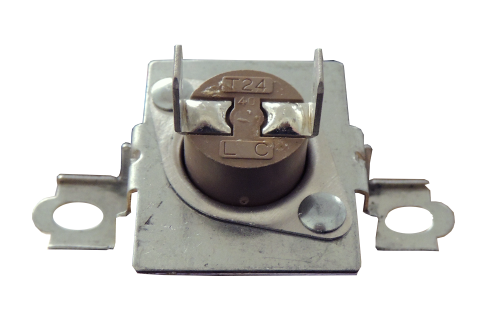
Temperature control is handled by thermostats and fuses working as a team:
Dryer symptoms point to specific parts more reliably than most appliances. Use this as a starting point, then confirm with a meter before ordering.
A key point for anyone replacing a thermal fuse: fuses blow for a reason. If you replace one without clearing the vent and checking the cycling thermostat, expect the new one to fail too.
Start with the model and serial tag. On most dryers it's inside the door opening, on the door frame, or on the back panel. Then find the OEM part number either from the old part itself or from the manufacturer's parts breakdown for that model. Supco product pages list the OEM numbers each part replaces, which makes cross-referencing straightforward.
| Part | Common Symptom | How to Verify | Replace With |
|---|---|---|---|
| Thermal fuse | No heat or no start (model dependent) | No continuity across terminals | Exact OEM temperature rating |
| Heating element | Drum turns, no heat (electric) | Open coil; resistance out of spec | Same OEM number, voltage, wattage |
| High-limit thermostat | No heat, or heat cycling off early | Open at room temperature | Same OEM number and rating |
| Cycling thermostat | Overheating or underheating | Open at room temp, or tests out of range | Same OEM number and rating |
| Gas valve coils | Igniter glows, no flame, often intermittent | Coil resistance out of spec, or fails when warm | Matched coil set |
| Igniter | No glow on gas model | No continuity; visible crack | Same shape and connector |
| Drum rollers / idler | Squeal, thump, grinding | Flat spots, rough or seized bearing | Matched set with belt |
| Drive belt | Motor runs, drum still | Broken, glazed or stretched | Exact OEM belt |
HVAC365 stocks Supco dryer parts because Supco has made dependable replacement components since 1945, built to match OEM fit and function. Each product page includes OEM cross-reference numbers and spec details so you can confirm the match before you order. Dryer parts in this category ship in 3-5 business days, which gets a down machine back in service fast.
Restricted airflow is the usual cause. A clogged vent, crushed duct or blocked lint housing traps heat until the fuse opens. A cycling thermostat that sticks closed or a heating element shorted to the housing can also do it. Clear the full vent run and test the thermostats before installing a new fuse.
On a dryer with several years of use, yes. Once the cabinet is open, the extra parts cost little compared to the labor of opening it again, and worn components fail on a similar timeline.
That pattern classically points to weak gas valve coils that fail once they warm up. The flame sensor and the high-limit thermostat are other suspects. Because this is gas work, have a qualified technician diagnose and replace the coils.
Look at the wall receptacle. A three-slot receptacle uses a 3-wire cord (NEMA 10-30); a four-slot receptacle uses a 4-wire cord (NEMA 14-30). Newer installations generally require 4-wire. Gas dryers use a standard 120V cord.
Only if it is specifically listed as replacing your OEM number. Element shape, wattage, resistance and terminal layout must match. Ordering by the OEM number is the safest route.
Yes. A torn screen lets lint into the blower and vent, cutting airflow and raising fire risk. Match the screen to the model, since frame shapes vary.

Fast Shipping

Easy Returns

Warranty Coverage

Financing Available