null
Commercial Air Conditioner Systems

Commercial Air Conditioner Systems

Commercial Air Conditioner Systems: Matched Condenser and Air Handler Split Systems

A commercial air conditioner system pairs an outdoor condensing unit with an indoor air handler that has been engineered and certified to work together. Buying the two as a matched system takes the guesswork out of compatibility: the coil is sized for the condenser's capacity, the refrigerant and metering device match, the blower is selected to deliver the right airflow, and the combination carries a published AHRI rating. For contractors, that means fewer surprises at startup and documentation that satisfies code officials and utility rebate programs. For building owners, it means the efficiency and capacity on the quote are the efficiency and capacity they actually get.

This guide covers why matched systems matter, how AHRI certification and EER/IEER ratings work, how to size a light commercial split system, three-phase power considerations, and the refrigerant transition to A2L refrigerants such as R-454B.

What is a matched commercial split system?

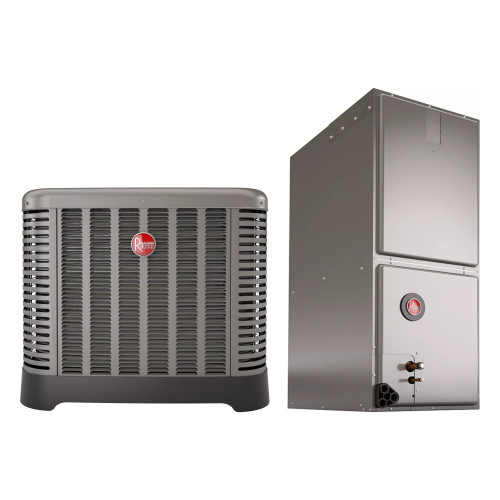
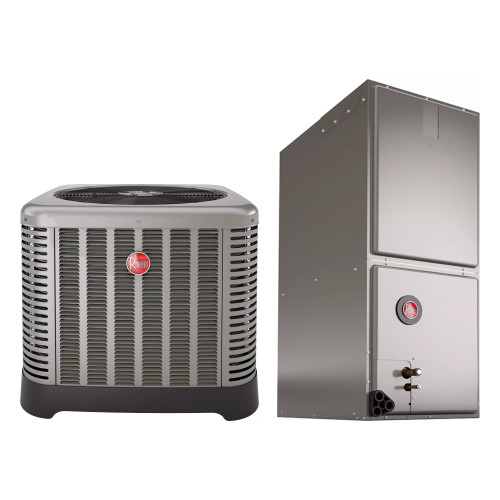
A matched system is a specific combination of outdoor condensing unit and indoor air handler (or coil and blower) that the manufacturer has tested and listed together. The match covers coil capacity, refrigerant circuiting, metering device, airflow, and controls. Rheem RACY condensers matched with RHCYA belt-drive VFD air handlers are an example: the pairing is listed by tonnage, with the air handler's coil designed for the RACY's R-454B circuit and the VFD set up to step airflow with the condenser's compressor stages.

Mixing components from different product lines or manufacturers may run, but performance is unpredictable. Coils that are too small can starve the compressor and reduce capacity; coils that are too large can cause poor dehumidification and oil return problems. A matched system avoids those issues.

What does AHRI certification mean for a commercial system?

AHRI, the Air-Conditioning, Heating, and Refrigeration Institute, runs certification programs in which manufacturers' published ratings are verified by independent testing. Commercial systems of 65,000 Btu/h (about 5.4 tons) and larger are rated under AHRI Standard 340/360, while smaller systems are rated under AHRI 210/240. An AHRI certificate lists the exact condenser and air handler model numbers, the rated capacity, and the efficiency ratings.

The AHRI certificate is often required for:

  • Energy code compliance documentation on permits.
  • Utility and state rebate applications.
  • Engineer submittal reviews on specified projects.
  • Confirming that federal minimum efficiency standards are met.

If you substitute a different air handler model, the certificate no longer applies, and the installation may not meet the documented efficiency.

What are EER, IEER, and SEER2 for commercial systems?

MetricWhat it measuresApplies to
SEER2Seasonal cooling efficiency under updated test conditionsSystems below 65,000 Btu/h
EER2 / EERFull-load efficiency at 95°F outdoorEER2 below 65,000 Btu/h; EER at 65,000 Btu/h and up
IEERWeighted efficiency at 100, 75, 50, and 25 percent loadSystems 65,000 Btu/h and up

IEER became the federal metric for commercial unitary equipment on January 1, 2023, when the Department of Energy raised minimum efficiency levels. IEER is weighted heavily toward part-load performance, because commercial cooling systems spend most hours below full capacity. Staged or variable compressors combined with variable-speed supply fans tend to achieve higher IEER. EER remains useful for peak demand comparisons and is often what utilities and engineers specify for hot climates.

How do I size a commercial split-system air conditioner?

Size from a commercial load calculation, such as ACCA Manual N or an engineering load program, that includes envelope, solar, occupancy, lighting, equipment, and ventilation air. Then select the system whose capacity at your design conditions, not just nominal tonnage, meets the load. Manufacturers publish expanded performance tables that show total and sensible capacity at various outdoor and entering air temperatures.

Key sizing points for commercial split systems:

  • Sensible versus latent capacity. In humid climates, confirm the system removes enough moisture; in dry climates, confirm enough sensible capacity.
  • Airflow. Design for roughly 350 to 450 CFM per ton, adjusting for climate and coil face velocity limits.
  • Static pressure. Select the air handler drive package to deliver design airflow against the duct system's external static pressure.
  • Avoid oversizing. Oversized systems short-cycle, control humidity poorly, and cost more. Staging helps, but right-sizing comes first.
  • Line set length. Long runs reduce capacity slightly and may require additional refrigerant and larger lines; include this in the selection.

What three-phase power do commercial systems need?

Most light commercial split systems above 5 tons are three-phase. Common voltages are 208/230V three-phase (from a 120/208V or 240V service), 460V three-phase for buildings with 480V service, and 575V three-phase where 600V service exists. Both the condenser and air handler must match the building's voltage, though in some cases the air handler is on a different voltage than the condenser; check the model numbers. Each component has its own MCA (Minimum Circuit Ampacity) for sizing conductors and MOP (Maximum Overcurrent Protection) for the largest allowed breaker or fuse. Electric heat in the air handler adds significantly to its MCA.

Three-phase scroll compressors must rotate in the correct direction. At startup, verify phase rotation; a compressor running backward will be noisy, draw low current, and fail to pump.

What should I know about R-454B and the 2025 refrigerant transition?

The EPA's Technology Transitions rule under the AIM Act set a GWP limit of 700 for new residential and light commercial air conditioning systems manufactured or imported starting January 1, 2025, with a final installation deadline of January 1, 2026 for split systems using pre-2025 R-410A components. Current matched commercial systems from Rheem use R-454B, with a GWP of about 466. Daikin uses R-32, with a GWP of about 675, in many of its products.

Both refrigerants are A2L: lower toxicity and mildly flammable. For split systems, that has practical effects:

  • The condenser and air handler must both be listed for the same A2L refrigerant. An R-410A air handler cannot be reused with an R-454B condenser.
  • Depending on charge size and the room served, the indoor unit may require a refrigerant detection sensor and mitigation, typically starting the blower on a leak signal.
  • Indoor field joints must be brazed or made with listed mechanical connectors.
  • Service tools, recovery equipment, and cylinders must be rated for A2L use.

When is a split system better than a packaged rooftop unit?

Choose a split system when the roof cannot carry a packaged unit, when the air handler should be indoors for access or filtration, when the building layout requires horizontal ducting from a mechanical room, or when replacing an existing split system. Packaged rooftop units are usually simpler to install where the roof and duct layout allow, with no field refrigerant piping. Both are valid; the building decides.

What commercial AC systems are available here?

This category features matched Rheem commercial split systems pairing RACY R-454B condensing units with RHCYA belt-drive VFD air handlers, along with matched light commercial systems from Daikin. Each system listing shows the condenser and air handler model numbers, nominal and rated capacity, EER and IEER or SEER2, voltage, and electrical data. Individual components are available under Commercial Air Conditioner Condensers and Commercial Air Conditioner Air Handlers.

What controls and thermostats work with commercial split systems?

Matched commercial split systems typically run from a 24V commercial thermostat or a building automation controller. Choose a control that supports the number of cooling stages the condenser offers, so a two-stage or tandem-compressor system can actually run at part load, and one that can signal the air handler's VFD or multi-speed fan to drop airflow at low stage. Commercial thermostats also handle occupied and unoccupied schedules, fan operation during occupied hours to deliver ventilation air, and optimal start. Where the building has a ventilation requirement, the air handler or a separate outdoor air damper must open during occupied hours. If the system includes electric heat, the thermostat must stage it correctly. On networked buildings, a BACnet or similar interface lets the system report alarms, run times, and setpoints to the building automation system. Getting controls right is the difference between a high-IEER system on paper and one that performs that way in the building.

Commercial AC System FAQ

Why choose a matched system instead of separate components?

A matched system carries a verified AHRI rating, ensures refrigerant and coil compatibility, and simplifies code and rebate documentation.

Can I find the AHRI certificate for a commercial system?

Yes. The AHRI Directory lists certified combinations, and manufacturers publish matched system tables. Search by the condenser and air handler model numbers.

Is IEER or EER more important?

IEER better reflects annual energy use because most hours are at part load. EER matters for peak demand and is often referenced in hot-climate utility programs.

Can a commercial split system include heat?

Yes. Cooling-only systems commonly use electric heat kits in the air handler. For efficient electric heating, consider a commercial heat pump system instead.

How long can the line set be on a commercial split system?

Manufacturers set limits on total length and vertical rise. Longer runs may need larger lines, added charge, and oil return provisions, so check the installation manual before designing the piping.

Compare
Show: 12 24 48

Fast Shipping

Easy Returns

Warranty Coverage

Financing Available