The Brand Story
Bosch: A Stuttgart Workshop, a Fort Lauderdale Heat Pump Plant
On November 15, 1886, a young engineer named Robert Bosch opened a small shop in the western part of Stuttgart, Germany, and called it the Workshop for Precision Mechanics and Electrical Engineering. The company that grew from that room now reaches into cars, kitchens and boiler rooms around the world. But for the water-source heat pumps in this collection, the most important part of the story happens not in Germany but in South Florida, in Fort Lauderdale.
Chapter 1 · 1886
The workshop in Stuttgart
The workshop grew into one of the best-known engineering names in the world, first through automotive and electrical work and later through tools, appliances and building technology. The company still runs its global operations from Gerlingen, just outside Stuttgart, not far from where Robert Bosch first set up his bench.
What makes Bosch different from almost every other company of its size is who owns it. Roughly 94 percent of the shares belong to the Robert Bosch Stiftung, a charitable foundation, which holds no voting rights. Voting control sits with a separate industrial trust, and the Bosch family holds a small stake. The arrangement keeps Bosch privately held and lets it plan in decades rather than quarters.
Chapter 2 · Heat and home
From spark plugs to boilers
Over time Bosch grew a home and building business alongside its automotive core. Its thermotechnology division, Bosch Thermotechnik, makes heating, hot water and air conditioning systems for homes and commercial buildings, and owns well-known European heating brands such as Worcester Bosch and Junkers. In 2014 Bosch took full ownership of BSH Hausgeräte, the appliance company it had run as a joint venture with Siemens, which makes refrigerators, dishwashers and ranges sold under the Bosch, Thermador and Gaggenau names.
Heat pumps were a natural extension of that heating expertise. In North America, Bosch needed a factory and a team that already knew the technology. It found both in South Florida.
Chapter 3 · 1969 to 2007
The Florida heat pump makers
FHP Manufacturing was founded in Fort Lauderdale in 1969. It specialized in electric water-source and geothermal heat pumps for homes and commercial buildings, with systems reaching up to 220 kilowatts. By the time Bosch came calling, FHP employed about 220 people and had decades of experience building equipment for one of the most demanding cooling climates in the country.
In February 2007 Bosch announced it was acquiring FHP and folding it into its Thermotechnology division under the leadership of the German heating business. Overnight, a Fort Lauderdale factory became the American base for Bosch geothermal and water-source heat pumps.
Chapter 4 · 2013
A partnership with Carrier
In November 2013 Robert Bosch North America and Carrier announced a joint venture to build geothermal and water-source heat pumps for the North American residential and commercial markets. Production was planned at the existing FHP plant in Fort Lauderdale, with products branded for both Bosch and Carrier and each company keeping its own sales channels. It was a sign of how specialized this corner of the HVAC industry is: two of the biggest names in heating and cooling chose to share one Florida factory rather than build two.
Chapter 5 · 2025
A much larger North American footprint
On August 1, 2025, Johnson Controls completed the sale of its residential and light commercial HVAC business to Bosch. The deal, valued at $8.1 billion in total, included the Johnson Controls North America ducted business and the global residential joint venture with Hitachi. With it, Bosch moved from a specialist in water-source and geothermal equipment to one of the larger players in American residential heating and cooling.
How it works
One water loop, many independent zones
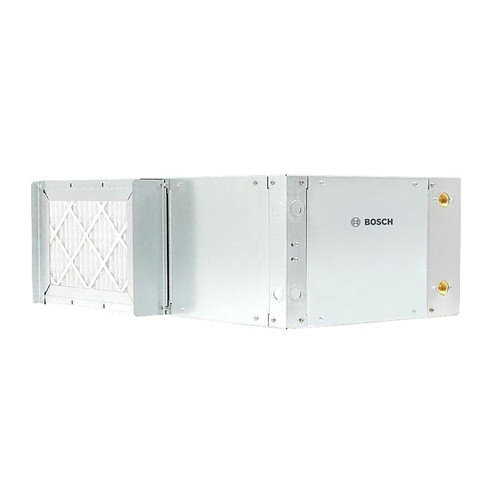
A water-source heat pump looks like an ordinary air handler with a compressor inside, but instead of trading heat with outdoor air, it trades heat with a loop of water piped through the building. In an office tower, hotel or condominium, each suite gets its own unit. On a hot afternoon, units in sunny rooms dump heat into the loop while units on the shaded side can pull heat back out. A cooling tower removes surplus heat, and a boiler adds it when the whole building calls for warmth. When the loop is buried in the ground instead, the same machine becomes a geothermal heat pump.
That design is why so many South Florida high-rises run on water-source units. Each tenant controls their own comfort, a failed unit affects one suite instead of a whole floor, and replacement is a matter of swapping a cabinet in a closet rather than rebuilding a central plant.
The Lineup
What Bosch builds today
Worldwide, Bosch builds everything from automotive systems to dishwashers to boilers. In heating and cooling for North America, its best-known specialty traces back to those Florida roots: water-source and geothermal heat pumps. That is the family HVAC365 carries:
- Water-source heat pump package units: self-contained vertical units in left- and right-return configurations, built for closet installations in condominiums, hotels and offices.
- Commercial Series units: water-source heat pumps rated around 13.8 to 14 EER in the smaller sizes, designed for multi-unit buildings and light commercial spaces.
- Sizes by tonnage: 1.5 ton, 2.5 ton and 3 ton units, plus other capacities, in single-phase 208/230V configurations.
- R-454B refrigerant: current units ship with R-454B, the lower-GWP A2L refrigerant replacing R-410A in new equipment.
The full collection also lives under all-in-one self-contained package units.
At a Glance
Bosch by the numbers
- Founded
- November 15, 1886, Stuttgart
- Founder
- Robert Bosch
- Headquarters
- Gerlingen, Germany
- Majority shareholder
- Robert Bosch Stiftung, about 94%
- Heat pump roots
- FHP Manufacturing, Fort Lauderdale, 1969
- FHP acquired
- 2007
- Johnson Controls HVAC deal
- Closed August 1, 2025
- Product focus here
- Water-source heat pumps
- Refrigerant
- R-454B
Questions
Frequently asked questions about Bosch
Who owns Bosch?
Bosch is privately held. About 94 percent of its shares belong to the Robert Bosch Stiftung, a charitable foundation, while voting control rests with a separate industrial trust and the Bosch family holds a small stake.
Where do Bosch water-source heat pumps come from?
Bosch's North American water-source and geothermal heat pump business grew out of FHP Manufacturing, a Fort Lauderdale, Florida, company founded in 1969 that Bosch acquired in 2007.
When was Bosch founded?
Robert Bosch opened his Workshop for Precision Mechanics and Electrical Engineering in Stuttgart, Germany, on November 15, 1886.
What is a water-source heat pump?
It is a heat pump that exchanges heat with a building's water loop instead of outdoor air. Each unit can heat or cool its own space independently, which makes it popular in condominiums, hotels and office buildings.
Did Bosch buy Johnson Controls' residential HVAC business?
Yes. Johnson Controls completed the sale of its residential and light commercial HVAC business to Bosch on August 1, 2025, in a deal valued at $8.1 billion that included its North America ducted business.
What refrigerant do current Bosch water-source heat pumps use?
The current Bosch water-source heat pumps in this collection use R-454B, a lower-GWP A2L refrigerant that replaces R-410A in new equipment.