The Brand Story
Mitsubishi Electric: A Century of Moving Air Without Ducts
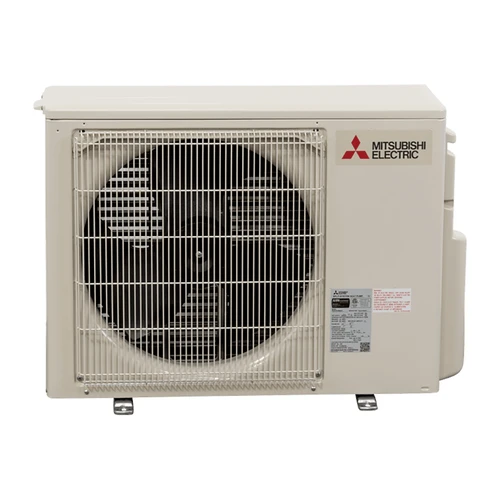
In 1968, in a Japan where most homes had no room for ductwork and summers were long and wet, Mitsubishi Electric engineers hung a slim cooling unit high on a wall and fed it from a compact box outside. They called it Kirigamine, after a mountain plateau known for its cool breezes, and they gave it a cross-flow fan that spread air quietly across the whole room. It was the company's first wall-mounted split air conditioner, and the idea behind it, comfort delivered room by room through two small refrigerant lines, would eventually cross the Pacific and change how American contractors think about heating and cooling.
Chapter 1 · 1921
Born in a shipyard
Mitsubishi Electric did not begin with air conditioning. It began in 1921, when the electrical machinery division of Mitsubishi Shipbuilding, the company now known as Mitsubishi Heavy Industries, was spun off on its own. Its roots were in a marine electric motor factory at the Kobe Shipyard, where workers built the motors that turned ships' machinery. The new company set up its headquarters in Tokyo, where it remains today in the Marunouchi business district.
The early decades were about electricity in every form: motors, generators and the industrial equipment of a modernizing country. A factory in Nagasaki opened in 1924. In 1943 production began at Wakayama Works, the plant that would later become the heart of the company's air conditioning and refrigeration business.
Chapter 2 · 1954 to 1978
From room coolers to the split system
In 1954 Mitsubishi Electric set up Shizuoka Works to concentrate on room and packaged air conditioners. Chillers followed in 1966, marking the company's full entry into commercial HVAC, and in 1967 its first water-cooled chillers were shipped abroad to Hong Kong.
Then came the Kirigamine in 1968, and with it the shape of the modern ductless system. Two years later the company introduced Lossnay, a heat recovery ventilator that brings in fresh outdoor air while holding on to most of the energy in the air going out. In 1978 Mitsubishi Electric launched Mr. Slim, a line of compact split systems for small commercial spaces. That name would become the company's calling card in North America.
Chapter 3 · 1982 to 1991
Mr. Slim comes to America
In 1982 Mitsubishi Electric brought Mr. Slim and its all-electric heat pump technology to the United States. At the time, American homes and offices were built almost entirely around ducted central systems, and a wall-mounted indoor unit looked strange to many contractors. The appeal was practical: an addition, a sunroom, a server closet or an old building with no space for ductwork could be conditioned with nothing more than a small hole through the wall.
Back in Japan, engineers were already working on the next problem, how to serve an entire building with ductless equipment. In 1984 the company launched CITY MULTI, its variable refrigerant flow (VRF) system, which lets one outdoor unit feed many indoor units, each with its own control. In 1991 CITY MULTI R2 added heat recovery through a two-pipe design, so one zone could heat while another cooled, moving energy from where it was not wanted to where it was.
Chapter 4 · 1997 to 2014
Learning to heat in the cold
For years the knock on heat pumps was simple: they struggled when the weather turned truly cold. Mitsubishi Electric answered in Japan in 1997 with Zubadan technology, built for stronger heating output in cold weather. In North America the company's cold-climate heat pumps carry the name Hyper-Heating INVERTER, known to contractors as H2i.
By 2014 the technology had reached multi-zone equipment. That September, Mitsubishi Electric introduced an H2i MXZ outdoor unit it described as the first cold-climate heat pump for multiple zones, rated to deliver 100% of its heating capacity at 5°F and to keep running down to -13°F. A year earlier the company's U.S. cooling and heating division had opened a new headquarters on Satellite Boulevard in Suwanee, Georgia, northeast of Atlanta.
Chapter 5 · 2018 to today
A partnership with Trane
In May 2018 Mitsubishi Electric and Ingersoll Rand, the parent of Trane, began operating a 50/50 joint venture called Mitsubishi Electric Trane HVAC US, or METUS. The new company took over the marketing, sales and distribution of Mitsubishi Electric ductless and VRF systems in the United States and parts of Latin America, still headquartered in Suwanee. Ingersoll Rand's climate business is now Trane Technologies, which holds the other half of the venture.
The parent company has kept growing around it. Mitsubishi Electric reported more than 149,000 employees in 2024, and that same year it launched room air conditioners using the newer R454B and R290 refrigerants as the industry moved away from R-410A.
The Lineup
What Mitsubishi Electric builds today
Mitsubishi Electric's air conditioning business spans single-room wall units, ducted and ceiling-mounted indoor units, multi-zone heat pumps, CITY MULTI VRF for large buildings, Lossnay ventilation, chillers and building controls. HVAC365 carries a wide slice of that range:
- Ductless mini split systems: wall-mounted heat pump systems from small 6,000 BTU units rated up to 35 SEER2 to larger 15,000 BTU and up models, the newest of them on R454B refrigerant. Browse by capacity in mini splits by room size, all the way up to 42,000 BTU systems.
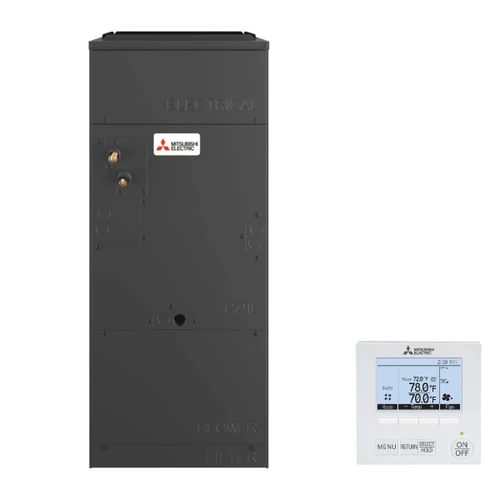
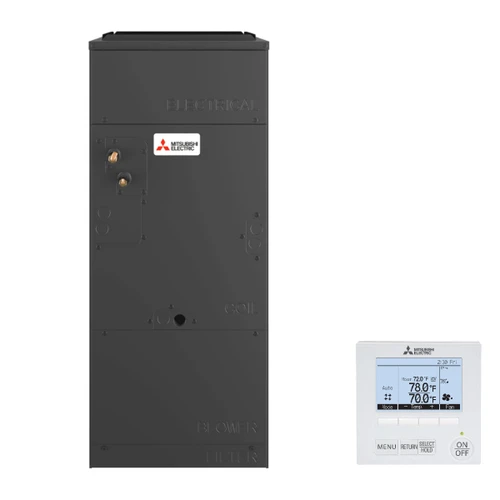
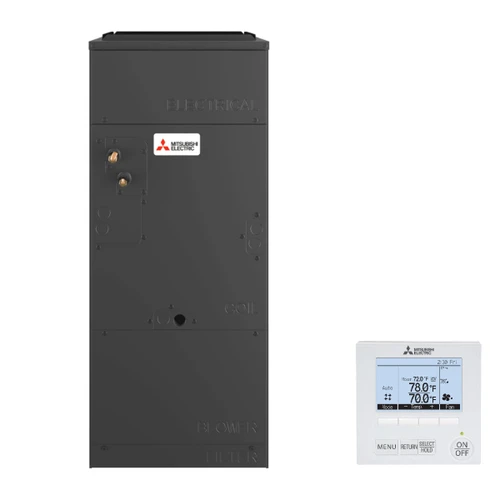
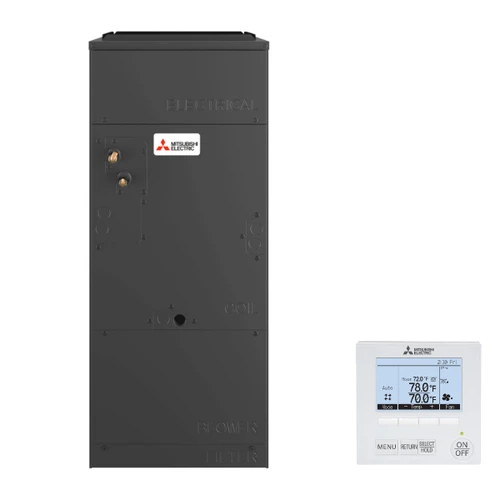
- Ductless heat pumps: including Hyper Heat equipment and multi-position air handlers that pair with Mitsubishi outdoor units for ducted comfort with inverter control.
- Multi-zone systems: one outdoor unit feeding several indoor units, from dual-zone pairings to larger whole-home layouts.
- Complete mini split systems: matched indoor and outdoor combinations for heating and cooling.
- Controls and interfaces: wired and wireless remote controllers, the MAC-334IF-E interface that links M-Series units to thermostats, CITY MULTI M-NET and MA control adapters, and BACnet gateways for building automation.
- Accessories: electric heat strips for air handler cabinets, condensate management parts, controller wall plates and faceplates.
The Next Chapter
A new generation of refrigerant
The newest Mitsubishi Electric systems in our catalog run on R454B rather than R-410A, part of an industry-wide shift toward refrigerants with lower climate impact. The change matters at the job site: new-refrigerant outdoor units are designed around their own matched indoor units, controls and procedures, so contractors should check that every component in a system is listed for the same refrigerant before installation.
At a Glance
Mitsubishi Electric at a glance
- Founded
- 1921, spun off from Mitsubishi Shipbuilding
- Headquarters
- Marunouchi, Tokyo, Japan
- First wall-mounted split
- Kirigamine, 1968
- U.S. debut
- Mr. Slim, 1982
- VRF launch
- CITY MULTI, 1984
- U.S. HVAC company
- Mitsubishi Electric Trane HVAC US, since 2018
- U.S. headquarters
- Suwanee, Georgia
- Joint venture partner
- Trane Technologies (50/50)
- Employees
- About 149,000 (2024)
Questions
Frequently asked questions about Mitsubishi Electric
Who makes Mitsubishi Electric mini splits sold in the United States?
Mitsubishi Electric Corporation of Tokyo designs and builds the equipment. In the U.S. it is marketed and distributed by Mitsubishi Electric Trane HVAC US, a 50/50 joint venture with Trane Technologies that began operating in 2018.
Is Mitsubishi Electric the same company as Mitsubishi Heavy Industries?
No. Both belong to the wider Mitsubishi group and share roots, but Mitsubishi Electric was spun off from Mitsubishi Shipbuilding, now Mitsubishi Heavy Industries, in 1921 and has operated as a separate company since.
When did Mitsubishi Electric start selling ductless systems in the U.S.?
Mitsubishi Electric introduced its Mr. Slim split-system heat pump technology to the U.S. market in 1982.
What is Mitsubishi Electric Hyper-Heating INVERTER?
Hyper-Heating INVERTER, or H2i, is Mitsubishi Electric's cold-climate heat pump technology. Its H2i multi-zone outdoor units were rated to deliver full heating capacity at 5°F and to operate down to -13°F.
What is CITY MULTI?
CITY MULTI is Mitsubishi Electric's variable refrigerant flow system, launched in 1984, which connects many individually controlled indoor units to a single outdoor unit for larger buildings.
Where is Mitsubishi Electric's U.S. HVAC headquarters?
Mitsubishi Electric Trane HVAC US is headquartered on Satellite Boulevard in Suwanee, Georgia, northeast of Atlanta.