Planning a 20-Ton Rooftop Unit Project From Quote to Startup
A 20-ton rooftop unit is nominally 240,000 Btu/h of cooling. At this size the equipment itself is only part of the job: the lift, the roof structure, the gas service, the electrical feed and the ventilation design all carry real cost and schedule risk. This page covers the 20-ton units in our Commercial Rooftop Units section and walks through the planning steps that keep a 20-ton project on budget.
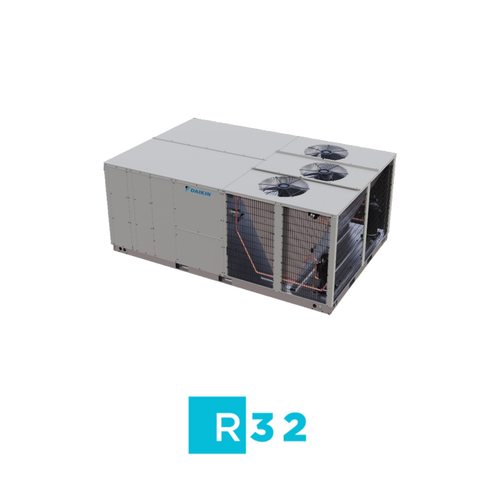
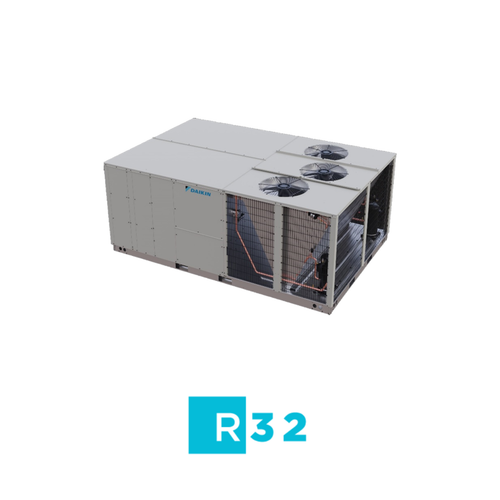
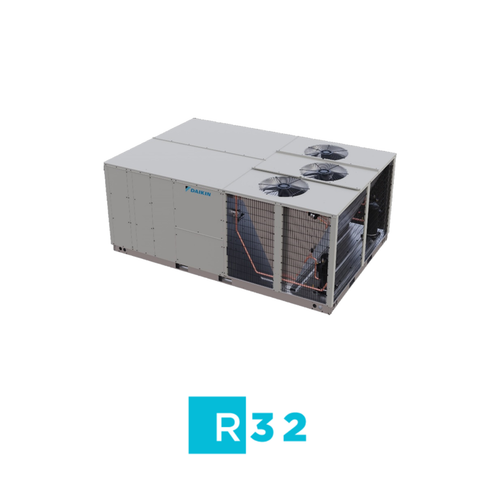
The selection here is Daikin's R-32 DSG gas/electric and DSC cooling-only units, Rheem's R-454B RGEGYB gas/electric and RACGYB cooling-only units, and Daikin DFG R-410A gas/electric listings.
Is 20 Tons the Right Answer?
Twenty-ton units are typically used on large open zones such as supermarket and warehouse-club floors, gymnasiums, auditoriums and sanctuaries, large restaurants and banquet halls, and production or distribution spaces that need comfort cooling. Before committing to a single 20-ton unit, compare it against two 10-ton units or a 15-ton plus a smaller unit. One large unit means one curb, one gas connection and one circuit, and usually a lower equipment cost per ton. Two smaller units give redundancy, so a compressor failure does not take the whole space down, and each lift is lighter. Neither is always right; the load profile, the roof layout and the owner's tolerance for downtime decide it. Any square-footage rule of thumb at this size is a rough check, and the load calculation, including ventilation air, should drive the decision.
Capacity and Efficiency of the Listed Units
The current R-32 and R-454B units on this page list about 228,000 to 230,000 Btu/h of cooling capacity; the Daikin DFG lists 240,000 Btu/h. Listed efficiencies:
- Daikin DSC cooling only: 14.2 IEER, 11 EER.
- Daikin DSG gas/electric: 14 IEER, 10 EER.
- Rheem RGEGYB gas/electric: 14 IEER, 10 EER.
- Rheem RACGYB cooling only (Renaissance Classic): 11.0 EER, 14 IEER.
- Daikin DFG gas/electric: 14 IEER.
With ratings this close, efficiency rarely separates the choices at 20 tons. Focus the comparison on electrical options, heat input, blower and duct fit, weight and availability. If the project has a code or incentive efficiency requirement, confirm the AHRI-certified rating for the exact model and its factory options.
Step 1: Electrical Service
All units here are three-phase. Daikin DSG, DSC and DFG are listed in 208/230V, 460V and 575V. Rheem RGEGYB is listed in 208/230V and 460V, and the Rheem RACGYB on this page is listed in 460V only. A 20-ton unit at 208/230V needs a substantial circuit, so the existing panel capacity and conductor sizes should be checked early. Where 480V service is available, 460V equipment usually means lower current and smaller wire and gear. Pull the MCA and MOP from the product listing, and have the electrician verify measured voltage and phase balance before startup.
Step 2: Gas Service and Heat Input
The Daikin DSG listings at 20 tons are offered with 260,000, 360,000 or 400,000 Btu/h gas input, and the Rheem RGEGYB listings show 400,000 Btu/h input. A 400,000 Btu/h burner can be a large share of a building's total gas load, so confirm the meter, regulator and piping can deliver the full input with every other appliance running, at the inlet pressure the manufacturer specifies. Choose the input from the heating load including ventilation air. In warm climates, the lowest input usually covers the need and avoids short heating cycles; in cold climates or high outside-air applications, the higher inputs may be required. Check the temperature rise range against design airflow on the product page.
Step 3: Structure and Rigging
Listed weights at this size run from about 2,045 lb to about 2,180 lb. That calls for a properly sized crane, spreader bars and the manufacturer's lifting points, along with a lift plan that accounts for the pick radius from where the crane can park. If the new unit is heavier than the original, sits in a new location or the building is older, have a structural engineer review the roof framing. Coordinate any street or lot closures and permits in advance, since a missed crane date on a 20-ton job is expensive.
Step 4: Curb, Ductwork and Discharge
Large-cabinet curbs rarely match across brands or product generations. Measure the existing curb and supply and return openings, and decide between a new curb and a manufacturer-approved adapter curb. Confirm downflow versus horizontal discharge on the selected model before ordering, and check that the existing ductwork can handle the airflow and static pressure of the new unit using the blower data in the spec sheet. The Rheem units list a belt-drive blower with a VFD, which can help match airflow to existing ductwork during commissioning.
Step 5: Ventilation, Economizer and Controls
Large zones served by 20-ton units are often high-occupancy spaces, which makes outdoor air one of the biggest loads on the unit. Depending on climate zone and the adopted edition of ASHRAE 90.1 or IECC, an air-side economizer, economizer fault detection and demand-controlled ventilation may be required. Settle these with the engineer of record before ordering, and specify the economizer, relief or power exhaust, and controls made for that cabinet. If the building has a building automation system, confirm the controller and communication options needed for integration.
Step 6: Staging and Commissioning
The Daikin and Rheem RACGYB listings at this size show two compressors, giving two stages of capacity; the Rheem listings describe two-stage operation. Proper commissioning at this size matters: verify airflow, refrigerant charge per the manufacturer's procedure, economizer operation, gas manifold pressure and temperature rise, and the safeties. Document the startup values; they make later troubleshooting far easier.
Refrigerant Handling
Daikin DSG and DSC use R-32 and the Rheem units use R-454B. Both are A2L refrigerants that require A2L-rated recovery machines and tools, trained technicians, and installation according to the manufacturer's manual and adopted mechanical code. Units of this size carry larger refrigerant charges, so review the installation manual's leak detection and mitigation requirements carefully and keep factory sensors wired as shown. Daikin DFG listings use R-410A; new R-410A packaged equipment is no longer being manufactured for this application, so confirm availability and project acceptance before ordering.
Lead Times and Ordering
Twenty-ton units, particularly 460V-only, 575V and high-heat versions, are not always on the shelf. Confirm availability before committing to a schedule, and order the curb early so it can be set and flashed ahead of the unit. If you are deciding between this size and the 15 Ton Rooftop Units or 25 Ton Rooftop Units pages, availability can be a legitimate tiebreaker when loads allow it.
20-Ton Models in This Category
| Brand | Series | Type | Voltages Listed | Efficiency (as listed) |
|---|
| Daikin | DSC | Cooling only, R-32 | 208/230V-3, 460V-3, 575V-3 | 14.2 IEER, 11 EER |
| Daikin | DSG | Gas/electric, R-32, 260,000 to 400,000 Btu/h input | 208/230V-3, 460V-3, 575V-3 | 14 IEER, 10 EER |
| Daikin | DFG | Gas/electric, R-410A | 208/230V-3, 460V-3, 575V-3 | 14 IEER |
| Rheem | RGEGYB | Gas/electric, R-454B, 400,000 Btu/h input, belt drive VFD | 208/230V-3, 460V-3 | 14 IEER, 10 EER |
| Rheem | RACGYB (Renaissance Classic) | Cooling only, R-454B, belt drive VFD | 460V-3 | 11.0 EER, 14 IEER |
Figures are taken from each product listing; confirm against the manufacturer's spec sheet or AHRI certificate for the exact model number.
Frequently Asked Questions
Is one 20-ton unit better than two 10-ton units?
One unit is simpler and usually cheaper per ton to install. Two units provide redundancy and zoning and lighter lifts. The right choice depends on the load profile, roof layout and how much downtime the owner can accept.
What size gas line does a 20-ton gas/electric unit need?
It depends on the unit's input (up to 400,000 Btu/h on the listings here), the other gas loads, pipe length and supply pressure. Have the gas piping sized to code for the full connected load and confirm inlet pressure against the installation manual.
Is the Rheem 20-ton cooling unit available in 208/230V?
The Rheem RACGYB on this page is listed in 460V only. For 208/230V cooling-only at 20 tons, the Daikin DSC is listed in 208/230V, 460V and 575V.
How heavy are 20-ton rooftop units?
Listed weights in this category run from about 2,045 lb to about 2,180 lb. Use the exact model weight for the crane lift plan and structural review.
Do I need demand-controlled ventilation on a 20-ton unit?
It depends on the space type, occupancy density, climate zone and adopted energy code. High-occupancy spaces served by large units are where it is most often required. Confirm with your engineer or plan reviewer.
What should be recorded at startup?
At minimum, supply voltage and amperage, airflow, refrigerant pressures and temperatures per the manufacturer's charging method, gas manifold pressure, temperature rise and economizer operation. Keep it with the unit documentation.