6-Ton Rooftop Units: Where Light Commercial Becomes Commercial-Rated Equipment
A 6-ton rooftop unit is nominally 72,000 Btu/h, and the listings in this category carry rated capacities from about 68,000 to 72,000 Btu/h. That puts every unit on this page at or above the 65,000 Btu/h line, which changes more than people expect. The efficiency metrics are different, the electrical options narrow to three-phase only, every listed unit has staged cooling, and high-static blower options start showing up as a regular choice. If you are used to quoting 5-ton units, read this page before you price a 6-ton job as simply "one more ton."
Six-ton units show up on larger retail tenant spaces, restaurant dining rooms and kitchens with significant make-up air, small medical and office buildings, classrooms, worship spaces, and as one zone of a multi-unit roof on bigger buildings. They are also a common choice when an engineer wants to break a large space into zones without going to a single 10-ton or larger unit.
This page collects every 6-ton packaged unit we carry. To browse by configuration across all sizes, see Gas/Electric Rooftop Units, Heat Pump Rooftop Units, or Air Conditioner Rooftop Units.
Sizing a 6-Ton Application
A proper load calculation is the starting point, and on jobs of this size there is often an engineer of record whose schedule governs. As a rough cross-check, light commercial space is often estimated at something like 300 to 500 square feet per ton, which would suggest roughly 1,800 to 3,000 square feet for a 6-ton unit. High-occupancy spaces, kitchens, and spaces with large outdoor air requirements can need much more capacity per square foot.
- Six versus five: Moving from 5 to 6 tons means three-phase power, a different rating system, and often a different cabinet and curb. If a 5-ton unit is borderline, check whether reducing duct leakage, correcting airflow, or adjusting ventilation rates resolves the shortfall before stepping up.
- Six versus 7.5: If the load runs near the top of the 6-ton range, compare the 7.5 Ton Rooftop Units page. A larger unit with good part-load control may be a better fit than a fully loaded 6-ton unit.
- Airflow: At a common design point of roughly 350 to 400 CFM per ton, a 6-ton unit moves something like 2,100 to 2,400 CFM. That is often more than older duct systems were built for. The high-static options listed here exist precisely because longer duct runs, filtration upgrades, and economizer sections add resistance.
EER and IEER: The Commercial Rating System
Because 6-ton units are at or above 65,000 Btu/h, they are rated as commercial unitary equipment using EER and IEER rather than SEER2 and EER2. EER is full-load efficiency at a standard hot condition. IEER is a weighted blend of efficiency at several load points and is the better indicator of annual operating cost, since commercial units spend most of their hours at part load. Heat pumps at this size are additionally rated for heating efficiency in COP at specified outdoor conditions; check the spec sheet for those values.
On the listings here, EER ranges from 11 to 12, and IEER ranges from about 14 on the Rheem RGECYB and RHPCYB to 18.6 on the Daikin DHG and DHC. The difference between a 14 IEER unit and an 18.6 IEER unit can matter considerably on a building that runs long hours, and it is often the deciding factor for utility efficiency programs. Do not compare these numbers against SEER2 ratings on the 5-ton and smaller pages; they are not on the same scale.
A note on the Daikin DFG listings: they are R-410A units listed at 11 EER, but the secondary ratings shown in their product names are inconsistent. Treat the manufacturer's spec sheet or AHRI certificate as the authority for those models before you put a number on a submittal.
Three-Phase Only: Voltage Options
None of the 6-ton units in this category are offered in single-phase. If the building only has single-phase service, you are looking at two smaller units or an electrical service upgrade. Voltages present on the 6-ton listings:
- 208/230V three-phase: All Daikin series on this page, plus Rheem RGECYB and RHPCYB.
- 460V three-phase: Daikin DSG, DHG, DSC, DHC, DSH, DHH, and DFG; Rheem RHPCYB.
- 575V three-phase: Daikin DSG, DHG, DSC, DHC, DSH, and DHH.
The Rheem RGECYB gas/electric is listed in 208/230V three-phase only at this size. On 460V buildings, that steers gas/electric selection toward the Daikin series. As always, size conductors and overcurrent protection from the minimum circuit ampacity and maximum overcurrent protection listed for the exact model, and note that high-static models can carry different electrical data than their standard-static counterparts.
Staging and High-Static Options
Every 6-ton unit in this category is listed with two-stage cooling. Staging helps commercial units match load across the long part-load hours that IEER is designed to capture, and it generally improves comfort and dehumidification compared with a single-stage unit of the same size.
High-static blower configurations are listed for the Daikin DSG, DHG, DSC, DHC, DSH, and DHH, and for at least one Rheem RHPCYB model. Choose high static when the fan performance table shows the standard blower cannot reach design airflow at your calculated external static pressure. Do not choose it by default; a high-static blower on a low-static duct system adds cost without a benefit, and it may need adjustment to avoid excessive airflow and noise.
Gas Heat Inputs at 6 Tons
Gas/electric 6-ton units on this page are offered with these inputs:
- Daikin DSG: 90,000, 115,000, and 140,000 Btu/h
- Daikin DHG: 70,000, 125,000, and 150,000 Btu/h
- Daikin DFG (R-410A): 90,000, 115,000, and 140,000 Btu/h
- Rheem RGECYB: 120,000 Btu/h
The 150,000 Btu/h Daikin DHG option is the largest gas input in this category and suits colder climates or spaces with heavy winter ventilation loads. The 70,000 Btu/h DHG option is a good fit where heating loads are light and a large burner would short-cycle or overshoot. Check the allowable temperature rise against design airflow either way. For electric heat on 6-ton air conditioners and heat pumps, match a kit to the exact model on the Commercial Electric Heat Kits page.
Refrigerants and A2L Requirements
Daikin D-series 6-ton units use R-32, and the Rheem CYB units use R-454B. Both are A2L refrigerants with lower global warming potential than R-410A and a mild flammability classification. Charge sizes on commercial units are larger than on residential equipment, so the manufacturer's requirements for refrigerant detection, leak mitigation, and service procedures deserve careful attention. Use A2L-rated recovery and evacuation equipment, follow the installation manual, and confirm what the adopted mechanical code requires in your jurisdiction. The Daikin DFG listings use R-410A; confirm availability before quoting them.
Cabinet, Curb, and Rigging
The 6-ton size is where many product lines move to a larger cabinet than their 3- to 5-ton models, though this varies by manufacturer and series. Before ordering:
- Compare the exact model's curb drawing with the existing curb footprint, height, and duct openings.
- Plan for a curb adapter on any brand change, and on a size change within the same brand, until the drawings show otherwise.
- Check unit weight against roof structure, and confirm crane capacity at the needed reach. Weights are listed on each product page.
- Line up gas, electrical, and condensate connections with existing rooftop runs, or include rerouting in the quote.
Curbs, adapters, economizers, and other accessories are on the Rooftop Unit Accessories page.
Economizers and Outdoor Air
At this capacity, energy codes such as ASHRAE 90.1 and the IECC commonly require an air-side economizer in climate zones where economizers apply, with exceptions that vary by edition and local amendment. Some code editions also tie fan control or staging requirements to unit size. Verify the requirements for your project with the adopted code and the mechanical drawings, and order the economizer designed for the specific series so controls integrate correctly. Where demand-controlled ventilation or fault detection is required, confirm the economizer controller supports it.
6-Ton Units in This Category
| Brand | Series | Type | Voltages Listed | Efficiency (as listed) | Refrigerant |
|---|
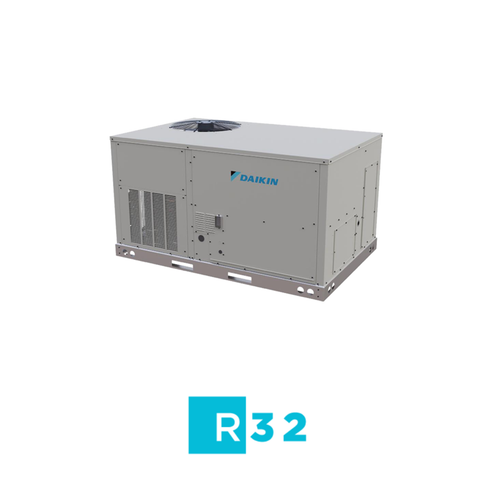
| Daikin | DSG | Gas/Electric, two-stage; standard and high static | 208/230V-3, 460V-3, 575V-3 | 11 EER / 16.7 IEER | R-32 |
| Daikin | DHG | Gas/Electric, two-stage; standard and high static | 208/230V-3, 460V-3, 575V-3 | 12 EER / 18.6 IEER | R-32 |
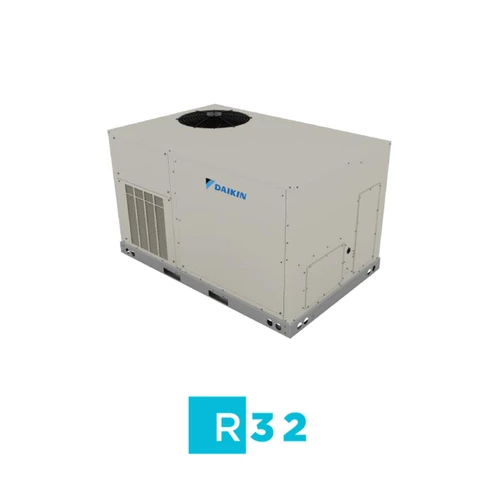
| Daikin | DSC | Air Conditioner, two-stage; standard and high static | 208/230V-3, 460V-3, 575V-3 | 11 EER / 16.7 IEER | R-32 |
| Daikin | DHC | Air Conditioner, two-stage; standard and high static | 208/230V-3, 460V-3, 575V-3 | 12 EER / 18.6 IEER | R-32 |
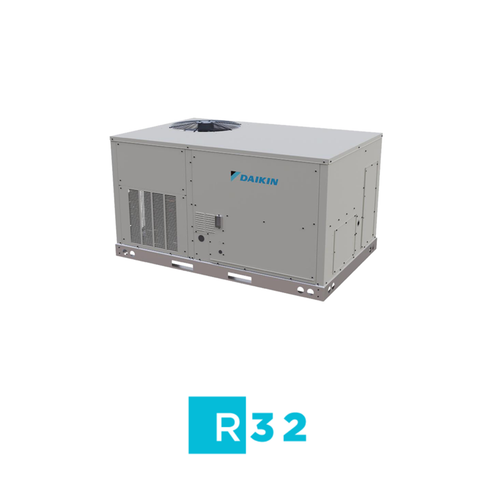
| Daikin | DSH | Heat Pump, two-stage; standard and high static | 208/230V-3, 460V-3, 575V-3 | 11 EER / 16.7 IEER | R-32 |
| Daikin | DHH | Heat Pump, two-stage; standard and high static | 208/230V-3, 460V-3, 575V-3 | 12 EER / 17.2 IEER | R-32 |
| Daikin | DFG | Gas/Electric, multi-position, two-stage | 208/230V-3, 460V-3 | 11 EER (confirm IEER on spec sheet) | R-410A |
| Rheem | RGECYB | Gas/Electric, two-stage | 208/230V-3 | 11 EER / 14.8 IEER | R-454B |
| Rheem | RHPCYB | Heat Pump, two-stage | 208/230V-3, 460V-3 | 11 EER / 14.1 IEER | R-454B |
Ratings are taken from the product listings in this category. Confirm the rating for the exact model number on the manufacturer's spec sheet or AHRI certificate before using it on a submittal, rebate application, or energy code compliance form.
Narrowing the Choice
Confirm three-phase voltage at the roof first. Then decide heat source and whether the duct system needs a high-static blower. If annual operating cost or a utility program drives the decision, the Daikin DHG, DHC, and DHH carry the highest IEER ratings on this page. The Daikin DSG, DSC, and DSH offer the same voltage range at a lower IEER and typically a lower first cost. The Rheem RGECYB and RHPCYB are straightforward options on 208/230V buildings, and the RHPCYB is also listed in 460V. If you need something smaller and single-phase, see 5 Ton Rooftop Units; for more capacity, see 7.5 Ton Rooftop Units.
Ordering Tips for 6-Ton Jobs
- Quote by full model number. Voltage, heat input, and static option all change the model code, and high-static and standard-static models are not interchangeable.
- Order the economizer, curb or adapter, and controls with the unit. Economizer requirements are common at this size, and a missing economizer can hold up final inspection.
- Plan freight receiving with a dock or liftgate service and inspect for damage before signing.
- Availability varies with season, voltage, and configuration. High-static and 575V models can take longer to source, so confirm before committing to a set date.
Frequently Asked Questions
Why are 6-ton units rated in IEER instead of SEER2?
Units with cooling capacity of 65,000 Btu/h or more are rated as commercial unitary equipment using EER and IEER. All 6-ton units on this page fall into that group, while 5-ton and smaller units use SEER2 and EER2.
Is any 6-ton rooftop unit available in single-phase?
Not in this category. Every 6-ton unit we list is three-phase: 208/230V, 460V, or 575V depending on the series.
When do I need the high-static version?
When the standard blower cannot deliver design airflow at your duct system's external static pressure according to the fan performance table. Long duct runs, high-efficiency filters, and economizer sections are common reasons.
Which 6-ton unit has the highest IEER here?
The Daikin DHG gas/electric and DHC air conditioner are listed at 18.6 IEER, followed by the Daikin DHH heat pump at 17.2 IEER. Confirm the exact model's rating on its AHRI certificate.
Can I get a 460V gas/electric unit at 6 tons?
Yes. The Daikin DSG, DHG, and DFG gas/electric series are listed in 460V three-phase at this size. The Rheem RGECYB 6-ton is listed in 208/230V three-phase only.
Does a 6-ton unit need an economizer?
In many climate zones, energy codes require one at this capacity, but exceptions and local amendments vary. Check the adopted code and the project's mechanical plans before ordering.