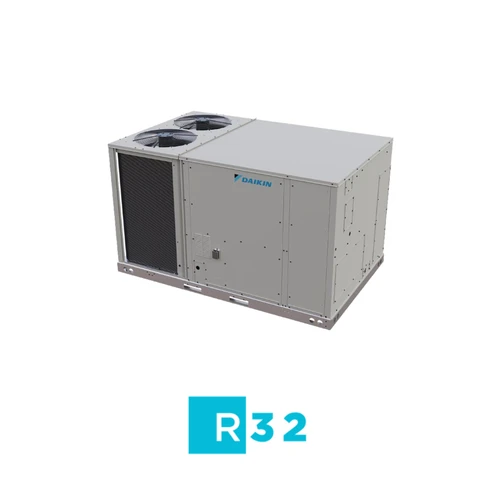
Choosing a 7.5-Ton Packaged Rooftop Unit for Light Commercial Buildings
A 7.5-ton rooftop unit is rated at a nominal 90,000 Btu/h of cooling, and it is the size where most buildings first leave residential-style equipment behind. Everything on this page is a true light commercial packaged unit: three-phase power, a commercial cabinet built to sit on a roof curb, and efficiency rated by EER and IEER rather than the SEER2 numbers used on equipment under 65,000 Btu/h. If you are replacing a tired 7.5-ton unit on a strip center, upgrading a small office from a pair of split systems, or quoting a new tenant build-out, this is the category to start in.
What follows is how we would walk a contractor or facility manager through the selection at the counter: confirm the load, pick the heating source, match the electrical service, compare efficiency, and then deal with the curb and the logistics before the order is placed.
Where 7.5 Tons Usually Fits
Only a load calculation tells you the right tonnage, and commercial loads swing hard with occupancy, lighting, glass, kitchen equipment and outside air. As a loose rule of thumb, 7.5-ton units commonly show up on small single-zone spaces: a retail suite in a strip center, a quick-service restaurant dining room (with the kitchen on its own unit), a small medical or dental office, a branch bank, a church fellowship hall, or a section of a larger building split into several zones. Treat any square-foot-per-ton figure you hear as a starting point for a conversation, not a sizing method. A space that is packed with people or has a lot of west-facing glass can need far more than an open warehouse office of the same footprint.
If your calculation lands between sizes, look at the neighboring pages before rounding up. The 8.5 Ton Rooftop Units page covers the gap between this size and the 10 Ton Rooftop Units page, and a correctly sized unit runs longer cycles, controls humidity better and short-cycles less than an oversized one.
Three Ways to Heat: Gas/Electric, Heat Pump or Cooling Only
This category carries all three common configurations at 7.5 tons, which is less common at the larger sizes:
- Gas/electric packaged units combine DX cooling with a natural gas furnace section. The Daikin DSG and DHG listings here are offered with 130,000, 180,000 or 225,000 Btu/h gas heat inputs, and the Rheem RGEDYB listings show a 150,000 Btu/h input. Pick the heat input from your heating load and ventilation air, not from habit; a high-heat unit on a mild-climate roof just adds cost and burner cycling.
- Packaged heat pumps provide both cooling and heating with the compressor. The Daikin DSH and Rheem RHPDYB listings fit buildings without gas service or owners moving away from combustion equipment. In colder climates, check the low-ambient heating capacity and whether supplemental electric heat is needed, using the manufacturer's performance data.
- Cooling-only packaged air conditioners (Daikin DSC and DHC, Rheem RACDYB, Comfortstar CRT7) suit buildings where heat comes from somewhere else, such as a boiler, unit heaters or a separate furnace, or where a field-installed electric heat kit is planned. Confirm accessory heat kit availability for the exact model before you count on it.
Voltage and Phase
Every unit on this page is three-phase. There is no single-phase 7.5-ton option here, so a building with only 208/230V single-phase service will need a utility upgrade, a phase converter conversation with the engineer, or smaller equipment. Within three-phase, the listed products break down this way:
- 208/230V-3: available across Daikin, Rheem and Comfortstar listings.
- 460V-3: available on Daikin DSG, DHG, DSC, DHC and DSH listings and on Rheem RGEDYB and RACDYB listings.
- 575V-3: Daikin only on this page, for Canadian-style 600V systems and some industrial plants.
Before ordering, confirm the actual measured voltage at the disconnect, not just what the panel schedule says. A 208V building fed to a unit that is happiest at 230V, or a 480V service that reads high, affects motor life and nuisance trips. Size the circuit from the unit's nameplate MCA and MOP shown on each product page.
Efficiency: Reading EER and IEER at 90,000 Btu/h
At 7.5 tons, federal and code efficiency for packaged commercial equipment is stated in EER (full-load efficiency at a single rating condition) and IEER (a weighted part-load figure that better reflects how a rooftop unit actually runs most of the year). IEER is the number to compare for operating cost, because a rooftop unit spends most of its hours below full load.
On this page, the Daikin high-efficiency DHG and DHC listings carry the highest ratings, listed at 17.5 IEER and 12 EER. The Daikin standard-efficiency DSG, DSC and DSH listings are rated at 16 IEER. The Rheem gas/electric and heat pump listings are rated at 14.6 and 14.1 IEER, the Rheem Renaissance Classic cooling unit lists 11.2 EER, and the Comfortstar Freedom CRT7 lists 11.6 EER. The step from standard to high efficiency usually costs more up front; whether it pays back depends on run hours, local electric rates and any utility incentive, so run those numbers for the specific building before you upsell or downgrade.
Compressor Staging and Part-Load Control
Most 7.5-ton loads spend their life well below design, so how the unit unloads matters. The Daikin listings here show two compressors, giving two steps of cooling capacity. The Rheem 7.5-ton listings show two-stage compressor operation with a belt-drive blower on a VFD, which lets the blower slow down at low stage. Comfortstar lists two compressors on the CRT7. If your project needs to meet a two-speed or variable fan requirement under the energy code that applies to your jurisdiction, check that the exact model, with its factory options, satisfies it.
Refrigerants: R-32, R-454B and the R-410A Listings
The Daikin DSG, DHG, DSC, DHC and DSH listings use R-32. The Rheem and Comfortstar listings use R-454B. Both are A2L refrigerants, classified as lower flammability. That changes some field practice: technicians need recovery machines, vacuum pumps and leak detectors rated for A2L use, and installation must follow the manufacturer's instructions and current mechanical code for the refrigerant in that unit. Many A2L packaged units include a factory refrigerant detection sensor that interacts with the blower; read the installation manual so the control wiring and sequence are not defeated during startup.
This page also lists Daikin DFG gas/electric units that use R-410A. Federal refrigerant rules have phased out manufacturing of new R-410A packaged equipment for this application, so these units come from existing production. Confirm availability with us, and confirm the unit is acceptable to your project and jurisdiction, before you order.
Curbs, Economizers and Ventilation
A replacement often lives or dies on the curb. Factory roof curbs are specific to a brand and cabinet, and a new Daikin or Rheem unit will rarely drop onto an old curb from a different manufacturer. Measure the existing curb and duct openings, then decide between a new matching curb or an adapter curb. Adapter curbs raise the unit height, so check the gas, condensate and electrical routing at the new elevation.
Economizers are another early decision. Depending on your climate zone and which edition of ASHRAE 90.1 or the IECC your jurisdiction has adopted, an air-side economizer may be required at this capacity, and so may fault detection on the economizer. Outside-air requirements for ventilation, often driven by occupancy, also affect the heating and cooling load. Confirm the code path with the engineer of record or plan reviewer, then order the factory or field economizer that matches the unit's cabinet.
Weight, Rigging and Shipping
Listed unit weights on this page run from roughly 770 lb for the lightest Rheem cooling unit to about 1,250 lb for the Daikin high-efficiency gas/electric unit. That is beyond what a crew should hand-lift onto a roof, so most installs use a crane or a boom truck. Check the roof structure for the new weight if the old unit was lighter, and use the lifting points and spreader bars shown in the installation manual. Units ship on a pallet by freight truck; make sure someone can receive a liftgate or forklift delivery and inspect for freight damage before signing.
Ordering Tips
- Match the full model number, not only the tonnage: heat input, voltage and efficiency tier are all coded into it.
- Order the curb, economizer, thermostat or controller, and any smoke detector or condensate accessories at the same time so the crane day is not wasted.
- 460V and 575V units and high-heat gas variants can have different availability than common 208/230V units; confirm stock and lead time before you schedule the lift.
- Keep the AHRI certificate for the exact model if the project needs code or incentive documentation.
7.5-Ton Models in This Category
| Brand | Series | Type | Voltages Listed | Efficiency (as listed) |
|---|
| Daikin | DHG | Gas/electric, R-32, high efficiency | 208/230V-3, 460V-3, 575V-3 | 17.5 IEER, 12 EER |
| Daikin | DSG | Gas/electric, R-32, standard efficiency | 208/230V-3, 460V-3, 575V-3 | 16 IEER, 12 EER |
| Daikin | DHC | Cooling only, R-32, high efficiency | 208/230V-3, 460V-3, 575V-3 | 17.5 IEER, 12 EER |
| Daikin | DSC | Cooling only, R-32, standard efficiency | 208/230V-3, 460V-3, 575V-3 | 16 IEER, 12 EER |
| Daikin | DSH | Heat pump, R-32 | 208/230V-3, 460V-3, 575V-3 | 16 IEER, 11 EER |
| Daikin | DFG | Gas/electric, R-410A | 208/230V-3, 460V-3, 575V-3 | Listed at 13.4 SEER2; check spec sheet for EER/IEER |
| Rheem | RGEDYB | Gas/electric, R-454B, belt drive VFD | 208/230V-3, 460V-3 | 14.6 IEER, 11 EER |
| Rheem | RHPDYB | Heat pump, R-454B, belt drive VFD | 208/230V-3 | 14.1 IEER, 11 EER |
| Rheem | RACDYB (Renaissance Classic) | Cooling only, R-454B, belt drive VFD | 208/230V-3, 460V-3 | 11.2 EER |
| Comfortstar | Freedom CRT7 | Cooling only, R-454B | 208/230V-3 | 11.6 EER |
Ratings are taken from each product's listing. Always confirm the final figures on the manufacturer's spec sheet or AHRI certificate for the exact model number.
Frequently Asked Questions
Is a 7.5-ton rooftop unit available in single-phase?
Not on this page. Every 7.5-ton unit listed here is three-phase, in 208/230V, 460V or, for Daikin, 575V. A single-phase building will need a service change or smaller equipment.
Can I replace a 7.5-ton unit with a heat pump instead of gas heat?
Often, yes. The Daikin DSH and Rheem RHPDYB are 7.5-ton packaged heat pumps. Check heating capacity at your local winter design temperature in the manufacturer's data, and confirm the electrical service can carry the added load if supplemental electric heat is needed.
Which gas heat input should I choose?
Choose from the heating load, including ventilation air, not from the old unit's nameplate alone. Daikin 7.5-ton gas/electric units here are offered at 130,000, 180,000 or 225,000 Btu/h input; the Rheem RGEDYB listing shows 150,000 Btu/h.
Will a new unit fit my existing curb?
Only if it is the same manufacturer and cabinet footprint, and even then you should verify. Different brands generally need a new curb or an adapter curb. Send us the old model number and curb measurements and we can help sort it out.
Do I need an economizer on a 7.5-ton unit?
It depends on your climate zone and the energy code adopted where the building is. Many jurisdictions require one at or near this size. Confirm with your engineer or plan reviewer before ordering.
What changes for my techs with R-32 or R-454B?
Both are A2L refrigerants. Use A2L-rated recovery and evacuation equipment, follow the unit's installation manual for leak detection and ventilation wiring, and make sure technicians have current A2L handling training.