Fitting a Commercial Air Handler Into the Building: Location, Orientation, and Service Access
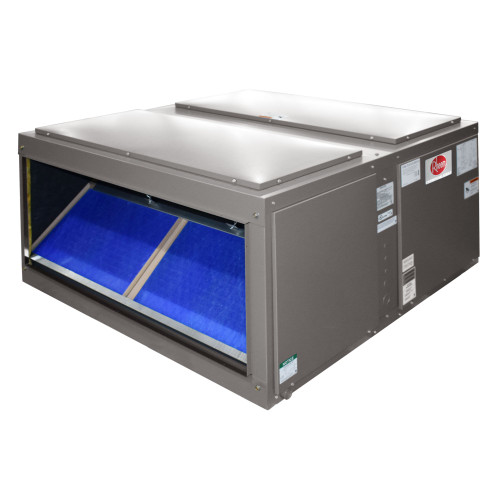
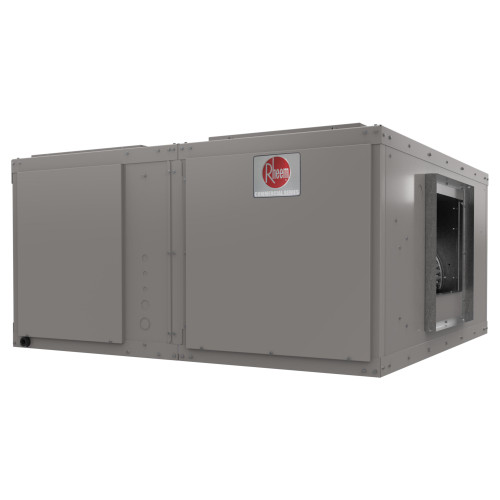
The outdoor unit gets most of the attention on a split system job, but the air handler is where installs get complicated. It has to fit through the door, sit in the right orientation for the ductwork, drain properly, leave room for filter changes and blower service, and be wired to whatever power the room has. This page looks at the commercial air handlers listed here from the point of view of the space they are going into, so you can confirm fit and configuration before the equipment shows up.
What Is Listed Here
| Model family | Sizes | Power | Blower | Use with |
|---|
| Rheem RHCYA | 7.5, 10, 12.5, 15, 20 tons | 208/230V or 460V 3-phase | Belt drive with VFD, medium static | Rheem RACY air conditioning condensers |
| Rheem RHCYP | 7.5, 10 tons | 208/230V or 460V 3-phase | Belt drive with VFD, medium static | Rheem RPCY heat pump condensers |
| Rheem RH2TY | 3, 4, 5 tons | 460V 3-phase (as listed on this page) | Constant torque ECM | Rheem 3 to 5 ton condensers and heat pumps, per approved pairing |
The RH2TY listings on this page are 460V 3-phase models in 17-1/2, 21, and 24-1/2 inch cabinet widths, which is useful on buildings where single-phase power is not convenient at the air handler location. The 3 to 5 ton bundles on the bundle pages use a 208/230V single-phase RH2TY instead, so check the voltage in the name of whichever version you pick. Surfsil SeaCoast coating options for 7.5 and 10 ton air handler cabinets are also listed here.
Mechanical Room, Closet, Ceiling, or Platform?
Where the air handler sits drives almost every other decision.
- Mechanical room on the floor: the easiest location for the larger RHCYA and RHCYP units. Plan for a housekeeping pad or vibration isolation, a straight path for the return, and enough room in front of the blower and filter access panels to actually open them and pull parts out.
- Closet: common for 3 to 5 ton RH2TY installs in offices and retail. The closet door has to be wide enough to bring the cabinet in, and the return has to be large enough that you are not starving the unit through a louvered door.
- Above the ceiling: horizontal installs save floor space but make service harder. You need structural support rated for the operating weight, a secondary drain pan where required by code, and a clear access path for filter changes. If maintenance staff cannot reach the filters, the filters will not get changed.
- Mezzanine or platform: works well for larger units in warehouses and high-bay retail. Confirm the platform load rating and provide a safe way up for service.
Orientation and Configuration
The RH2TY is sold as a multi-position air handler, which means one cabinet can be set up for more than one airflow direction. Which positions are supported, and whether the coil or drain pan has to be repositioned to change orientation, is spelled out in the installation manual for each model. Read that before you promise a horizontal install in a tight ceiling.
The belt-drive RHCYA and RHCYP units are larger, heavier cabinets designed for commercial supply and return connections. Confirm the available configurations, supply and return connection locations, and whether any field conversion is needed in the spec sheet, then lay out the duct transitions before the unit is set. A transition that has to make a sharp turn right off the blower outlet will cost you static pressure you cannot get back.
Condensate: The Detail That Causes Callbacks
In most air handlers the blower pulls air through the coil, so the drain pan sits in negative pressure. Without a properly sized trap, the blower can hold water in the pan or pull air back up the drain line, and the pan overflows. Follow the manufacturer’s trap dimensions for the static pressure the unit will run at. Beyond the trap:
- Pitch the drain line continuously toward its termination and support it so it does not sag.
- Above ceilings or over finished spaces, install a secondary drain pan or overflow protection as required by the mechanical code, and a float switch that shuts down cooling if the primary drain backs up.
- If gravity drainage is not possible, specify a condensate pump sized for the system’s cooling capacity and the vertical lift.
Setting Airflow on Belt-Drive VFD Units
On the RHCYA and RHCYP, airflow is set by a combination of the pulley (sheave) setup and the VFD speed. The VFD lets you trim airflow and slow the blower at reduced load, and on two-stage systems it can drop airflow when the condenser runs at low stage. Commissioning should include measuring external static pressure, confirming airflow against the design, checking belt tension and alignment, and recording the VFD settings so the next technician knows what the system was balanced to. A medium-static blower package is meant for typical commercial duct systems; if your duct design runs higher, check the blower tables before ordering.
Power and Controls at the Air Handler
The air handler is powered by its own circuit, separate from the condenser. It does not need to match the condenser voltage, but it must match the power available where it is installed. A 460V condenser with a 208/230V air handler is perfectly normal when the rooftop disconnect is fed from 480V service and the mechanical room only has 208V. Add any electric heat to the air handler load when sizing that circuit, and check the installation manual for which electric heat accessories are approved for each model.
A2L refrigerant air handlers, including the R-454B units listed here, may include or require a refrigerant detection sensor and mitigation controls, depending on the model, refrigerant charge, and room size. Those controls can energize the blower when a leak is detected, so they must be wired as the manufacturer directs and left in place.
What to Measure on a Replacement
When an old air handler is coming out, measure before you order rather than after the crate arrives. Record the cabinet footprint and height, the supply and return opening sizes and locations, the width of every door, corridor, and stair landing on the way in, and the distance from the unit to the nearest floor drain or condensate riser. Note the existing filter size, whether the return is ducted or uses a plenum, and the existing disconnect and wire size. Compare all of that to the new unit’s dimensional drawing. A new cabinet that is a few inches taller or has its return on a different face can mean a new transition, a revised filter rack, or a platform change, and those are all easier to price into the job up front. If the new unit simply will not fit the old opening, splitting the load across two smaller systems, or a different indoor product altogether, may be the better answer.
Service Access Checklist
- Filter rack accessible without removing ductwork or ceiling grid that someone will not want to touch
- Room to remove the blower assembly or motor, and to reach belts and sheaves on belt-drive units
- Clearance in front of the electrical panel per the electrical code
- Coil accessible for cleaning
- Drain trap and cleanout reachable
Frequently Asked Questions
Can I install an RHCYA air handler horizontally above a ceiling?
Check the RHCYA spec sheet for supported configurations. These are large belt-drive cabinets, and most are better suited to a floor, pad, or platform where the blower and filters can be serviced.
Does the air handler need a trap on the condensate drain?
Yes, in almost all draw-through air handlers. Size it to the manufacturer’s trap dimensions for your operating static pressure.
Why choose a 460V RH2TY instead of the single-phase version?
When the air handler location only has 480V three-phase power available, a 460V air handler avoids running a separate 208/230V circuit or adding a transformer.
Which air handler goes with a Rheem RPCY heat pump?
The RHCYP heat pump air handler of the same capacity and an appropriate voltage. Matched RPCY and RHCYP pairs are also sold together on Commercial Heat Pump Split System Bundles.
Can the VFD replace sheave changes?
It reduces how often you need them, but the sheave setup still sets the airflow range. Set the drive within the range the manufacturer specifies and use the VFD for fine-tuning and staging.
Are electric heat kits included with these air handlers?
Not unless the listing says so. Check the installation manual for approved heat accessories and their circuit requirements.