The Brand Story
Daikin: One Hundred Years of Learning to Move Heat
Osaka, October 1924. A young engineer named Akira Yamada opens a small metalworking shop with a team of fifteen people. Their first job has nothing to do with comfort: they bend and shape radiator tubes for aircraft. The company is called Osaka Kinzoku Kogyosho, Osaka Metalworking Industries, and nothing about it suggests that a century later it will be one of the largest air conditioning makers on earth. What changed its course was curiosity about a gas, and a willingness to keep asking how cold could be made safer, quieter and cheaper to run.
Chapter 1 · 1924
A tube shop with an inventive streak
Yamada's shop was built on precision metalwork, and that discipline carried into everything that followed. Radiator tubes taught the young company how heat moves through metal and how to manufacture parts that could not leak or fail in the air. Those are the same lessons every air conditioner depends on. By the early 1930s the small Osaka firm was ready to look past metal and toward the fluid that would run through it.
Chapter 2 · 1933 to 1938
Chasing the refrigerant
In 1933 the company began researching fluorine-based refrigerants, at a time when most cooling equipment relied on toxic or flammable gases such as ammonia. Two years later fluorocarbon gas was produced in Japan for the first time. In 1936 that research found its first public stage: an air-conditioned passenger train for the Nankai Electric Railway. In 1938 the company delivered Japan's first refrigeration system running on fluorocarbon refrigerants.
That dual identity, part chemical company and part equipment maker, still defines Daikin. It develops refrigerants and fluorochemicals as well as the machines that use them, and in 1953 it introduced Daiflon, a fluorine-based polymer. Few competitors have ever controlled both sides of the cooling equation.
Chapter 3 · 1951 to 1973
The packaged air conditioner
In 1951 Daikin introduced its first packaged air conditioner, a self-contained machine that automatically managed its own compressor, condenser and fan. In 1958 it followed with a packaged unit built around heat pump technology, a machine that could both cool and heat by reversing the flow of refrigerant. By the early 1960s it had become the first Japanese manufacturer to mass-produce self-contained and packaged air conditioning equipment, and in 1963 it took the name Daikin.
The company looked overseas a decade later. In 1973 its first European assembly plant opened in Ostend, Belgium, building small air conditioners and water-cooled chillers.
Chapter 4 · 1982
One outdoor unit, many rooms
In 1982 Daikin introduced the world's first Variable Refrigerant Volume system in Japan, sold under the name VRV. The idea was elegant: a single outdoor unit varies the amount of refrigerant it sends to many indoor units, each one controlled separately, so every room gets only the cooling or heating it needs. VRV reshaped how offices, hotels and apartment buildings are conditioned around the world, and the same thinking runs through the multi-zone ductless systems homeowners use today.
Chapter 5 · 2004 to 2024
Coming to America
Daikin entered the North American air conditioning market in 2004. Two years later it bought McQuay International, a Minneapolis company whose roots go back to 1933 and which now operates as Daikin Applied, building large commercial systems such as chillers. American Air Filter followed in 2007. Then, in August 2012, Daikin agreed to buy Goodman Global for $3.7 billion, a deal expected to make it the world's largest HVAC manufacturer.
In 2017 Daikin opened the Daikin Texas Technology Park in Waller, Texas, a $417 million campus built to consolidate Goodman's manufacturing. Alliance Air Products joined the family in 2023, and in May 2024 Daikin marked its 100th anniversary with nearly 100,000 employees worldwide.
The Next Chapter
The R-32 bet
Daikin's century-old interest in refrigerants came full circle in 2012, when it launched the first residential air conditioners in Japan to use R-32, a single-component refrigerant with roughly a third of the global warming potential of the refrigerants most common in North America. Rather than guard the technology, Daikin opened access to its R-32 equipment patents: 93 patents for emerging countries in 2011, then worldwide in 2015, then in 2019 a pledge of free access to about 180 patents filed since 2011.
In December 2021 Daikin announced Atmosphera, which it described as the first home comfort product in North America to use R-32, initially released in Washington, Oregon and Florida. Under the EPA's Technology Transitions rule, new residential and light commercial air conditioners and heat pumps must now use refrigerants with a global warming potential below 700, and R-32 is Daikin's answer across its ductless line. R-32 carries an A2L (mildly flammable) safety class, so it is installed with A2L-rated tools and procedures.
The Lineup
What Daikin builds today
Daikin today makes almost every kind of machine that moves heat: ductless and ducted residential systems, VRV and light commercial packaged units, large chillers through Daikin Applied, air filtration through AAF, and the refrigerants themselves. The Daikin equipment HVAC365 carries is concentrated in ductless and packaged equipment:
- Single-zone ductless systems: the Entra series, Daikin's entry-level wall-mounted heat pump rated up to 18 SEER2; the Oterra series, rated up to 21 SEER2 with cooling operation into very hot weather; the cold-climate Aurora series, which holds full heating capacity at 5°F and keeps running to -13°F; and Atmosphera, the R-32 flagship with efficiency above 25 SEER2 in the 12,000 BTU size.
- Ductless heat pumps and mini split systems: matched indoor air handlers and outdoor condensers sold as complete heat pump systems.
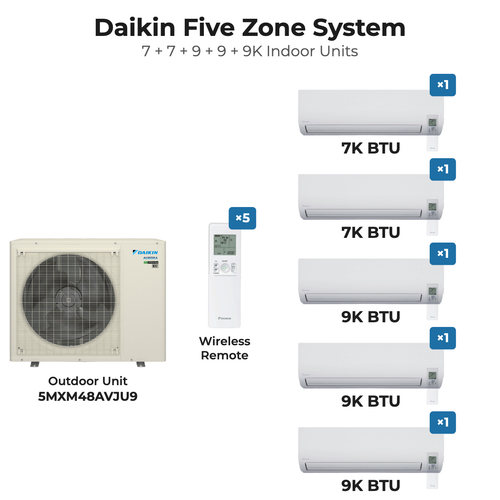
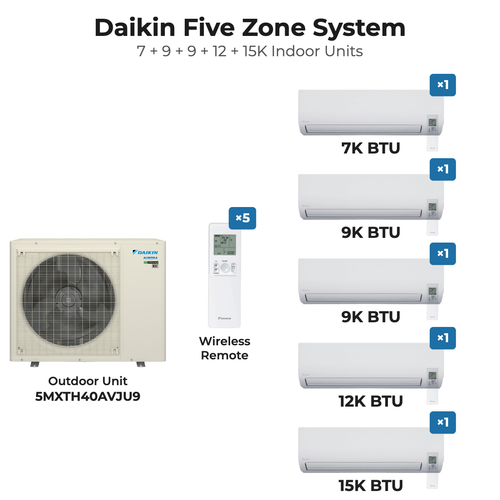
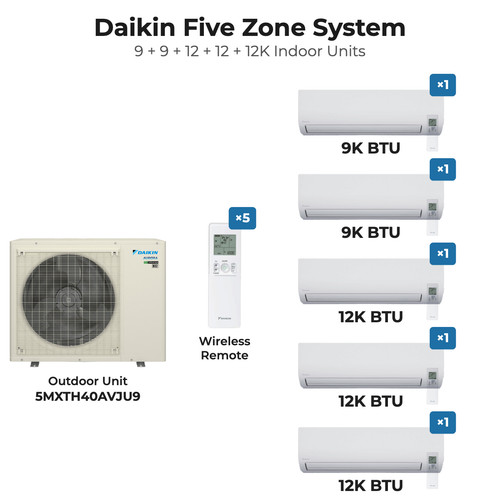
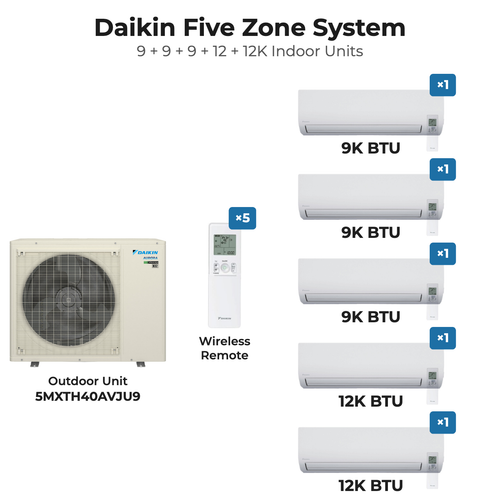
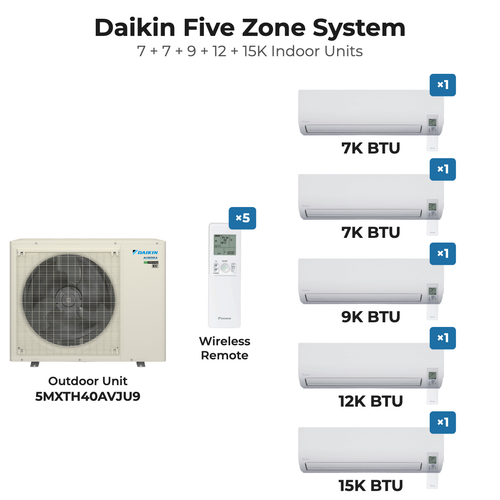
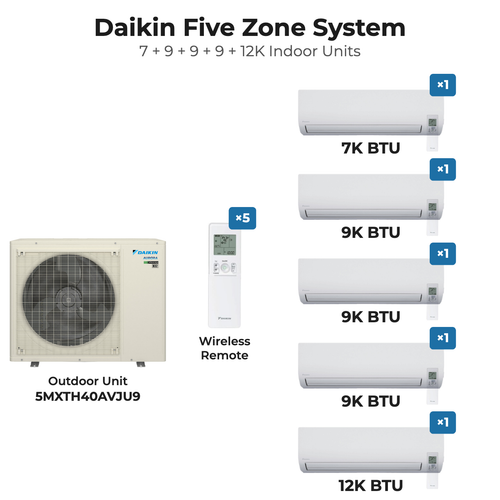
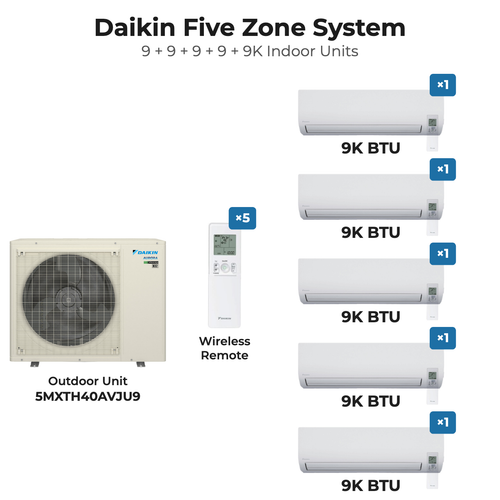
- Multi-zone systems: MXM and MXTH series outdoor units that run two or three indoor heads, such as 9K + 9K and 7K + 9K dual-zone pairings and 9K + 9K + 9K tri-zone setups. Browse sizes in mini splits by room size.
- Ceiling cassettes: decorative grille panels such as the BYFQ60C2W1W for FXZQ-TA and FFQ ceiling cassettes.
- Packaged units: light commercial rooftop equipment and gas/electric package units, along with factory accessories for 7.5 to 12.5 ton units, including downflow and horizontal Jade economizers and power exhaust kits.
At a Glance
Daikin by the numbers
- Founded
- October 25, 1924, Osaka, Japan
- Founder
- Akira Yamada
- Original name
- Osaka Kinzoku Kogyosho
- Headquarters
- Osaka, Japan
- First packaged air conditioner
- 1951
- First VRV system
- 1982
- Employees
- About 98,000 (2024)
- U.S. factory
- Daikin Texas Technology Park, Waller, TX
- North American brands
- Goodman, Amana, Daikin Applied, AAF, Quietflex
Questions
Frequently asked questions about Daikin
Who owns Daikin?
Daikin Industries, Ltd. is a Japanese company headquartered in Osaka. In North America it operates through affiliates that include Daikin Comfort, Daikin Applied, Goodman, Amana and AAF.
When was Daikin founded?
Akira Yamada founded the company in Osaka on October 25, 1924, as Osaka Kinzoku Kogyosho, a maker of aircraft radiator tubes. It took the Daikin name in 1963.
Is Daikin the same company as Goodman?
Daikin agreed to acquire Goodman Global in 2012 for $3.7 billion, so Goodman is part of the Daikin family. Goodman remains its own value-focused brand, built at the Daikin Texas Technology Park in Waller, Texas.
What is the difference between Daikin Entra, Oterra and Aurora?
Entra is the entry-level single-zone heat pump, rated up to 18 SEER2. Oterra is the mid-range line, rated up to 21 SEER2. Aurora is the cold-climate line, holding full heating capacity at 5°F and operating down to -13°F, and it is offered in single-zone and multi-zone versions.
What refrigerant do Daikin mini splits use?
Current Daikin ductless lines such as Atmosphera and Entra use R-32, a lower global warming potential A2L refrigerant. Daikin launched its first R-32 residential air conditioners in Japan in 2012.
What is Daikin VRV?
VRV, short for Variable Refrigerant Volume, is a system Daikin introduced in Japan in 1982. One outdoor unit varies the refrigerant it sends to multiple indoor units, so each zone is conditioned independently.