The Brand Story
Goodman: Built in Houston, by a Contractor Who Knew What Failed
Before Goodman built a single air conditioner, Harold V. Goodman spent years installing them. His Houston contracting company, American Airco, grew into one of the largest residential installers in the country, putting in roughly 15,000 systems a year in one of the most punishing cooling climates in America. He saw firsthand which equipment held up in the Gulf Coast heat, which parts failed, and what a callback cost a contractor. That experience became the blueprint for a manufacturer.
Chapter 1 · 1975
It started with ductwork
Goodman's first factory didn't make air conditioners at all. In 1975 Harold Goodman began manufacturing affordable flexible air duct and plastic blade registers, the unglamorous parts every installation needs. Flexible duct is still part of the family today: Quietflex, a Houston duct manufacturer, is listed among Goodman's own facilities.
Chapter 2 · 1982
A manufacturer walks away, and Goodman walks in
In 1982 an established air conditioning manufacturer decided to exit the business. Goodman bought the Janitrol line, moved the equipment to Houston, and began building central air conditioners and heat pumps under his own name. Goodman Manufacturing Company was born with an idea that was unusual for the time: build for the dealer, price for the homeowner.
His stated goal was to "revolutionize the heating and air conditioning industry."
Instead of fancy offices and national advertising, the money went into manufacturing lines and dealer support. The approach worked. By 2000, colleagues pointed out that Goodman had gone nearly two decades without a price increase.
Chapter 3 · 1986 to 2001
Furnaces, packaged units and a household name
Goodman introduced its first gas furnaces and Goodman-designed residential packaged units in 1986. In 1990 it began offering a 5-year limited warranty on all parts, a bold promise from a value brand. Manufacturing expanded beyond Texas in 1994, and a dedicated gas/electric packaged unit plant opened in Houston in 1995.
Harold Goodman died in 1996. A year later the company he built acquired Amana, the appliance and HVAC maker, from Raytheon. Goodman kept the Amana heating and cooling brand and sold the appliance business to Maytag in 2001. By the turn of the century Goodman ran seven factories with more than 4 million square feet of manufacturing space and was one of the largest privately held companies in America.
Chapter 4 · 2001 to 2012
Engineering the details
The next decade was about solving the failures contractors saw in the field. Goodman introduced an aluminized steel tubular heat exchanger in 2001. In 2007 it extended a 10-year limited parts warranty to all residential products. In 2009 came ComfortNet communicating controls, SmartCoil condenser coils and all-aluminum evaporator coils, a single-metal design aimed at one of the leading causes of premature coil leaks. The SmartFrame air handler followed in 2012, and by 2016 Goodman had built its one millionth.
Ownership changed along the way. Apollo Management bought the company in 2004 for about $1.43 billion, Goodman went public on the New York Stock Exchange in 2006, and Hellman & Friedman took it private again in a $1.8 billion deal. In August 2012 Japan's Daikin Industries, the world's largest air conditioning manufacturer, acquired Goodman for $3.7 billion.
Chapter 5 · 2015 to today
Everything under one roof
In 2015 Daikin broke ground on a $417 million campus in Waller, Texas, just northwest of Houston. The first Goodman air conditioners and gas furnaces rolled off its lines in October 2016. The Daikin Texas Technology Park now covers about 4.2 million square feet under a single roof, one of the largest factories in the United States, bringing manufacturing, engineering, testing, logistics and customer support together in one place. Goodman, Amana and Daikin residential equipment is built there, and the company operates today as Daikin Comfort Technologies North America.
The Lineup
What Goodman builds today
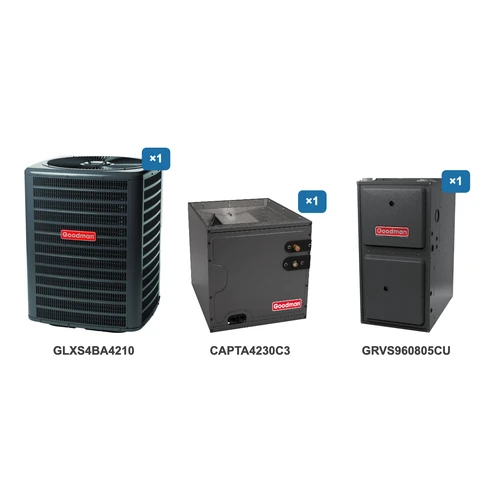
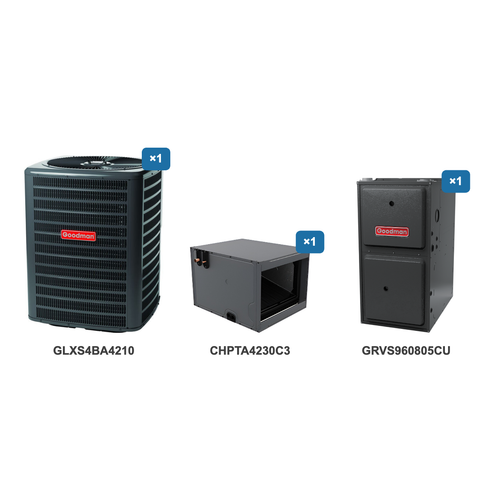
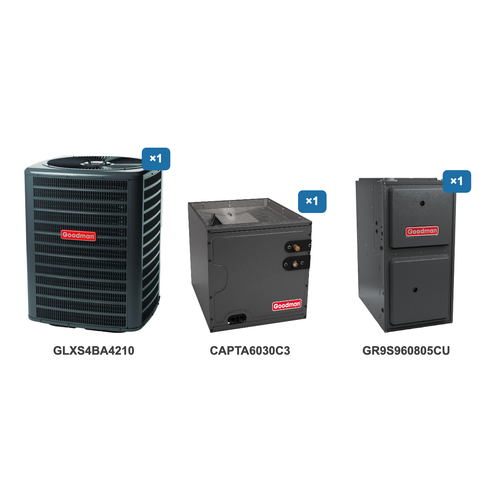
Goodman builds complete ducted heating and cooling systems for homes and light commercial buildings, nearly all of it now on R-32 refrigerant. Here is how the line breaks down:
- Air conditioners: the GLXS single-stage condensers at 14.3 SEER2, the higher-efficiency GLXT series, and the GXV side-discharge inverter condenser for tight spaces.
- Heat pumps: the GLZS and GLZT series and the GZV side-discharge inverter heat pump, the workhorses of warm-climate homes like those in Florida and Texas.
- Gas furnaces: 92% and 96% AFUE single-stage GR9S and GD9S furnaces, GRVT and GDVT two-stage furnaces with variable-speed blowers, and 97% AFUE GRVM and GDVM models, in upflow, horizontal and downflow configurations.
- Air handlers and blowers: AMST multi-position and AMVT variable-speed air handlers, AHVE units built for side-discharge systems, AWST front-return wall units, ACST ceiling-mount air handlers, and MBVB and MBVK modular blowers with communicating controls.
- Evaporator coils: CAPTA and CAPFA cased coils, CAUTA uncased coils, CHPTA horizontal coils and CSCT slab coils, sized to match Goodman condensers and furnaces.
- Packaged units: GPGM gas/electric units, GPUM low-NOx gas/electric units for California air districts, GPCM and GPCH packaged air conditioners, and GPHM and GPHH packaged heat pumps.
- Matched systems: gas furnace and AC split systems, heat pump systems and hybrid dual fuel systems, each built from an AHRI-rated combination of Goodman components.
- Installation accessories: propane conversion kits, high-altitude kits, concentric vent kits, downflow subbases and hurricane clip kits.
The Next Chapter
The R-32 era
When federal rules began phasing down R-410A, Daikin chose R-32 for its new residential equipment, and Goodman followed. R-32 is a single-component refrigerant with roughly a third of the global warming potential of R-410A, and it carries an A2L (mildly flammable) safety class, so contractors install it with A2L-rated tools and Goodman's updated procedures. Because R-32 and R-410A equipment can't be mixed, matched Goodman systems are the cleanest way to replace an older setup.
The Promise
The warranty that began in 1990
Warranties have been part of the Goodman story since the 5-year parts promise of 1990. Today, equipment registered online within 60 days of installation carries a 10-year parts limited warranty, a 10-year unit replacement limited warranty on select models, a lifetime heat exchanger limited warranty on gas furnaces, and a lifetime compressor limited warranty on select higher-efficiency air conditioners and heat pumps. Unregistered equipment carries 5 years on parts. Homeowners in California, Florida, Georgia and Quebec get registered-owner coverage without registering. Installation by a licensed HVAC contractor is required, and each model's warranty certificate sets the final terms.
At a Glance
Goodman by the numbers
- Roots
- 1975, Houston, Texas
- First Goodman air conditioners
- 1982
- Founder
- Harold V. Goodman
- Parent company
- Daikin Industries, since 2012
- Acquisition price
- $3.7 billion
- Factory
- Daikin Texas Technology Park, Waller, TX
- Factory size
- About 4.2 million sq ft
- Sister brands
- Amana, Daikin, Janitrol, Quietflex
- Refrigerant
- R-32
Questions
Frequently asked questions about Goodman
Who owns Goodman?
Goodman has been owned by Daikin Industries of Japan since August 2012, when Daikin acquired Goodman Global for $3.7 billion. It operates as part of Daikin Comfort Technologies North America.
Where are Goodman air conditioners made?
Goodman equipment is built at the Daikin Texas Technology Park in Waller, Texas, near Houston, a single-roof campus of about 4.2 million square feet.
When was Goodman founded?
Harold V. Goodman started manufacturing flexible duct and registers in Houston in 1975, and Goodman began building its own central air conditioners and heat pumps in 1982.
What is the difference between Goodman and Amana?
Both are built by the same company in the same Texas factory. Goodman is the value-focused line, while Amana is positioned as the premium brand with stronger unit replacement coverage.
What refrigerant do new Goodman systems use?
Current Goodman residential air conditioners and heat pumps use R-32, a lower-GWP A2L refrigerant that replaces R-410A.
How long is the Goodman warranty?
Registered within 60 days, Goodman residential equipment carries a 10-year parts limited warranty, with unit replacement coverage on select models, a lifetime heat exchanger warranty on gas furnaces and a lifetime compressor warranty on select higher-efficiency condensers. Unregistered equipment carries 5 years on parts.