The Brand Story
Whynter: A California Answer to the Room the Central Air Forgot
Every house has one. The converted garage, the back bedroom over the porch, the home office at the far end of the ductwork where the vents barely breathe. For a lot of people, the fix is not a new system but a machine on wheels that can be rolled in, vented through a window and plugged into the wall. In 2006, a small appliance company in Brea, California, set out to make that machine, and a handful of related ones, a little better than the ones already on the shelf.
Chapter 1 · 2006
A Southern California appliance maker
Whynter was established in 2006 and is based in Brea, in northern Orange County. From the beginning it has worked in the space between the big home appliance names and the bargain aisle, building compact appliances meant to solve specific problems: portable air conditioners and dehumidifiers, ice makers, wine and beverage refrigerators, freezers, and portable fridge-freezers that run on AC or DC power. The company describes its products as built around three ideas, portability, innovation and reliability, and frames performance by whether it actually improves daily life.
Chapter 2 · The engineering
Why two hoses matter
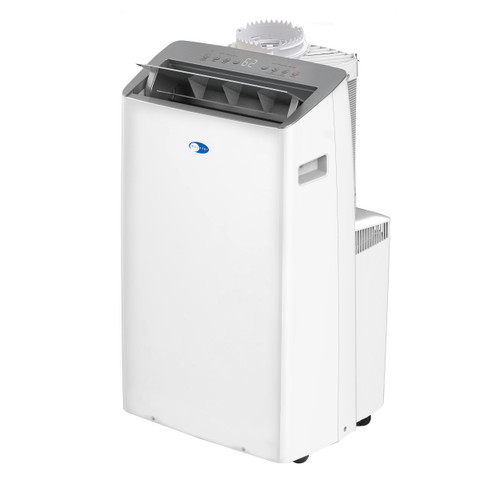
Every portable air conditioner has to send its heat outside. A single-hose unit does it by pulling air from the room it is cooling, running that air across its hot condenser coil and blowing it out the window. The catch is that the air it throws away has to be replaced, so warm outdoor air leaks back in under doors and around windows. A dual-hose unit like the Whynter models HVAC365 carries uses one hose to draw outside air in for the condenser and a second hose to send it back out, so the cooled room air stays in the room. In hot, humid places like South Florida, that difference shows up in how fast the room actually comes down to temperature.
Chapter 3 · Reading the label
Two BTU numbers, one machine
Portable air conditioner boxes often show two capacity numbers. The larger figure is the traditional rating. The smaller one, labeled SACC for seasonally adjusted cooling capacity, is a newer rating meant to better reflect real-world performance once heat from the unit and its hose is accounted for. The Whynter ARC-147WFH, for example, is listed at 14,000 BTU traditional and 10,000 BTU SACC. When sizing a portable unit for a room, the SACC number is the one to compare.
The Lineup
What Whynter builds today
Whynter's catalog runs across air comfort, refrigeration, wine and beverage storage, ice makers, ice cream makers and small commercial appliances. HVAC365 carries its air comfort side:
At a Glance
Whynter at a glance
- Established
- 2006
- Headquarters
- Brea, California
- Ownership
- Whynter, LLC
- Product focus
- Portable air conditioners and compact appliances
- Other categories
- Dehumidifiers, ice makers, wine and beverage refrigerators, freezers
Questions
Frequently asked questions about Whynter
Where is Whynter based?
Whynter, LLC is based in Brea, California, in northern Orange County. The company was established in 2006.
What is a dual-hose portable air conditioner?
A dual-hose portable air conditioner uses one hose to bring outside air in to cool its condenser and a second hose to exhaust that air back outside, so it does not pull already-cooled room air out of the space.
What does SACC mean on a Whynter portable air conditioner?
SACC stands for seasonally adjusted cooling capacity, a rating meant to reflect real-world cooling once heat from the unit and its hose is counted. It is lower than the traditional BTU figure.
Do Whynter portable air conditioners also heat?
Some do. Models such as the ARC-147WFH include a heating mode in addition to cooling and dehumidifying.
What else does Whynter make?
Besides portable air conditioners, Whynter makes dehumidifiers, ice makers, wine and beverage refrigerators, freezers, portable fridge-freezers and ice cream makers.