Commercial Air Conditioner Condensers: Split-System Condensing Units From 3 to 20 Tons
A commercial condensing unit is the outdoor half of a split-system air conditioner. It houses the compressor or compressors, the condenser coil, the condenser fans, and the controls, and it connects to an indoor air handler or evaporator coil through refrigerant piping. Split systems are used in light commercial buildings when a packaged rooftop unit is not practical: the roof cannot carry the weight, ducts and equipment must be indoors, the building has a mechanical room or mezzanine, or the condenser needs to sit on a ground pad, a wall bracket, or a separate roof area away from the conditioned space.
This guide covers how commercial condensing units are sized and rated, how to match them to air handlers, what two-stage and tandem compressors offer, what the voltage and electrical data mean, and what changes for refrigerant piping with A2L refrigerants such as R-454B.
When should I use a split-system condenser instead of a rooftop unit?
- Indoor air handling is preferred. Mechanical rooms, mezzanines, and closets keep the air handler and filters accessible and out of the weather.
- Roof structure or access is limited. Older buildings and some multi-story buildings cannot easily take a packaged unit.
- Ducts run horizontally within the building. Office floors in multi-story buildings often have air handlers on each floor with condensers on the roof or at grade.
- The space needs a specific indoor unit. Server rooms, labs, and process spaces may call for a particular air handler configuration.
- Replacement of an existing split system. Matching the existing layout is usually the most cost-effective path.
What sizes do commercial condensing units come in?
Light commercial condensing units commonly range from 3 to 20 tons, with three-phase power on most sizes and single-phase availability on many 3 to 5 ton models. Units below 65,000 Btu/h are rated in SEER2 and EER2; units at 65,000 Btu/h and above are rated as a system with a matched air handler in EER and IEER under AHRI 340/360.
| Nominal size | Common compressor setup | Typical voltages |
|---|
| 3 to 5 tons | Single scroll, single or two-stage | 208/230-1, 208/230-3, 460-3 |
| 6 to 10 tons | Single, two-stage, or tandem scroll | 208/230-3, 460-3, 575-3 |
| 12.5 to 20 tons | Tandem or dual-circuit scrolls | 208/230-3, 460-3, 575-3 |
Why must a commercial condenser be matched to an air handler?
A condensing unit does not have a performance rating on its own. Capacity and efficiency depend on the indoor coil it is paired with, the metering device, and the airflow across that coil. For units of 65,000 Btu/h and larger, the AHRI 340/360 rating is for the combined system: a specific condenser model with a specific air handler or coil. Installing an unlisted combination may still work mechanically, but the published capacity and efficiency no longer apply, which can affect code compliance, utility rebates, and warranty coverage.
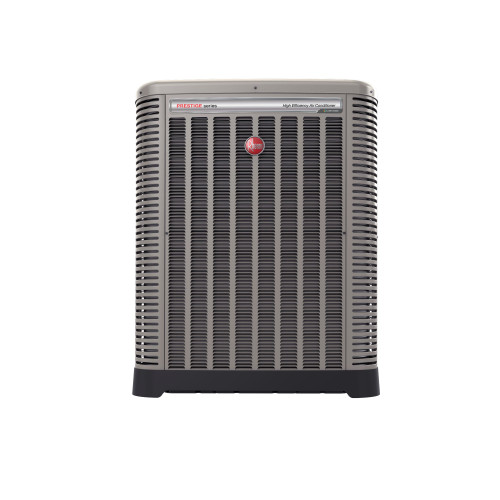
Check the AHRI Directory or the manufacturer's matched system tables before ordering. Rheem RACY condensers, for example, are listed with matched Rheem RHCYA belt-drive air handlers in specific tonnages. The air handler's coil must also be compatible with the refrigerant: an R-410A coil cannot be used with an R-454B condenser.
What are two-stage and tandem compressors?
Many larger condensing units use more than one capacity step:
- Two-stage scroll compressors run at a lower capacity, commonly around two-thirds, and at full capacity, all in one compressor.
- Tandem compressors are two scroll compressors piped together on a single refrigerant circuit. The unit can run one compressor for part load or both for full load.
- Dual-circuit units have two separate refrigerant circuits, each with its own compressor, which also provides some redundancy if one circuit fails.
- Variable-speed compressors modulate capacity across a wide range, mostly on smaller and premium units.
Staging improves part-load efficiency, which is what the IEER rating captures, and improves dehumidification by running the coil cold for longer cycles at reduced airflow. To take advantage of it, the air handler fan should also step down in speed at low stages, which is why many matched commercial air handlers come with VFD-driven blowers.
What do MCA and MOP mean on a condensing unit?
MCA (Minimum Circuit Ampacity) sets the minimum conductor size for the condenser's branch circuit, and MOP (Maximum Overcurrent Protection) is the largest fuse or HACR breaker allowed. The condenser and the air handler each have their own electrical data and are usually on separate circuits. Measure the actual supply voltage before startup, and confirm phase rotation on three-phase scroll compressors, which can be damaged by running backward.
How do A2L refrigerants change line set work?
Since January 1, 2025, new light commercial split-system air conditioners manufactured or imported must use refrigerant with a GWP below 700. Rheem's RACY condensers use R-454B, and Daikin uses R-32 in many of its products. Split R-410A systems built with components manufactured before 2025 could be installed only until January 1, 2026. For installers, the main line set considerations with A2L refrigerants are:
- Joints: Brazed joints are the standard. Mechanical connections in occupied spaces must be listed for the application under UL 60335-2-40 and the installation instructions. Flare joints indoors are generally not allowed unless the manufacturer specifies them.
- Sizing and length: Follow the manufacturer's line sizing tables for suction and liquid lines based on length and vertical rise. Long runs may require a larger liquid line, suction risers sized to return oil, and additional refrigerant charge.
- Charge limits: The total system charge and the size of the space served determine whether the system needs a refrigerant detection system and mitigation, such as starting the indoor fan on a leak signal. Matched air handlers designed for A2L include provisions for this.
- Reusing old line sets: R-454B and R-32 use POE oil like R-410A, so existing line sets can sometimes be reused if they are the correct size, pressure rated, clean, and leak free. Many manufacturers recommend flushing or replacement. Follow the condenser installation manual.
- Tools: Use recovery machines, vacuum pumps, and leak detectors rated for A2L refrigerants, and recovery cylinders marked for flammable refrigerants.
Evacuate to a deep vacuum, typically 500 microns or less with a decay test, and charge by weight per the manufacturer's data plus line length adjustments, then verify subcooling.
Where should a commercial condensing unit be located?
Give the condenser the airflow clearances listed in the installation manual so discharge air does not recirculate into the coil. Avoid placing it where it will be surrounded by walls, under overhangs, or next to exhaust that could foul the coil. Keep line set length and vertical separation within limits, and plan for service access on the compressor side. In coastal locations, consider coated coils and corrosion-resistant hardware. In hurricane zones, secure the unit to its pad or stand per local code.
What commercial condensers are offered here?
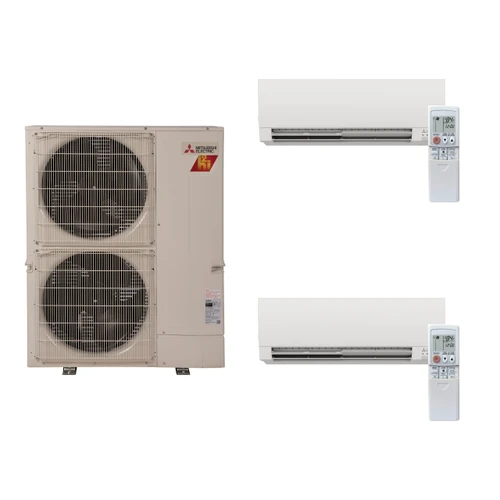
This category features Rheem RACY commercial condensing units using R-454B, designed to match RHCYA belt-drive VFD air handlers, along with other light commercial condensers from Rheem and Daikin. Product pages list nominal capacity, compressor configuration, voltage, MCA and MOP, matched air handlers, and AHRI ratings. For complete matched systems, see Commercial Air Conditioner Systems.
What maintenance does a commercial condensing unit need?
Commercial condensers run long hours and live outdoors, so routine maintenance pays off in capacity and compressor life. At each scheduled visit, clean the condenser coil from the inside out with a coil-safe cleaner, check fan blades and motor bearings, and confirm the fan cycles correctly. Inspect contactors for pitting, tighten electrical connections, and measure voltage and amperage on each leg of three-phase circuits to catch imbalance early; voltage imbalance of more than about 2 percent can cause significant extra heating in three-phase motors. Record suction and liquid line pressures, superheat, and subcooling and compare them with previous readings to spot slow leaks or airflow problems. On units with crankcase heaters, verify they are working, since they protect compressors from liquid refrigerant migration during off cycles. Coastal installations benefit from more frequent fresh-water rinsing of the coil. On A2L systems, use leak detection equipment rated for A2L refrigerants when checking for leaks.
Commercial Condenser FAQ
Can I pair a new R-454B condenser with my existing air handler?
Only if the air handler's coil is approved for R-454B and the combination is listed by the manufacturer. In most replacements, an R-410A coil must be replaced to match the new condenser and keep the AHRI rating valid.
What is a tandem compressor condenser?
It is a condensing unit with two compressors connected in parallel on a single refrigerant circuit. Running one compressor gives part-load capacity; running both gives full capacity.
How far can a commercial condenser be from the air handler?
Each manufacturer publishes maximum line length and vertical separation. Long runs require careful sizing for oil return and may require additional charge or accessories.
Are commercial condensers rated in SEER2?
Condensers in systems below 65,000 Btu/h are rated in SEER2. Systems of 65,000 Btu/h and larger are rated in EER and IEER as matched systems.
Do commercial condensers need a low ambient kit?
Only if the space needs cooling when outdoor temperatures are low, such as server rooms or interior zones in winter. Low ambient kits control head pressure so the system can operate safely in cold weather.