null
Electric Cooling Rooftop Units

Electric Cooling Rooftop Units

Electric Cooling Rooftop Units: Cooling-Only RTUs With Optional Electric Heat

An electric cooling rooftop unit, often called a cooling-only RTU or a straight-cool packaged unit, is a packaged air conditioner with no gas furnace and no heat pump reversing valve. It cools and dehumidifies with a single refrigerant system, and it can be fitted with an electric resistance heat kit when the space needs some heating. These units are the workhorse for hot-climate commercial buildings, for spaces where heat comes from another source such as a boiler or unit heaters, and for zones with high internal heat gain that rarely call for heating at all.

This guide covers where cooling-only RTUs make sense, how electric heat kits are sized and staged, how compressor staging and VFD-driven blowers improve comfort and efficiency, and what to look for on the spec sheet before you order.

When does a cooling-only rooftop unit make sense?

  • Hot climates with short heating seasons. In South Florida, the Gulf Coast, Arizona, and southern Texas, heating needs are small and infrequent. A cooling-only unit with a modest electric heat kit covers the occasional cold morning.
  • Buildings with a separate heating plant. Some facilities heat with a hydronic boiler system, perimeter baseboard, or gas-fired unit heaters and use RTUs only for cooling and ventilation.
  • High internal load spaces. Kitchens, data and telecom rooms, manufacturing areas, and densely occupied interior zones often need cooling year-round.
  • No gas service on the roof. If extending gas is expensive and heating loads are small, electric heat avoids that cost.

Where heating is a meaningful part of the year, compare a heat pump RTU before defaulting to cooling-only with large electric strips. Electric resistance heat has a COP of 1.0, while a heat pump typically delivers two to three times that much heat per kilowatt in moderate weather.

How are electric heat kits sized for a rooftop unit?

Electric heat kits for packaged units are factory or field-installed resistance elements in the supply air path. They are sold in kilowatt ratings, commonly from about 5 kW on small units to 50 kW or more on large cabinets, and each kilowatt produces about 3,412 Btu/h. A 15 kW kit, for example, provides roughly 51,200 Btu/h of heat.

Start with the building heat loss at the winter design temperature, including the outdoor ventilation air that the RTU must heat. Then select the smallest kit that covers that load. Oversizing electric heat raises demand charges and installation cost without improving comfort. Keep these electrical points in mind:

  • Heat kits significantly increase the unit's MCA (Minimum Circuit Ampacity) and MOP (Maximum Overcurrent Protection). A cooling-only 10-ton unit and the same unit with a 30 kW heater can need very different wire and breaker sizes.
  • Kit voltage must match the unit voltage: 208/230V three-phase, 460V, or 575V.
  • Heater output drops when a 240V-rated element runs on 208V. Resistance heat output varies with the square of voltage, so a 240V-rated kit on 208V delivers roughly 75 percent of its rated kW. Use the manufacturer's 208V rating when sizing.
  • Some kits include single-point power wiring so the unit and heater share one supply circuit; others require a separate circuit.

How is electric heat staged on a packaged unit?

Larger heat kits are divided into stages, often one or two, controlled by the thermostat or building automation system. Staging lets the unit bring on part of the heat for mild conditions and the full kit for cold mornings, limiting peak electrical demand. Each stage is protected by automatic-reset and one-time (manual reset or fusible link) limits. The supply blower must run whenever the heat is on, and airflow must be at or above the minimum listed for the kit size.

What is compressor staging, and why does it matter?

Small RTUs typically have a single compressor running at full capacity or off. Units around 6 tons and up commonly use two compressors (tandem or on separate circuits), a two-stage compressor, or a variable-speed compressor. Staging allows the unit to run at a reduced capacity, for example about 50 percent, when the load is light, which is most of the operating hours for commercial buildings.

Benefits of staged and variable capacity cooling include:

  • Better humidity control. Longer run times at lower capacity keep the evaporator coil cold long enough to pull moisture out of the air.
  • Higher part-load efficiency. This shows up directly in the IEER rating, which weights 75, 50, and 25 percent load heavily.
  • Fewer starts. Reduced cycling lowers wear on compressors and contactors.
  • More stable space temperatures. Smaller swings around setpoint mean fewer comfort complaints.

What are the benefits of a VFD supply blower?

A variable frequency drive (VFD) on the supply fan motor lets the unit run the blower at different speeds rather than full speed all the time. On staged RTUs, the common approach is single-zone variable air volume (SZVAV): the fan slows down at low cooling stages and during ventilation-only operation, then speeds up for full cooling. Because fan power falls sharply with speed, running at lower airflow during part load can cut fan energy considerably. Energy codes based on ASHRAE 90.1 generally require multi-speed or variable fan control on DX cooling units of 65,000 Btu/h and larger.

VFDs also make commissioning easier. Instead of changing pulleys to hit design airflow, the technician sets the drive frequency. Some units use electronically commutated (EC) direct-drive motors instead of belt-drive with VFD; both approaches allow fan speed control. Note that with electric heat, airflow during heating must stay above the kit's minimum.

How is cooling-only RTU efficiency rated?

Three-phase units below 65,000 Btu/h are rated in SEER2. Units of 65,000 Btu/h and above are rated in EER and IEER under AHRI 340/360. Since January 1, 2023, the federal minimum for air-cooled units from 65,000 to under 135,000 Btu/h with electric resistance heat or no heat is 14.8 IEER. Units with electric resistance heat or no heat have slightly higher minimums than gas/electric units in the same size class, because the federal standard gives a small allowance for the added air-side resistance of a gas heat exchanger.

Spec sheet itemWhat to check
Total and sensible capacitySensible capacity at your design conditions, especially in humid climates
EER, IEER, or SEER2Meets code and any utility rebate thresholds
Compressor stagesSingle, two-stage, tandem, or variable speed
Blower typeBelt drive with VFD, direct drive, or EC; external static available
Electrical dataVoltage, MCA, and MOP with and without heat kit
Heat kit optionsAvailable kW sizes and staging
Airflow configurationDownflow, horizontal, or convertible

What does the R-454B transition mean for cooling-only RTUs?

Since January 1, 2025, new light commercial air conditioners manufactured or imported for the U.S. market must use a refrigerant with a GWP below 700 under the EPA Technology Transitions rule. Rheem's Commercial Renaissance Line Classic cooling-only units, the RACCYB, RACDYB, and RACGYB, use R-454B, an A2L refrigerant with a GWP of about 466. Because packaged RTUs are factory charged and sealed, most installations involve no field refrigerant piping. Service work requires A2L-compatible tools, and units include refrigerant detection where required by the UL 60335-2-40 safety standard.

What cooling-only rooftop units are offered here?

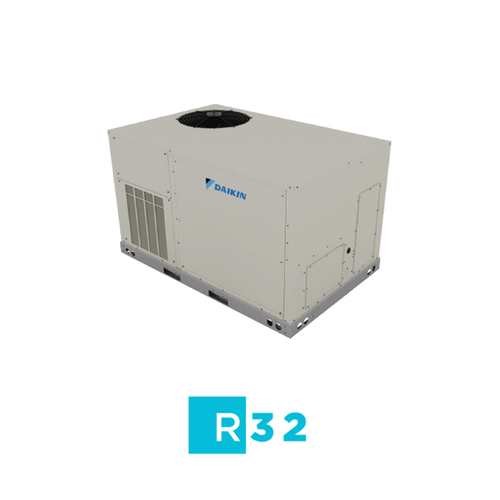
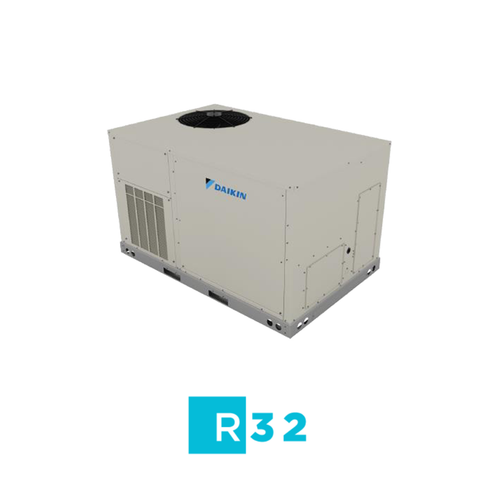
This category includes Rheem RACCYB, RACDYB, and RACGYB electric cooling packaged units and Daikin light commercial cooling-only packaged units where available. Product pages list capacity, efficiency ratings, compressor staging, blower options, and electrical data. Electric heat kits, curbs, and economizers are available under Rooftop Unit Accessories.

Can a cooling-only RTU help with humidity control?

Yes, especially with staged compressors and a variable-speed blower. Some units also offer hot gas reheat, which reheats overcooled air so the unit can dehumidify without overcooling the space. That option is useful in humid climates and in buildings with high ventilation loads.

Electric Cooling Rooftop Unit FAQ

Can I add heat to a cooling-only rooftop unit later?

In most cases, yes. Many cooling-only RTUs accept a field-installed electric heat kit. Confirm the electrical service can support the higher MCA and that the circuit and breaker are sized for the heat kit.

Is a cooling-only RTU with electric heat cheaper than a heat pump?

The equipment usually costs less up front, but electric resistance heat costs more to run. In climates with very few heating hours, the difference may be small; elsewhere, a heat pump often pays back.

What is sensible heat ratio and why does it matter?

Sensible heat ratio is the share of total cooling capacity that lowers air temperature versus removing moisture. In humid climates, a lower sensible heat ratio, aided by staging and lower airflow, improves humidity control.

Do cooling-only RTUs need an economizer?

Energy codes generally require economizers on cooling units of about 54,000 Btu/h and larger in most climate zones, with exemptions in the hottest and most humid zones such as Climate Zone 1A. Check your local code edition.

Why does my electric heat kit deliver less heat than its rating?

The most common reason is running a 240V-rated heater on 208V service, which reduces output to roughly three-quarters of nameplate. Also check that all stages are energizing and that limits are not tripping from low airflow.

Compare
Show: 12 24 48

Fast Shipping

Easy Returns

Warranty Coverage

Financing Available