3-Ton Commercial Rooftop Units: Packaged Equipment for Small-Zone Commercial Work
A 3-ton rooftop unit is nominally 36,000 Btu/h of cooling. On the listings in this category, rated capacities come in a little under nominal, from roughly 33,400 to 36,000 Btu/h depending on the series and configuration, which is normal for packaged equipment rated to AHRI conditions. This is the smallest tonnage in the Commercial Rooftop Units tree, and it is where most of the small-zone commercial work lives: single-tenant suites in strip centers, small professional offices, branch banks, server or telecom closets that need a dedicated unit, modular buildings, and the one-off zone on a larger roof that serves a conference room or a back-of-house area.
This page groups every 3-ton packaged unit we carry across gas/electric, straight cooling, and heat pump configurations, so you can compare series side by side at one capacity. If you already know the heating type and want every size in that style, the Gas/Electric Rooftop Units, Heat Pump Rooftop Units, and Air Conditioner Rooftop Units pages are organized that way instead.
Is 3 Tons the Right Size for the Space?
The honest answer is that only a load calculation tells you. Commercial loads swing far more than residential loads because occupancy, lighting, equipment, glass, and outside air vary so much from one tenant to the next. A common rule of thumb for light commercial space is somewhere in the range of 300 to 500 square feet per ton, which would put a 3-ton unit on something like 900 to 1,500 square feet, but treat that as a sanity check, not a design method. A 1,200 square foot nail salon with heavy occupancy and exhaust is a very different load than a 1,200 square foot insurance office.
A few points that come up constantly at this size:
- Replacement work: Matching the old nameplate is a starting point, not the answer. Many older 3-ton units were sized when the space had a different tenant, different lighting, or a different ventilation requirement. If the old unit short-cycled or struggled with humidity, a straight like-for-like swap carries the problem forward.
- Oversizing: On small zones, an oversized unit cycles off before it removes much moisture. In humid climates like South Florida, that shows up as a clammy space and complaints even when the thermostat is satisfied. Two-stage equipment helps here, which is one reason the Daikin DHG, DHC, and DHH series are worth a look at this size.
- Airflow: Packaged equipment is commonly designed around roughly 350 to 400 CFM per ton, so a 3-ton unit typically lands somewhere around 1,050 to 1,200 CFM. Check the unit's fan performance table against your duct system's external static pressure before you commit, especially on retrofits with undersized or restrictive return ductwork.
- Outside air: If the space needs a significant amount of ventilation air, the sensible and latent load from that air can push a borderline 3-ton job to 4 tons. Run the ventilation numbers first.
Efficiency Ratings at 36,000 Btu/h: SEER2 and EER2
Because a 3-ton unit falls below 65,000 Btu/h, it is rated with the same SEER2 and EER2 metrics used under the current DOE test procedure for small packaged equipment, including three-phase models. You will not see IEER on the rating plate for these units the way you do on 6-ton and larger equipment. SEER2 reflects seasonal performance; EER2 reflects steady-state efficiency at a hot outdoor condition, which matters more for peak demand and for some utility programs.
In this category, SEER2 ratings run from 13.4 on the entry-level Daikin DP3 and Rheem RACCYB, RGECYB, and RHPCYB listings up to 16.6 on the Daikin DHG and DHC series. EER2 ratings listed on these products run from 10 up to 13, with the Daikin DHH heat pump at the top. If a rebate or a project specification calls for a minimum EER2, check that value specifically, because two units with similar SEER2 can differ on EER2.
DOE regional standards also apply to some of this equipment, so confirm the unit is compliant for the region where it will be installed. The DOE regional compliance field on each product page shows how the listing is categorized.
Voltage and Phase Options in This Category
Three-ton is one of the few commercial sizes where single-phase power is still widely available, and that matters on small buildings and converted residential properties that never had three-phase service. Across the listings here you will find:
- 208/230V single-phase: Daikin DSG, DHG, DSC, DHC, DSH, and DHH; Rheem RACCYB; and the Comfortstar Star Pro CSV inverter heat pump.
- 208/230V three-phase: All of the Daikin D-series, Daikin DP3, Daikin DFG, and the Rheem RACCYB, RGECYB, and RHPCYB.
- 460V three-phase: Daikin DSG, DHG, DSC, DHC, DSH, DHH, and DFG; Rheem RACCYB and RGECYB.
- 575V three-phase: Daikin DSG, DHG, DSC, DHC, DSH, and DHH, for Canadian-style and some industrial electrical services.
Confirm the actual service at the disconnect before ordering. A 208V building and a 230V building are both served by a 208/230V unit, but 460V and 575V units are not interchangeable with anything else, and a voltage mistake on a rooftop unit usually means a restocking conversation, not a field fix. Size the breaker and conductors from the minimum circuit ampacity and maximum overcurrent protection on the specific model's data, which we list on each product page.
Gas Heat Input Options at 3 Tons
Gas/electric units at this size are offered with a range of heat exchanger inputs so you can match heating load and temperature rise without oversizing. Across the listed 3-ton gas/electric products, inputs include:
- Daikin DSG: 45,000, 60,000, 70,000, 80,000, 90,000, and 100,000 Btu/h
- Daikin DHG: 45,000, 60,000, 70,000, 80,000, 100,000, and 115,000 Btu/h
- Daikin DP3: 80,000 Btu/h, with an ultra low NOx version (DP3UM) and a standard version (DP3GM)
- Daikin DFG (R-410A): 45,000, 70,000, and 90,000 Btu/h
- Rheem RGECYB: 75,000 and 100,000 Btu/h
In mild climates, the smallest heat input that covers the design heating load is usually the right choice, since a large burner on a 3-ton cabinet can produce a high temperature rise at low airflow. Check the allowable temperature rise range on the spec sheet against your expected airflow. Several Daikin DSG and DHG listings are also offered as ultra low NOx models for jurisdictions that regulate NOx emissions from gas-fired equipment; confirm what your local air district requires before ordering. If you need electric heat on a cooling-only or heat pump unit, see the Commercial Electric Heat Kits page and match the kit to the exact model.
Refrigerants and A2L Handling
Most current-production units on this page use A2L refrigerants: R-32 on the Daikin and Comfortstar models, and R-454B on the Rheem models. A2L refrigerants are classified as mildly flammable, and the installation and service requirements reflect that. Technicians should be trained on A2L practices, use recovery machines, vacuum pumps, and leak detectors rated for A2L use, and follow the manufacturer's installation instructions and the code adopted in your jurisdiction for charge limits, ventilation, and any refrigerant detection requirements. Some units ship with a factory refrigerant detection sensor; check the installation manual for the specific model.
The Daikin DFG listings are R-410A equipment. They remain useful for replacements where the owner wants to stay on R-410A, but availability of R-410A equipment is limited and you should confirm current stock before quoting.
Cabinet, Curb, and Replacement Notes
Three-ton packaged units are typically built on a small cabinet shared with neighboring tonnages, and many are convertible between downflow (vertical) and horizontal discharge. On rooftop replacements, the curb is often the hardest part of the job. Before ordering:
- Measure the existing curb footprint, height, and supply and return opening locations, and compare them to the new unit's curb drawing.
- If the footprint does not match, plan for a curb adapter. Adapters are model-specific, and ordering one early avoids a crane day with nothing to set.
- Confirm gas connection location, electrical entry, and condensate drain location relative to the existing rooftop runs.
- Verify roof structure for the new unit weight; the shipping and unit weights are listed on each product page.
Curbs, adapters, economizers, and other add-ons are on the Rooftop Unit Accessories page.
Economizers and Ventilation at This Size
Energy codes such as ASHRAE 90.1 and the IECC tie economizer requirements to climate zone and cooling capacity. A 3-ton unit falls below the economizer threshold in many code editions and climate zones, but that is not universal, and local amendments vary. If the project needs a measured amount of outside air for ventilation, an economizer or a motorized outdoor air damper is often the cleanest way to deliver it regardless of whether the code mandates economizer operation. Check the adopted code and the mechanical drawings, and order factory-compatible accessories for the specific series.
3-Ton Rooftop Units in This Category
| Brand | Series | Type | Voltages Listed | Efficiency (as listed) | Refrigerant |
|---|
| Daikin | DSG | Gas/Electric, single-stage | 208/230V-1, 208/230V-3, 460V-3, 575V-3 | 14 SEER2 / 12 EER2 | R-32 |
| Daikin | DHG | Gas/Electric, two-stage | 208/230V-1, 208/230V-3, 460V-3, 575V-3 | 16.6 SEER2 / 12 EER2 | R-32 |
| Daikin | DSC | Air Conditioner, single-stage | 208/230V-1, 208/230V-3, 460V-3, 575V-3 | 14 SEER2 / 12 EER2 | R-32 |
| Daikin | DHC | Air Conditioner, two-stage | 208/230V-1, 208/230V-3, 460V-3, 575V-3 | 16.6 SEER2 / 12 EER2 | R-32 |
| Daikin | DSH | Heat Pump, single-stage | 208/230V-1, 208/230V-3, 460V-3, 575V-3 | 14 SEER2 / 12 EER2 | R-32 |
| Daikin | DHH | Heat Pump, two-stage | 208/230V-1, 208/230V-3, 460V-3, 575V-3 | 16.4 SEER2 / 13 EER2 | R-32 |
| Daikin | DP3 (DP3GM, DP3UM, DP3HM) | Gas/Electric and Heat Pump | 208/230V-3 | 13.4 SEER2 / 10 EER2 | R-32 |
| Daikin | DFG | Gas/Electric, multi-position | 208/230V-3, 460V-3 | 13.4 SEER2 / 11 EER2 (confirm on spec sheet) | R-410A |
| Rheem | RACCYB | Air Conditioner | 208/230V-1, 208/230V-3, 460V-3 | 13.4 SEER2 / 10 EER2 | R-454B |
| Rheem | RGECYB | Gas/Electric | 208/230V-3, 460V-3 | 13.4 SEER2 / 10 EER2 | R-454B |
| Rheem | RHPCYB | Heat Pump | 208/230V-3 | 13.4 SEER2 / 10 EER2 | R-454B |
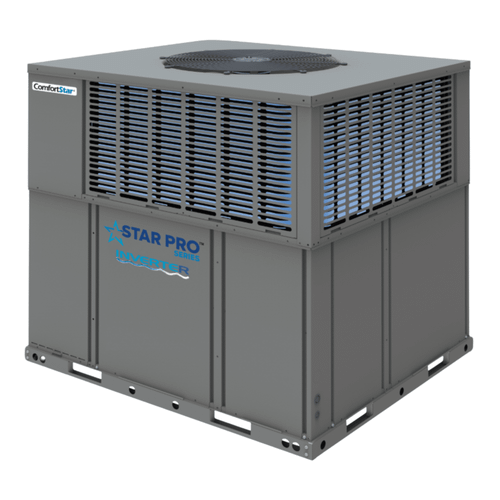
| Comfortstar | Star Pro CSV | Inverter Heat Pump | 208/230V-1 | 13.8 SEER2 / 8.2 EER2 | R-32 |
Ratings shown are taken from the product listings in this category. Always confirm the final rating for a specific model number on the manufacturer's spec sheet or AHRI certificate, particularly when a rebate or specification depends on it.
How to Narrow It Down
Start with the power available at the roof, then the heating source, then the efficiency level the project or the owner's operating budget justifies. For a budget replacement on three-phase power, the Daikin DP3 and Rheem CYB series are the straightforward options. Where humidity control or a utility incentive tied to higher efficiency matters, the two-stage Daikin DHG, DHC, and DHH are the ones to price. For a small building with only single-phase service, the Daikin D-series single-phase models, the Rheem RACCYB single-phase models, and the Comfortstar Star Pro CSV are your candidates. If the load calculation lands between sizes, compare this page with 4 Ton Rooftop Units before deciding.
Ordering and Lead Time Tips
- Send us the full model number, not just the tonnage. Voltage, heat input, and NOx options are all coded into the model number, and they change what ships.
- Order curbs, curb adapters, economizers, and thermostats or controls at the same time as the unit so everything arrives together.
- Rooftop units ship by freight. Plan for a receiving location with a dock or a liftgate delivery, and inspect for freight damage before signing.
- Lead times vary by series, voltage, and season. Less common voltages such as 575V can take longer, so confirm availability before you commit to a set date.
Frequently Asked Questions
Can I put a 3-ton rooftop unit on single-phase power?
Yes. Several series in this category are offered in 208/230V single-phase, including the Daikin DSG, DHG, DSC, DHC, DSH, and DHH, the Rheem RACCYB, and the Comfortstar Star Pro CSV. Check the specific model number, since not every configuration is offered in single-phase.
Why is the rated capacity below 36,000 Btu/h?
Nominal tonnage is a size class. Rated capacity comes from testing at AHRI conditions and varies by series and configuration, so listings here run roughly 33,400 to 36,000 Btu/h. Use the rated capacity and the manufacturer's expanded performance data, not the nominal tonnage, when you check it against the load calculation.
Is a 3-ton commercial rooftop unit rated in SEER2 or IEER?
SEER2 and EER2. Packaged units under 65,000 Btu/h are rated with SEER2 and EER2, including three-phase models. IEER applies to larger commercial equipment, starting with the 6-ton units in this tree.
Do I need an economizer on a 3-ton unit?
It depends on the energy code adopted in your jurisdiction, the climate zone, and how the system is configured. Many code editions do not require one at this size, but some do, and ventilation requirements may call for outdoor air regardless. Check the mechanical drawings and local code.
What is the difference between the Daikin DS and DH series?
On these listings, the DS series (DSG, DSC, DSH) uses single-stage compression, while the DH series (DHG, DHC, DHH) uses two-stage compression and carries higher SEER2 ratings. Two-stage operation generally improves part-load comfort and dehumidification.
Will a new 3-ton unit fit my existing roof curb?
Only if the footprint and openings match. Compare the existing curb dimensions to the new unit's curb drawing. If they differ, a model-specific curb adapter is usually the solution, available through our Rooftop Unit Accessories page.