The Brand Story
Copeland: A Century Spent on the Heart of the Cold Chain
In 1921, in a Detroit still learning what electricity could do inside a kitchen or a corner store, an inventor named Edmund Copeland started a company to change how refrigeration worked. His name ended up on something most people never see: the compressor humming behind a walk-in cooler, a supermarket display case or a rooftop air conditioner. A hundred years later, that name is still stamped on the machines that keep food cold, medicine safe and buildings comfortable.
Chapter 1 · 1921
An inventor in Detroit
Edmund Copeland founded his company in Detroit, Michigan, in 1921 to put his own refrigeration inventions to work. Mechanical refrigeration was young, and the industry was full of small firms trying to turn a laboratory idea into something a butcher, a grocer or a homeowner could rely on every day. Copeland's bet was on the machinery itself: the compressor that moves refrigerant and makes the whole cycle possible.
Chapter 2 · 1937
Hard times, and a new home in Sidney, Ohio
The Great Depression nearly ended the story. The company's assets were sold, and in 1937 its operations were moved to Sidney, a small manufacturing town in western Ohio. Four young engineers bought the business along with its compressor patent and kept it alive.
Sidney became the brand's center of gravity. Generations of Copeland compressors were designed and tested there, and the town is still home to the company's engineering work today. It is a reminder that some of the most important equipment in American commerce was shaped far from the big cities that depend on it.
Chapter 3 · 1986 to 1987
Emerson and the scroll
In 1986 Emerson acquired Copeland. The new owner invested heavily in a scroll compressor Copeland engineers had been developing, and in 1987 the first scroll compressor sold under the Copeland name reached the market.
A scroll compressor squeezes refrigerant between two interlocking spirals, one fixed and one orbiting, instead of driving pistons back and forth. Fewer moving parts and smoother operation made it a natural fit for equipment expected to run for years. That first design grew into a whole family of scrolls for home and light commercial air conditioning, food and healthcare refrigeration, and refrigerated marine containers. Copeland kept building semi-hermetic and hermetic reciprocating compressors alongside it for the jobs where those designs still make sense.
Chapter 4 · 2021
One hundred years
Copeland marked its 100th anniversary in 2021. Rather than a monument, the milestone came with a building: a multimillion-dollar expansion of the engineering center in Sidney that added 110,000 square feet of laboratory space. The work being done there reflects where the industry is heading, toward lower-impact refrigerants, variable-speed compressors and electronic controls that watch over equipment around the clock.
Chapter 5 · 2023 to today
Copeland stands on its own again
For decades the business was known as Emerson Climate Technologies. On May 31, 2023, Blackstone completed its purchase of a majority stake in the business at a valuation of $14.0 billion, taking a 60% controlling interest while Emerson kept 40%. The company took back the name its founder gave it more than a century earlier: Copeland.
Headquartered in St. Louis, Missouri, and led by chief executive Ross B. Shuster at the time of the deal, the company reported fiscal 2022 sales of about $5.0 billion and more than 18,000 employees. Its work now reaches well beyond compressors to controls, thermostats, valves, monitoring and software for homes, businesses and industry.
The Lineup
What Copeland builds today
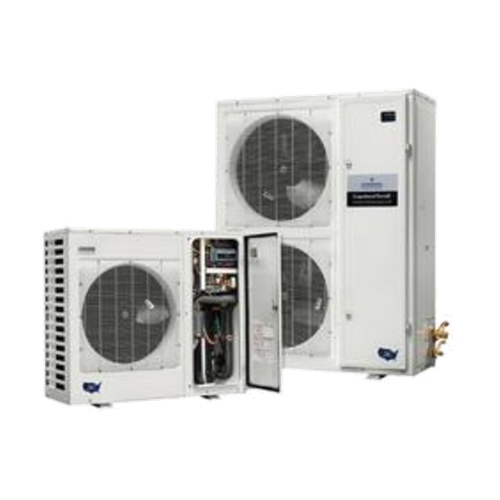
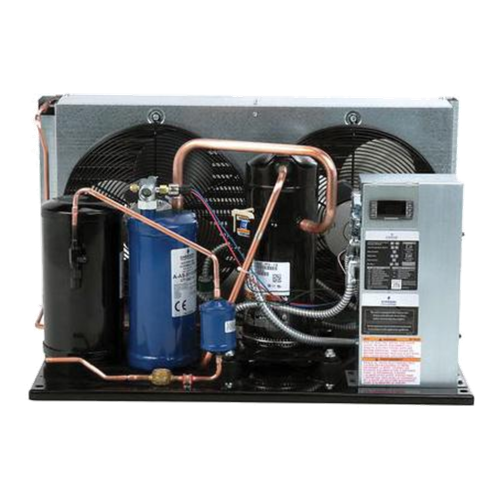
Copeland builds compressors for air conditioning, heat pumps and refrigeration, along with the condensing units, electronics and controls that surround them. HVAC365 carries Copeland air-cooled refrigeration condensing units, the outdoor half of a walk-in cooler, walk-in freezer or display case system:
- Medium temperature units: sized for walk-in coolers, prep rooms and refrigerated cases that hold product just above freezing.
- Low temperature units: built for walk-in freezers and frozen-food cases, including semi-hermetic models rated for R-404A and R-507.
- X-Line outdoor scroll units: weather-ready scroll condensing units for low, medium and multi-temperature duty, designed to sit outside on a pad or rooftop.
- XY-Series outdoor units: larger outdoor condensing units, from about 2.4 HP for low temperature work up to 5 HP and beyond for medium temperature loads.
- F-Line scroll units: compact scroll condensing units for medium and multi-temperature applications, in single-phase and three-phase versions.
- M-Line hermetic units: small fractional-horsepower units, including 115V models, for reach-ins, small coolers and light-duty boxes.
- High temperature units: air-cooled units for applications like cooling rooms and process work, including models originally rated for R-22 for service and replacement.
- Refrigeration parts and accessories that support these systems, with the full range collected under refrigeration condensing units.
In the Field
Matching a unit to the job
A condensing unit is chosen by three numbers: the box temperature, the refrigeration load and the refrigerant. Medium temperature and low temperature units are not interchangeable, because the compressor is engineered for a specific range of suction pressures. Many current Copeland units are listed as multi-refrigerant, meaning the nameplate approves more than one refrigerant, which gives a contractor flexibility as the industry moves away from older, higher-impact refrigerants. Always size the unit to the matching evaporator and confirm the approved refrigerant on the nameplate before charging the system.
At a Glance
Copeland at a glance
- Founded
- 1921, Detroit, Michigan
- Founder
- Edmund Copeland
- Engineering home
- Sidney, Ohio, since 1937
- Headquarters
- St. Louis, Missouri
- First Copeland scroll
- 1987
- Owned by Emerson
- 1986 to 2023
- Majority owner
- Blackstone, 60% since 2023
- Employees
- More than 18,000
Questions
Frequently asked questions about Copeland
Who owns Copeland?
Blackstone has held a 60% controlling stake in Copeland since May 31, 2023, and Emerson retains a 40% stake. The deal valued the business at $14.0 billion.
Is Copeland the same company as Emerson Climate Technologies?
Yes. Copeland was the name of Emerson Climate Technologies before the 2023 Blackstone transaction, when the business returned to its founding name.
When and where was Copeland founded?
Edmund Copeland founded the company in Detroit, Michigan, in 1921. Its operations moved to Sidney, Ohio, in 1937, and Sidney remains the home of its engineering work.
When did Copeland introduce the scroll compressor?
The first scroll compressor sold under the Copeland name was introduced in 1987, a year after Emerson acquired the company.
What is the difference between medium temp and low temp condensing units?
Medium temperature units are built for coolers and refrigerated cases held above freezing, while low temperature units are built for freezers. Their compressors are designed for different operating pressures, so the two are not interchangeable.
What refrigerants do Copeland condensing units use?
It depends on the model. Many current units are approved for multiple refrigerants, while older models are rated for refrigerants such as R-404A, R-507 or R-22, so always check the unit nameplate.