The Brand Story
Kramer: More Than a Century of Keeping the Cold Room Cold
Every walk-in cooler has a moment of truth. It usually comes late, after the kitchen has closed and the door has been opened a few hundred times since morning. The room is full of product someone paid for, the compressor outside is working against a Florida night that refuses to cool off, and the coil on the ceiling has to pull the box back down to temperature before dawn. Nobody notices refrigeration when it works. Kramer has been building the machines for that unnoticed job for more than a hundred years.
Chapter 1 · 1914
Roots older than the home refrigerator
Kramer traces its roots to 1914. That date puts the brand in the era when mechanical refrigeration was still an industrial tool, a long way from the kitchen appliance most people know today. Butchers, dairies, breweries and grocers were the first customers for machines that could make cold on demand, and commercial refrigeration grew up serving them.
The company records we could verify say little about the earliest decades, and we would rather leave that gap open than fill it with guesses. What the record does show is a brand that has stayed in the same lane the entire time: large, working refrigeration systems for people who store food and other temperature-sensitive goods for a living.
Chapter 2 · Scottsboro, Alabama
A family of cold-room brands
Today Kramer is one of four brands made by Heat Transfer Products Group, better known as HTPG. Its siblings are Russell, a name trusted in refrigeration since 1946; Witt, an original equipment manufacturer since 1961; and ColdZone. HTPG's manufacturing plant sits in Scottsboro, Alabama, in the hills of the northeast corner of the state, with warehouses in California, Texas and Alabama and offices in the Atlanta suburbs.
Each brand in the family has its own personality. Within the group, Kramer is the name attached to the larger, more engineered systems: split systems, condensing units, evaporators and remote condensers for foodservice, food retail warehouses, industrial plants and pharmaceutical storage. Its trade names include Thermobank, Quantum Air, the QV-Series, Unicon and Coolmaster, a vocabulary that refrigeration contractors have learned over generations.
Chapter 3 · December 2013
Rheem takes the keys
In December 2013 Rheem, the Atlanta-based maker of furnaces, air conditioners and water heaters, bought HTPG from the private equity firm Monomoy Capital Partners. Rheem kept the Scottsboro plant running, set HTPG up as a standalone division alongside its Raypak pool heater business, and said it planned to reinvigorate the brands with new product development and its own experience in electronic controls.
The logic was simple. Rheem's chief executive at the time described heat transfer technology as core to every product both companies made. A furnace, a water heater and a walk-in evaporator all come down to moving heat across a coil efficiently, and Rheem saw a refrigeration group with deep product knowledge that could grow under a larger owner with export reach.
A decade on, the Kramer website carries the Rheem family name, and its literature is organized around the refrigerants of the future rather than the past.
Chapter 4 · How a walk-in works
Two halves of one machine
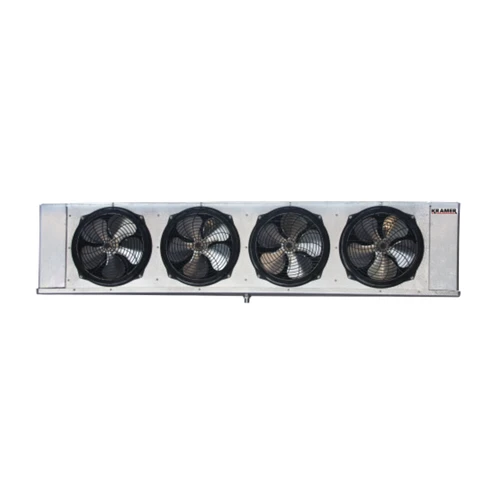
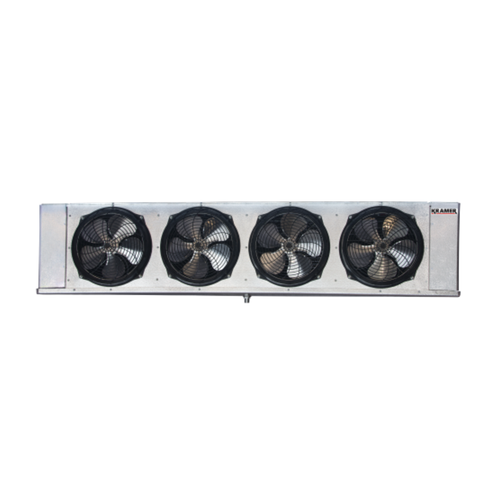
A walk-in refrigeration system is a conversation between two pieces of equipment. Inside the box hangs the unit cooler, also called the evaporator: a finned coil with fans that pull warm air across it, where liquid refrigerant boils and soaks up heat. Outside, usually on a roof or a pad, sits the condensing unit, whose compressor pumps that heat-laden vapor to a condenser coil and dumps the heat into the outdoor air or, on water-cooled models, into a water loop.
Two details decide whether the system lives a long, quiet life. The first is defrost. Medium temperature boxes, the coolers that hold produce and dairy, can often clear frost with the fans alone during an off cycle, which is air defrost. Freezers need help, usually electric heaters in the coil or hot refrigerant gas, to melt ice before it chokes off airflow. The second is matching: a condensing unit and unit cooler sized for the same load, temperature and refrigerant. Kramer's catalog is built around those pairings.
The Lineup
What Kramer builds today
Kramer's full range runs from small step-in coolers to warehouse-scale systems: unit coolers in step-in, low profile, center mount, low air velocity, medium profile, heavy duty, warehouse and glycol styles; air-cooled condensing units from fractional horsepower to 100 HP; water-cooled condensing units; Quantum remote condensers and fluid coolers; and Thermobank systems. Here is the part of that range HVAC365 carries:
- Low profile unit coolers: the most common walk-in evaporator, slim enough to hang near the ceiling of a cooler or freezer, offered with two-speed EC fan motors and air or electric defrost, including dual-rated models for either duty.
- Center mount coolers: units that blow air in two directions from the middle of the ceiling, useful in long boxes and prep rooms, available with electric defrost for freezer work.
- Reach-in and specialty coolers: Slim-Temp display case unit coolers for step-in and merchandiser applications, plus Twin-Temp reach-in coils.
- Medium temperature condensing units: Next-Gen MiniCon units with scroll or hermetic compressors for coolers, including extended medium temperature models.
- Low temperature condensing units: Next-Gen II units with scroll and Discus semi-hermetic compressors for freezers and larger boxes.
- Water-cooled units: Next-Gen WC-Series condensing units for kitchens and buildings where rejecting heat into a water loop makes more sense than an outdoor fan.
Browse the full range under unit coolers and evaporators and refrigeration condensing units.
The Next Chapter
From R-404A to a new generation of refrigerants
For years R-404A was the default refrigerant in walk-in coolers and freezers. Its high global warming potential has pushed the industry toward lower-impact blends, and Kramer's catalog shows the transition in real time. Many Next-Gen condensing units are rated for R-448A and R-449A, the nonflammable A1 replacements, with R-404A compatibility for service work. Newer models are rated for R-454A, R-454C and R-455A, mildly flammable A2L refrigerants with much lower warming potential. Kramer now sorts its technical literature into A1 and A2L classes, and A2L equipment calls for A2L-rated tools, leak detection and installation practices.
At a Glance
Kramer by the numbers
- Roots
- 1914
- Manufacturer
- Heat Transfer Products Group (HTPG)
- Parent company
- Rheem, since December 2013
- Factory
- Scottsboro, Alabama
- Sister brands
- Russell, Witt, ColdZone
- Product focus
- Commercial and industrial refrigeration
- Markets
- Foodservice, food retail, industrial, pharmaceutical
- Refrigerant classes
- A1 and A2L
Questions
Frequently asked questions about Kramer
Who makes Kramer refrigeration equipment?
Kramer is a brand of Heat Transfer Products Group (HTPG), which Rheem acquired from Monomoy Capital Partners in December 2013. HTPG also makes the Russell, Witt and ColdZone brands.
Where is Kramer equipment made?
HTPG manufactures its refrigeration equipment at its plant in Scottsboro, Alabama, with warehouses in California, Texas and Alabama.
How old is the Kramer brand?
Kramer traces its roots to 1914, making it one of the longest-running names in American commercial refrigeration.
Is Kramer part of Heatcraft?
No. Kramer belongs to HTPG and the Rheem family, while Heatcraft, with its Bohn, Larkin, Climate Control and Chandler brands, is a separate refrigeration business.
What refrigerants do Kramer condensing units use?
Many current Next-Gen units are rated for R-448A and R-449A with R-404A compatibility, and newer models are rated for lower-GWP A2L refrigerants such as R-454A, R-454C and R-455A. Always match the unit cooler and condensing unit to the same refrigerant.
What is the difference between air defrost and electric defrost?
Air defrost uses the evaporator fans during an off cycle to melt frost and suits coolers held above freezing. Electric defrost adds heaters to the coil and is used in freezers and low temperature boxes.