-
$189.62Ships in 1-2 Business Days3 in stock
-
$225.34Ships in 1-2 Business Days29 in stock


Fast Shipping

Easy Returns

Warranty Coverage

Financing Available
In a saltwater pool, the ladder rails can start to pit, a heat exchanger can wear thin, and the rim of a light niche can stain long before anyone expects it. The culprit is usually galvanic corrosion, the slow electrical tug-of-war between different metals sitting in the same conductive water. Pool Tool Company makes a simple answer: a piece of zinc that is meant to dissolve so the rest of the equipment does not.
When two different metals share an electrolyte such as salt water, the more active metal corrodes first. Zinc is more active than the copper, brass and stainless steel found in pool equipment, so a zinc anode connected to the pool's bonding system becomes the part that wears away. Boats have used the same principle for generations. In a pool, the anode sits in the plumbing, takes the corrosion on itself, and is replaced when it is spent. Its maker describes it as a must for salt water pools.
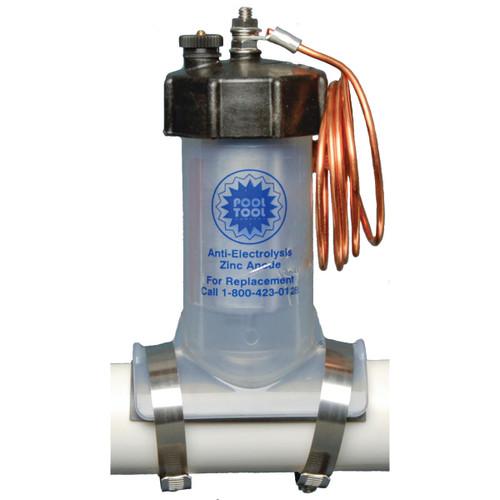
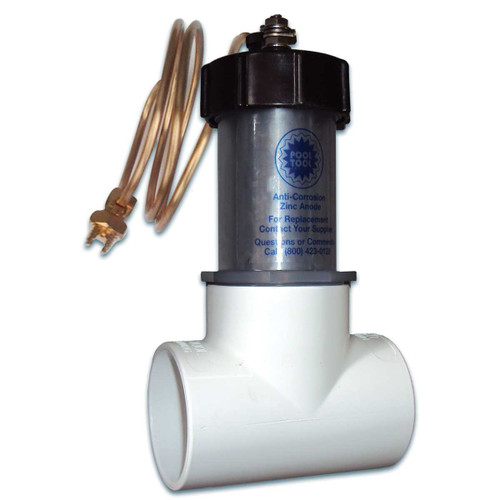
Pool Tool Company's anti-electrolysis zinc anodes come in several styles, including inline, rail-mount, pool-light and basket-weight versions. HVAC365 carries the inline versions in its zinc anodes section:
Plan on replacing the zinc about every three years, or sooner once it has shrunk to half its original size. More options are under filters and sanitizers.
A zinc anode corrodes in place of the metal parts in a pool, such as ladders, light rings and heater components, protecting them from galvanic corrosion. It is especially useful in saltwater pools.
It fits into a 2-inch tee in the pool plumbing without re-plumbing, and its copper wire is connected to the pool equipment's copper bonding wire.
The product guidance calls for replacing the zinc about every three years, or sooner if it has shrunk to half its original size. The clear housing makes it easy to check.
Salt pools are more conductive than fresh-water pools, which speeds galvanic corrosion, so a zinc anode is widely recommended for saltwater pools with metal components.