null

Commercial HVAC & Refrigeration

Commercial Equipment for HVAC and Refrigeration Contractors

This is the starting point for everything HVAC365 carries for commercial work. If you install, service, or replace equipment on retail strips, offices, restaurants, schools, warehouses, churches, medical suites, or multifamily common areas, the products you need are organized here by equipment family rather than by brand. The residential side of the store covers homes and light-commercial overlap; this section is built around how commercial jobs are actually bid and ordered: by tonnage, by voltage and phase, by fuel type, and by what is already sitting on the roof or in the mechanical room.

Right now the bulk of this section is commercial heating and cooling equipment. Commercial refrigeration, including condensing units, unit coolers, compressors, and ice machines, is being brought under this same hub so that a contractor who handles both comfort cooling and walk-in boxes can work from one place. If you do not see a refrigeration item here yet, it is still in the store under Commercial Refrigeration while that move is completed.

How This Section Is Organized

The tree is built so you can drill down from a broad equipment family to a specific replacement in two or three clicks.

  • Commercial HVAC is the umbrella for comfort heating and cooling: packaged rooftop units, commercial split condensers and heat pumps, commercial air handlers, ductless and VRV-compatible equipment, electric heat kits, economizers, roof curbs and curb adapters, dampers, sensors, thermostats, and service kits.
  • Commercial Rooftop Units sits under Commercial HVAC and holds packaged RTUs from 3 to 25 tons. It splits further into Gas/Electric Rooftop Units, Heat Pump Rooftop Units, and Air Conditioner Rooftop Units, so you can go straight to the heating type the building already has.
  • Commercial Refrigeration covers condensing units, unit coolers (evaporators), compressors, and ice machines for walk-in coolers and freezers, reach-in and food service applications, and process cooling.

Accessories live next to the equipment they serve. Economizers, curbs, and heat kits are listed in Commercial HVAC with the model families they fit called out in the product name, which makes it easier to build a complete order for one unit without guessing at cross-references.

Brands and Equipment Currently Listed

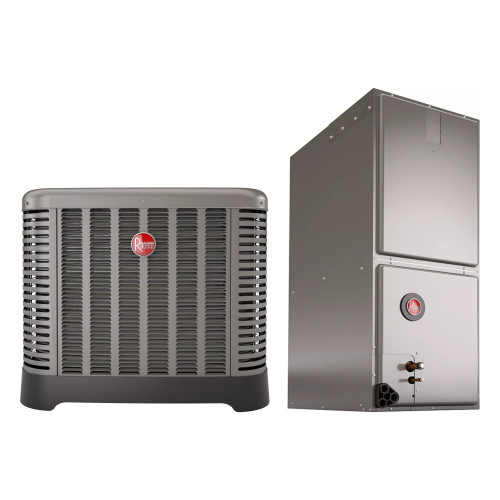
Packaged rooftop equipment here comes mainly from Daikin and Rheem, with Comfortstar packaged units in select sizes. On the Daikin side you will find several generations of packaged equipment, including newer R-32 lines and earlier models that are still in stock. Rheem packaged units listed here use R-454B. Split-system and ductless equipment includes Daikin commercial split condensers and heat pumps, Rheem commercial condensers and belt-drive air handlers, Mitsubishi ducted and ductless heat pump equipment, and Cooper and Hunter ceiling cassettes. Heat kits and accessories come from Daikin, Rheem, Goodman, Comfortstar, and others.

Because inventory changes as manufacturers roll out new refrigerant platforms, always check the product page and the manufacturer spec sheet for the exact model number, refrigerant, and electrical data before ordering. The SKU in the product title is the manufacturer model number, so you can match it against submittals or an existing unit's nameplate.

Choosing Between Equipment Families

Most commercial replacement decisions start with what is already installed. Before you get into efficiency or features, answer three questions: where does the equipment sit, what fuel does the building use for heat, and what electrical service is available.

Existing setupWhere to lookWhat to confirm first
Packaged unit on a roof curb, gas line to the unitGas/Electric Rooftop UnitsTonnage, heat input, curb footprint, gas pressure, voltage and phase
Packaged unit on a curb, no gas, mild or moderate climateHeat Pump Rooftop UnitsTonnage, backup electric heat size, voltage and phase, available amperage
Packaged unit on a curb, cooling only or electric strip heatAir Conditioner Rooftop UnitsTonnage, whether a heat kit is needed, voltage and phase
Condenser on a pad or roof with an indoor air handler or furnaceCommercial HVAC (split condensers, heat pumps, air handlers)Matched indoor section, line set size and length, refrigerant compatibility
Individual zones, server rooms, additions without ductworkCommercial HVAC (ductless and VRV-compatible)Zone loads, indoor unit style, condenser placement, controls
Walk-in cooler or freezer, reach-in, ice productionCommercial RefrigerationBox temperature, box size and load, refrigerant, condensing unit location

A like-for-like changeout is usually the fastest path to a finished job. Switching equipment types, for example replacing a gas/electric RTU with a heat pump RTU, can make sense for an owner trying to drop gas service or electrify, but it changes the electrical load and the heating performance in cold weather, so it should be engineered rather than assumed.

Electrical Service: The Detail That Holds Up Orders

Commercial equipment is sold by voltage and phase, and the wrong electrical configuration is one of the most common reasons a unit gets sent back or sits on a jobsite. Listings in this section are offered in some combination of the following, depending on the model family:

  • 208/230V single-phase for smaller packaged units, typically in the 3 to 5 ton range, common in small retail, offices converted from houses, and some light commercial suites.
  • 208/230V three-phase, the most common commercial service for rooftop and split equipment across the size range.
  • 460V three-phase, common in larger buildings, industrial spaces, and big-box retail.
  • 575V three-phase, used mainly in certain industrial facilities. Within this section, 575V options are found mostly in the Daikin packaged lines.

Read the existing nameplate, then verify at the disconnect with a meter. A building can have 208V service that someone has labeled 230V, and some equipment performs differently at the low end of its voltage range. Check the minimum circuit ampacity and maximum overcurrent protection on the new unit's spec sheet against the existing wire and breaker, especially when you are adding electric heat.

Efficiency Ratings You Will See

Commercial listings use two sets of efficiency metrics depending on capacity. Units under 65,000 Btu/h of cooling, roughly up through 5 tons, are rated in SEER2 and EER2, the same metrics used on residential equipment. Units at 65,000 Btu/h and above are rated in EER and IEER. IEER weights part-load performance, which matters on commercial buildings where units spend most of their hours at less than full capacity. Heat pump heating efficiency is typically shown as HSPF2 on smaller units and COP on larger units; check the spec sheet for the rated values. Don't compare a SEER2 number on a 5 ton unit to an IEER number on a 7.5 ton unit; they are measured differently.

Minimum efficiency requirements are set federally and can be tightened by state and local energy codes, which commonly reference ASHRAE 90.1 or the IECC. If a project is going through plan review, confirm the code edition the jurisdiction has adopted, because that affects required efficiency and economizer requirements.

Refrigerant Transition and What It Means for Ordering

New commercial comfort equipment is moving from R-410A to A2L refrigerants. In this section, newer Daikin packaged and split equipment uses R-32, and Rheem packaged equipment uses R-454B. Both are classified A2L, meaning lower flammability. Practically, that means your techs should be trained on A2L handling, use recovery machines, vacuum pumps, and leak detectors rated for A2L refrigerants, and follow the manufacturer's installation instructions on refrigerant detection, ventilation, and clearances. Some equipment includes refrigerant detection hardware or requires it in certain configurations, so read the installation manual before the unit arrives.

A2L equipment is not a drop-in for an R-410A system. When replacing one half of a split system, plan to replace both halves with matched A2L components. Older listings that do not name a refrigerant in the title may be R-410A remaining stock; confirm the refrigerant on the spec sheet and make sure installation is allowed under current EPA rules for your project timeline.

Ordering Tips From the Counter

  • Send us the existing nameplate photo, model and serial number. We can help identify tonnage, heat input, and electrical configuration from it.
  • Order the curb adapter, economizer, and heat kit with the unit. Accessories that arrive a week after the RTU can keep a crane booked twice.
  • Larger packaged units, 460V and 575V configurations, and units with factory options often have longer lead times than common 208/230V three-phase models. Ask about availability before you lock in an install date.
  • Freight equipment ships on a truck. Plan for a liftgate or forklift at delivery and inspect the unit for freight damage before signing.
  • Pull permits early. Rooftop replacements can trigger structural, electrical, and mechanical review, and some jurisdictions require a new economizer or controls upgrade at replacement.

Frequently Asked Questions

Is this section only for commercial buildings?

It is organized for commercial buyers, but the equipment is not restricted. A 3 ton single-phase packaged unit here may also suit a large home or small office. If you are working on a residential job, the residential categories may be easier to shop.

Where are the walk-in cooler and freezer parts?

Condensing units, unit coolers, compressors, and ice machines are in Commercial Refrigeration, which is being placed under this Commercial hub. Until that move finishes, you can find them in the main Commercial Refrigeration category.

Do you sell to contractors only?

HVAC365 sells equipment to contractors, businesses, and property owners. Commercial equipment should be installed by a licensed contractor, and some manufacturers tie warranty coverage to professional installation. Check the manufacturer's warranty terms for the specific unit.

How do I know which voltage to order?

Match the existing unit's nameplate, then confirm at the disconnect with a meter. If the building has 208V service, make sure the new unit is rated for 208/230V. A 460V unit cannot be connected to 208/230V service without a transformer.

Can I mix an R-32 condenser with an existing R-410A air handler?

No. Refrigerants cannot be mixed, and A2L systems are designed and listed as matched components. Plan to replace the indoor coil or air handler with a matched unit for the new refrigerant.

Can you help me cross-reference an old unit?

Yes. Send the model and serial number from the nameplate, plus photos of the unit, curb, and electrical data. We can suggest current models with similar capacity and footprint, but final selection should be confirmed against the manufacturer spec sheet and a load check when the building use has changed.

Compare
Show: 12 24 48

Fast Shipping

Easy Returns

Warranty Coverage

Financing Available