null

Commercial HVAC

Matching Commercial HVAC Equipment to the Building and the Job

Commercial HVAC covers a wide range of equipment, and the right choice depends less on brand than on the building: how it is used, where equipment can physically go, what utilities are on site, and what is being replaced. This category brings together packaged rooftop units, commercial split condensers and heat pumps, commercial air handlers, ductless and VRV-compatible equipment, and the accessories that make a commercial installation complete, including electric heat kits, economizers, roof curbs, dampers, sensors, and thermostats.

Use this page to work out which equipment type fits your project, then move into the more specific categories. If you already know you are replacing a packaged unit on a curb, go straight to Commercial Rooftop Units and pick the heating type.

Equipment Types in This Category

Packaged Rooftop Units

Packaged RTUs put the compressor, condenser, evaporator, blower, and heating section in one cabinet on a curb or slab. They are the default on single-story retail, strip centers, restaurants, offices, schools, and warehouses because they keep mechanical equipment off the floor plan and make replacement a single lift. Listings here run from 3 to 25 tons in gas/electric, heat pump, and cooling-only configurations from Daikin, Rheem, and Comfortstar.

Commercial Split Systems

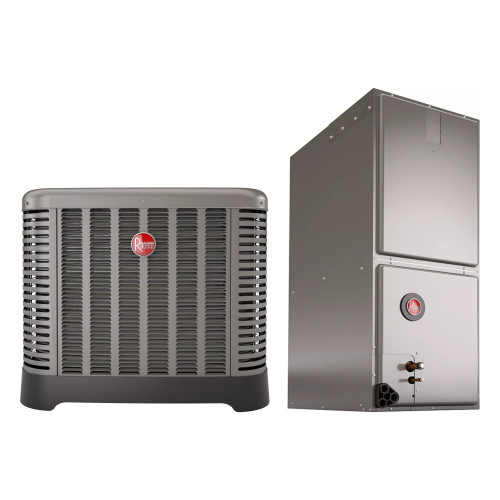
Split systems put the condenser or heat pump outdoors on a pad or roof and the air handler or furnace indoors in a mechanical room, ceiling space, or mezzanine. They make sense where there is no roof access for a large unit, where the duct system starts indoors, or where the existing system is already split. This category includes Daikin R-32 commercial split air conditioner condensers and heat pump outdoor units, Rheem commercial condensers, and Rheem belt-drive commercial air handlers with VFD options in the 7.5 to 10 ton range. Commercial splits should be selected as matched systems; check the manufacturer's matching tables and refrigerant compatibility before you pair an outdoor unit with an indoor section.

Ductless and VRV-Compatible Equipment

Ductless equipment handles spaces that do not fit a central duct system: server and telecom rooms, additions, offices carved out of warehouse space, guard shacks, and buildings with mixed occupancy schedules. Here you will find Mitsubishi ducted and ductless heat pump equipment, including PEAD ducted air handlers with PUZ outdoor units, Daikin wall-mounted indoor units and outdoor units listed as VRV-compatible, and Cooper and Hunter ceiling cassettes. For VRV or VRF system design, the outdoor unit, branch selectors, piping, and indoor units must be selected together using the manufacturer's design software, so treat individual listings as components of an engineered system.

Electric Heat Kits

Heat kits add electric resistance heat to packaged heat pumps, cooling-only packaged units, and air handlers. Listings here include Daikin heat kits for packaged families such as DFC, DFG, and DFH and for AMST air handlers, Rheem heat kits for packaged heat pumps, and Comfortstar heat strips for package units. Each kit is specific to a cabinet family, voltage, and phase, and the product title lists what it fits. Confirm the kit against the unit's installation manual, because adding a kit changes the minimum circuit ampacity and breaker size.

Economizers, Curbs, and Controls

Economizers bring in outside air for free cooling when conditions allow and are required on many new and replacement installations under energy codes. Daikin economizers here include ultra low-leak horizontal and downflow models with JADE controllers and dry bulb or enthalpy sensors, matched to specific packaged cabinet sizes. Rheem economizers and dampers are listed by unit family. Roof curbs and curb adapters from Daikin, Rheem, and others are here too, along with filters, sensors, thermostats, and service kits.

Equipment Type by Building Type

The table below is a starting point based on common practice. Every building has its own constraints, and an engineer or the authority having jurisdiction may require something different.

Building typeTypical equipmentNotes
Strip retail, single-story officesPackaged RTUs, 3 to 10 tons per zoneOne unit per tenant space is common; gas/electric where gas is on the roof
RestaurantsGas/electric RTUs, often with makeup air considerationsKitchen exhaust affects building pressure and outside air requirements; coordinate with the hood design
Big-box retail, warehousesLarger RTUs, 10 to 25 tons, often 460V three-phaseCheck curb size, structural capacity, and crane access early
Schools and churchesRTUs or split systems with economizers and ventilation controlHigh occupancy swings; demand-controlled ventilation may apply
Multi-story offices, medical suitesSplit systems, air handlers, ductless, or VRVMechanical room or ceiling space drives the selection
Server and telecom roomsDuctless heat pumps or dedicated split equipmentYear-round cooling load; check low-ambient operation on the spec sheet
All-electric buildingsHeat pump RTUs, heat pump splits, ductlessSize backup electric heat for the climate

Replacement Scenarios

Like-for-like packaged replacement

This is the most common commercial job. You match tonnage, heating type, voltage, and supply/return orientation, then check whether the new unit fits the existing curb. If it does not, a curb adapter bridges the old curb to the new unit's footprint without reroofing. The Commercial Rooftop Units category covers this planning in detail.

Changing heating type

Owners going all-electric may swap a gas/electric RTU for a heat pump RTU with electric heat. That usually increases the electrical load, so verify service capacity before committing. In colder climates, look carefully at the heat pump's heating capacity at low outdoor temperatures and size the backup heat to cover the gap.

Split system changeout during the refrigerant transition

R-410A split systems cannot be partially replaced with R-32 or R-454B components. Plan for both the outdoor and indoor sections, inspect the line set, and flush or replace it as required by the manufacturer's instructions. Line set sizing and maximum lengths vary by model, so check the installation manual.

Adding a zone

For an addition or a remodel that changes room use, a ductless system or a small packaged unit can avoid oversizing the existing system. Run a load calculation for the new zone rather than adding tonnage by rule of thumb.

Voltage, Efficiency, and Refrigerant at a Glance

  • Voltage and phase: Equipment here is offered in 208/230V single-phase (mainly smaller units), 208/230V three-phase, 460V three-phase, and in some Daikin packaged lines, 575V three-phase. Match the building service and verify with a meter.
  • Efficiency metrics: Units under 65,000 Btu/h are rated in SEER2 and EER2. Units at 65,000 Btu/h and above are rated in EER and IEER. The listed ratings come from the manufacturer; confirm the rated combination on the AHRI certificate when a rebate or code compliance depends on it.
  • Refrigerants: Newer Daikin equipment here uses R-32, and Rheem packaged units use R-454B; check the spec sheet on split and ductless equipment. Both are A2L refrigerants and require A2L-rated tools, technician training, and adherence to the manufacturer's instructions for leak detection and mitigation.
  • Codes: Energy codes based on ASHRAE 90.1 or the IECC set economizer, ventilation, and efficiency requirements that can apply at replacement. Requirements depend on climate zone, capacity, and the code edition in force, so check with the local jurisdiction.

Lead Times and Ordering

Common 3 to 10 ton units at 208/230V three-phase tend to be the easiest to source. Larger tonnages, 460V and 575V configurations, factory options such as stainless steel heat exchangers or coil guards, and matched accessories may take longer. When an install date matters, order the unit and its accessories together and confirm availability before scheduling a crane or a shutdown. Commercial equipment ships freight, so make sure someone can receive and unload it, and note any visible damage on the delivery receipt.

Frequently Asked Questions

Should I choose a packaged unit or a split system?

Start with what the building already has. If there is a curb and roof access, a packaged unit is usually the simplest replacement. If the duct system starts in a mechanical room and the outdoor unit sits on a pad, stay with a split system unless there is a good reason to change.

Do I need an economizer on a replacement unit?

Often, yes. Many energy codes require economizers on cooling equipment above a certain capacity in most climate zones, and some apply that requirement when equipment is replaced. Check the code adopted locally and the plans if the building was engineered.

How do I pick the right heat kit?

Find the kit listed for your exact unit family, voltage, and phase, then confirm the kW size against the heating load and the unit's installation manual. The kit must be one the manufacturer approves for that cabinet.

Are the ductless units here suitable for a VRV system?

Some Daikin indoor and outdoor units are listed as VRV-compatible. A VRV system still has to be designed as a whole with the manufacturer's selection software, including piping and branch selectors, so treat individual units as components.

Can a 208/230V unit run on 240V service?

Units rated 208/230V are designed for that range of nominal voltages. Measure actual voltage at the disconnect and compare it to the operating range on the spec sheet.

What does IEER tell me that EER does not?

EER measures efficiency at one full-load condition. IEER combines efficiency at several part-load points, which better reflects how commercial units run most of the year.

Compare
Show: 12 24 48

Fast Shipping

Easy Returns

Warranty Coverage

Financing Available