
-
Honeywell Residential
Honeywell Residential Direct Spark Ignition Control 1 Trial for Ignition with 6 Sec Trial Time. Two Rod. Includes Alarm Terminal | S8701A1098
SKU: S8701A1098
$629.40- 🚚Qualifies for FREE Shipping
- ⚡Fast Shipping
Ships in 3-5 Business Days4 in stock -
Honeywell Residential
Honeywell Residential Direct Spark Ignition Control. 1 Trial for Ignition with 11 Sec Trial Time Two Rod. Includes Alarm Terminal | S8701A1106
SKU: S8701A1106
$629.40- 🚚Qualifies for FREE Shipping
- ⚡Fast Shipping
Ships in 3-5 Business Days4 in stock -
Honeywell Residential
Honeywell Residential Direct Spark Ignition Control. 1 tTial for Ignition with 11 Sec Trial Time. One Rod. Includes Alarm Terminal | S8701A1074
SKU: S8701A1074
$612.09- 🚚Qualifies for FREE Shipping
- ⚡Fast Shipping
Ships in 3-5 Business Days4 in stock -
Honeywell Residential
Honeywell Residential Direct Spark Ignition Control. 1 Trial for Ignition with 21 Sec Trial Time. Two Rod | S8701A1026
SKU: S8701A1026
$635.58- 🚚Qualifies for FREE Shipping
- ⚡Fast Shipping
Ships in 3-5 Business Days5 in stock -
White-Rodgers
White-Rodgers Single Stage Hot Surface Ignition Integrated Furnace Control for Lennox | 50A66-743
SKU: 50A66-743
$308.00- 🚚Qualifies for FREE Shipping
- ⚡Fast Shipping
Ships in 3-5 Business Days9 in stock -
White-Rodgers
White-Rodgers One or Two Stage Hot Surface Ignition Integrated Furnace Control for Goodman | 50M56-743
SKU: 50M56-743
$136.96- 📦$19.95 Flat-Rate Shipping
- ⚡Fast Shipping
Ships in 3-5 Business Days5 in stock -
Honeywell Residential
Honeywell Residential Retrofit Kit for Natural/lp Gas 150000 BTU | Y8610U4001
SKU: Y8610U4001
$741.16- 🚚Qualifies for FREE Shipping
- ⚡Fast Shipping
Ships in 3-5 Business Days4 in stock -
Honeywell Residential
Honeywell Residential Universal Hot Surface Ignition Integrated Furnace Control with Wiring Harnesses for All Crosses | S9200U1000
SKU: S9200U1000
$333.82- 🚚Qualifies for FREE Shipping
- ⚡Fast Shipping
Ships in 3-5 Business Days10 in stock -
Honeywell
Honeywell Flame Amplifier Used with 7800 Series Relay Modules | R7847A1025
SKU: R7847A1025
$610.56- 🚚Qualifies for FREE Shipping
- ⚡Fast Shipping
Ships in 3-5 Business Days10 in stock -
$466.24
- 🚚Qualifies for FREE Shipping
- ⚡Fast Shipping
Ships in 3-5 Business Days12 in stock -
Honeywell Residential
Honeywell Residential 36" Ignition Cable 1/4" QC on Module End. 90 Degree Boot | 394800-36
SKU: 394800-36
$159.49- 🚚Qualifies for FREE Shipping
- ⚡Fast Shipping
Ships in 3-5 Business Days6 in stock -
Honeywell
Honeywell Flame Amplifier Infrared Ffrt: 2.0 Sec or 3.0 Sec for 7800 Series Relay Modules | R7852A1001
SKU: R7852A1001
$824.51- 🚚Qualifies for FREE Shipping
- ⚡Fast Shipping
Ships in 3-5 Business Days5 in stock
Buying guidance
Ignition Controls & Flame Safeguards
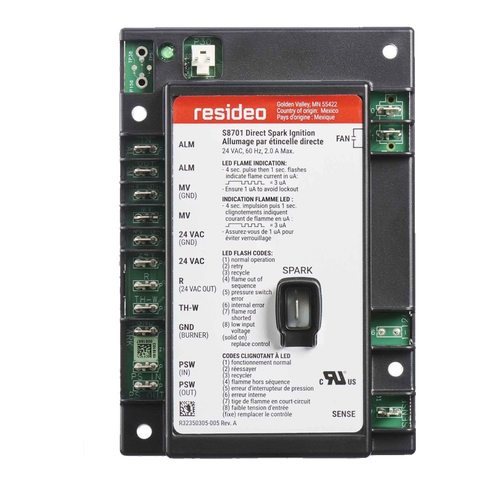


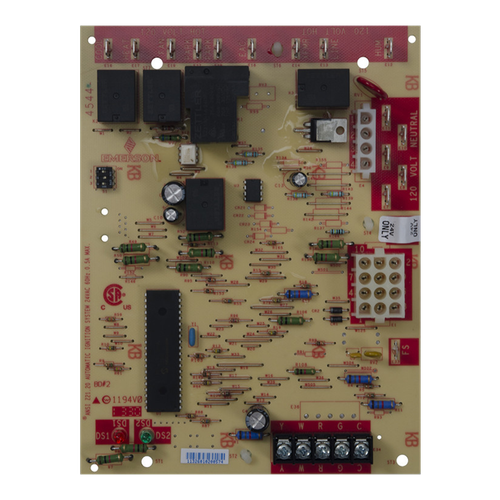

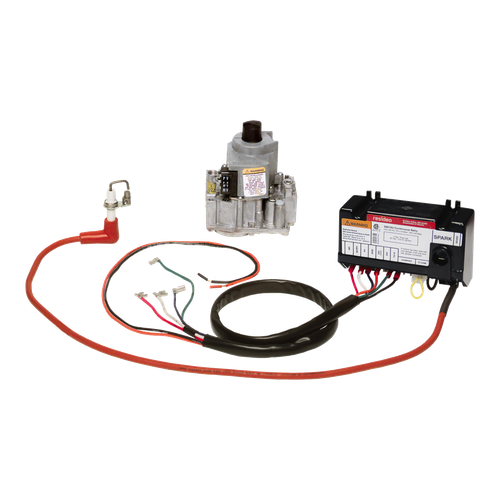

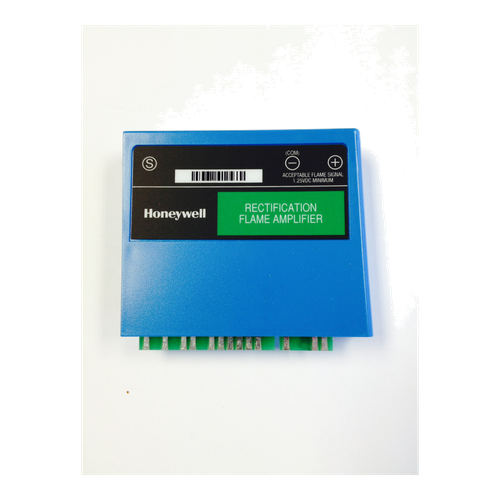


Every gas or oil burner needs a brain that decides when it is safe to light and when it must shut down. On a furnace that brain is the ignition control or integrated furnace control board. On boilers, rooftop units, unit heaters and commercial burners it is the primary control or flame safeguard, often paired with a flame scanner or amplifier that "sees" the flame. If that control does not prove a flame within a few seconds, it closes the gas or oil valve and locks out. This category covers those controls and their companion parts: hot surface and direct spark ignition modules, intermittent pilot controls, integrated furnace controls, burner primary controls, flame safeguard relay modules, UV and infrared flame scanners, flame amplifiers, wiring subbases and display modules.
We carry these parts from Honeywell, Fireye, White-Rodgers, Robertshaw, ICM Controls, Johnson Controls and the OEM parts lines of Goodman, Carrier, Rheem, York, ICP and Nordyne, with live stock counts on every listing. This guide explains how each type works, how to match a replacement and how to tell a failed control from the parts around it.
How an ignition sequence works
Most modern gas appliances follow the same basic sequence when the thermostat calls for heat:
- Self-check and prepurge. The control checks that the flame circuit shows no flame and, on induced-draft equipment, starts the inducer and waits for the pressure switch to prove airflow.
- Trial for ignition. The control energizes the igniter, spark electrode or pilot, then opens the gas valve for a set number of seconds.
- Flame proving. A flame sensor, flame rod or scanner must report flame before the trial time ends. Most gas controls use flame rectification, measuring a small DC microamp signal through the flame.
- Run. The burner fires, the blower or circulator starts on its delay and the control keeps watching the flame.
- Shutdown or lockout. When the call ends, the valve closes and post-purge runs. If flame is lost or never proven, the control retries a set number of times and then locks out, usually signaled by an LED flash code.
Types of ignition controls in this category
Hot surface ignition (HSI) modules
These modules heat a silicon carbide or silicon nitride igniter, then open the gas valve and prove flame with a separate sensor or the igniter itself (local or remote sensing). Universal HSI modules can replace many OEM modules when the igniter type, voltage and timing match; they usually include adjustable timings and adapter harnesses.
Direct spark ignition (DSI) controls
DSI controls produce a high-voltage spark directly at the main burner. They are defined by the number of trials for ignition, trial time, single-rod (spark and sense on one rod) or two-rod sensing, and lockout behavior.
Intermittent pilot controls
These light a pilot with a spark on every call for heat, prove the pilot, then open the main valve. They pair with dual-operator intermittent pilot gas valves. Many are field selectable for natural gas or LP and for 100 percent shutoff or continuous retry.
Integrated furnace controls
An integrated control combines ignition, blower timing, safety circuit monitoring and diagnostic codes on one board. OEM boards are tied to specific furnace models; universal replacements cover many furnaces with selectable blower and timing options.
Primary controls and flame safeguards
Commercial and oil-fired burners use primary controls and flame safeguard relay modules (for example the Honeywell 7800 series and Fireye controls). These manage prepurge, pilot and main flame trials, post-purge and lockout, and they work with plug-in amplifiers, wiring subbases and display or annunciator modules. Oil primary controls monitor the flame with a cad cell.
Flame scanners and amplifiers
UV scanners detect the ultraviolet light from a gas or oil flame; infrared scanners detect flicker from the hot flame. The scanner, amplifier and relay module must be a compatible set, and scanners come with different sight-pipe mounting threads, head angles and cable lengths.
How to match a replacement control
- Start with the part number on the old control. Search it on HVAC365; many listings include the part numbers they replace.
- Match the ignition type (hot surface, direct spark, intermittent pilot or standing pilot) shown in the Ignition Type filter.
- Match the voltage. Furnace controls are typically 24-volt with 120-volt line power for the blower and inducer; commercial primaries and flame safeguards are commonly 120 volts.
- Match the timings: prepurge, trial for ignition, number of retries, inter-purge, post-purge and blower on and off delays.
- Match the flame sensing method: local versus remote sensing, single-rod versus two-rod, flame rod versus UV or infrared scanner.
- Check the application in the Application filter: furnace, boiler, water heater, oil burner or commercial burner.
| Control type | Typical voltage | Flame proving | Common equipment |
|---|---|---|---|
| Hot surface ignition module | 24V control, 120V igniter | Flame rod or igniter | Furnaces, unit heaters, boilers |
| Direct spark ignition control | 24V | Flame rod (one or two rod) | Rooftop units, unit heaters, pool heaters |
| Intermittent pilot control | 24V | Pilot flame rod | Boilers, older furnaces, commercial heaters |
| Integrated furnace control | 24V / 120V | Flame rod | Residential gas furnaces |
| Burner primary / flame safeguard | 120V | UV, IR scanner or flame rod | Commercial boilers and burners |
| Oil primary control | 120V | Cad cell | Oil furnaces and boilers |
Is it really the control?
Controls are often blamed for problems caused by the parts around them. Before replacing one, a technician will usually:
- Read the LED flash code or lockout history and look it up in the appliance's service literature.
- Check the flame signal in microamps. A dirty or poorly grounded flame sensor is the most common reason a furnace lights and then shuts off after a few seconds.
- Confirm the pressure switch closes, limit switches are closed and the inducer runs.
- Measure voltage to the igniter or spark transformer and to the gas valve during the trial for ignition.
- Check polarity and grounding. Many controls cannot sense flame if line voltage polarity is reversed or the burner is not grounded.
- Inspect the board for burnt traces, swollen relays or water damage from a leaking coil or condensate line.
Installation notes
Ignition controls and flame safeguards are safety devices. They should be installed and checked out by a qualified technician following the equipment manufacturer's wiring diagram and the codes that apply where the equipment is installed. Label every wire before removing the old control, set any DIP switches or jumpers to match the original timings, and verify safe shutdown by testing flame failure response after installation. Commercial flame safeguard systems may require specific purge timings and proving switches set by the burner manufacturer, so always follow the burner's own documentation.
Shopping this category
Filter by brand, part type (ignition module, integrated furnace control, burner primary control, flame scanner, flame amplifier, wiring subbase or display module), ignition type, application and voltage. Each listing shows the manufacturer part number, cross-references when published and the quantity in stock right now. Need help matching a control? Call 1.888.509.3391 with the equipment model and the numbers printed on the old control.
Frequently asked questions
Will a universal ignition module work on my furnace?
It will if the ignition type, igniter type, voltage, sensing method and timings can be matched to your original control. Universal kits list the OEM controls they replace, and the product page shows the cross-references when the manufacturer publishes them.
What does a flashing LED on my control board mean?
It is a diagnostic code. The meaning is printed on a label inside the furnace door or in the control's instructions, and it points to the failed circuit, such as a pressure switch, limit, flame sense or ignition lockout.
Why does my furnace light and then shut off after a few seconds?
The control lit the burner but did not see enough flame signal. The usual cause is a dirty or damaged flame sensor, a poor ground or reversed polarity, not the control itself.
What is the difference between a flame scanner and a flame sensor?
A flame sensor (flame rod) sits in the flame and measures a small electrical current through it. A scanner views the flame through a sight pipe and detects ultraviolet or infrared light. Scanners are used on larger commercial burners and oil burners.
Do I need a new subbase when I replace a flame safeguard relay module?
Usually not. Most relay modules plug into the existing wiring subbase. Replace the subbase only if it is damaged or if the new module requires a different one.
How do I reset a locked-out control?
Most residential controls reset by removing power for about 30 seconds or by cycling the thermostat. Commercial flame safeguards have a reset button. Repeated lockouts mean something is wrong and the cause should be found before resetting again.


