The Brand Story
Appion: The Colorado Toolmaker That Went After Wasted Time
Every refrigeration technician knows the waiting. The recovery machine groans on a hot rooftop while a tank slowly fills. The vacuum pump runs, and runs, and the gauge barely moves. The truck is idling, the next call is across town, and the customer is asking how much longer. None of that time fixes anything. It is simply the cost of doing the job right. Appion, a manufacturer based in the Denver area of Colorado, built its business around a stubborn question: how much of that waiting is actually necessary?
Chapter 1
A rooftop problem
Refrigerant recovery is not optional. Before a sealed system can be opened for repair, the refrigerant inside has to be pulled out and captured, and the machines that do it have historically been heavy, hot-running and slow when liquid refrigerant is involved. Many units throttle back on liquid to protect their compressors, which stretches a ten-minute task into something much longer. For a technician carrying a machine up a ladder, every pound counts too.
Appion's answer was to treat the recovery machine as an engineering problem rather than a commodity. Instead of building another version of the familiar box, the company started from the compressor out.
Chapter 2
The G5Twin
Appion entered the HVAC/R market with the G5Twin, a recovery machine built around horizontally opposed twin cylinders and twin condensers. The design lets it move both liquid and vapor without throttling, and a seven-inch, ten-blade turbine fan pushes more than 600 cfm of cooling air across the condensers to keep it working in the heat. The crankcase is bearing-lined, permanently lubricated and isolated from the refrigerant stream. The whole machine weighs about 24 pounds.
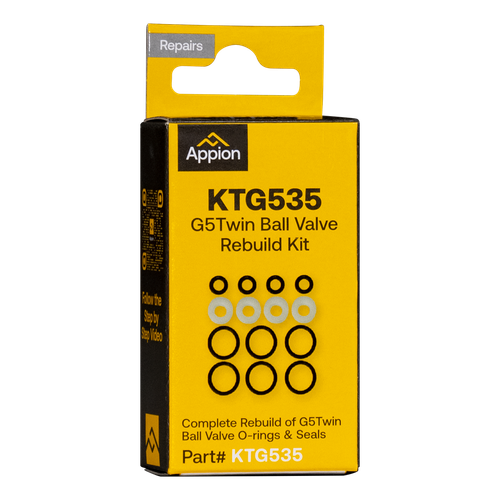
Just as important to the people who own one, the G5Twin was designed as a modular machine that can be rebuilt in the field in roughly 20 to 30 minutes, rather than shipped away for weeks. It is certified for a wide range of refrigerant classes and works with mineral, PAG and POE oils. Today's version is listed as A2L compatible.
Chapter 3
Rethinking the vacuum
Once refrigerant is out and repairs are made, the system has to be evacuated: pumped down to a deep vacuum so that moisture boils off and air is removed before a fresh charge goes in. For years the usual approach was to hook up a bigger pump and wait. Appion looked at the path between the pump and the system instead.
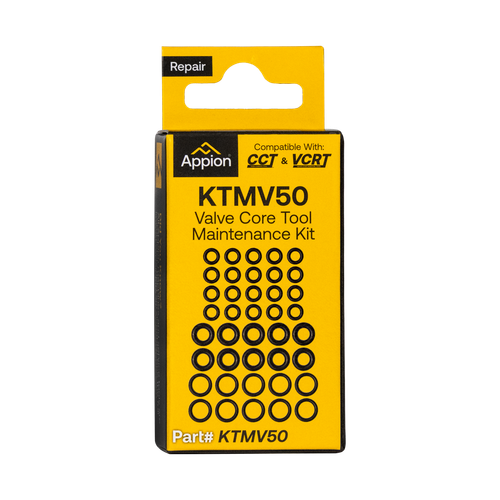
A standard quarter-inch hose and an installed Schrader valve core form a narrow bottleneck. No matter how strong the pump is, the vapor can only leave as fast as that restriction allows. Appion's TEZ Speed System combined vacuum pumps with tools that open up that path. Its MegaFlow hoses use larger 3/8-inch and 1/2-inch diameters with vacuum-rated construction, and its MegaFlow valve core removal tools let a technician pull the core out of the service port while staying sealed, then reinstall it without breaking vacuum. The core tools are vacuum-rated to 20 microns and use double O-ring seals to keep air from leaking in.
Chapter 4
Measuring what matters
A faster evacuation only helps if the technician can trust the reading at the end. Appion's measurement line grew to include wireless digital gauges built for exactly that moment. The AV760 vacuum gauge reads across a span from 760,000 microns, roughly atmospheric pressure, all the way down to 1 micron. The PTC900 pressure and temperature gauge covers from a deep vacuum to 900 psi, and pairs of them make up a wireless manifold kit. Readings travel to a phone instead of a gauge face hanging off a service port, so a technician can watch a decay test from across the room.
Chapter 5
More than a tool catalog
From its home in Englewood, Colorado, just south of Denver, Appion describes itself as a workflow partner to the trade as much as a tool supplier, with a heavy emphasis on technician education and support. Repair parts for its machines ship from the factory in Denver. The company has also taken its tools to Chillventa, the international refrigeration trade fair in Germany, where its catalog spans measurement equipment, recovery, evacuation and charging accessories.
The Lineup
What Appion builds today
Appion makes refrigerant recovery machines, vacuum pumps, evacuation hoses and core tools, digital gauges and charging accessories. The Appion tools HVAC365 carries include:
- Recovery machines: the G5Twin twin-cylinder recovery machine, A2L compatible.
- Vacuum pumps: the TEZ6, a 6 CFM two-stage pump with auto-switching 100-240V power, A2L compatible.
- Gauges and hoses: the AV760 wireless vacuum gauge, PTC900 wireless pressure and temperature gauges and the PTCGKT1 two-gauge kit, along with MegaFlow 1/2-inch evacuation hoses.
- Core tools and kits: the CCT14 core control tool, MGAVCT MegaFlow valve core removal tool, MegaFlow Basics evacuation kits (MGABAS and MGABRO), and the SPDKIT-V vacuum and SPDKIT-R recovery speed kits with Speed-Y fittings.
- Refrigerant oils and charging scales to round out the charging side of the job.
The Next Chapter
Tools for the A2L era
As new equipment moves to lower-GWP A2L refrigerants such as R-32 and R-454B, which are classified as mildly flammable, tools that touch the refrigerant circuit have to be suited to the job. Recovery machines and vacuum pumps in particular are now built and labeled for A2L compatibility. Appion's current G5Twin and TEZ6 are both listed as A2L compatible, so the same tools can follow a technician from an older R-410A changeout to a new A2L installation.
At a Glance
Appion in brief
- Headquarters
- Englewood, Colorado
- Factory
- Denver, Colorado area
- First product to market
- G5Twin recovery machine
- G5Twin weight
- About 24 lb
- Signature systems
- TEZ Speed System, MegaFlow
- Focus
- Recovery, evacuation and measurement
Questions
Frequently asked questions about Appion
Where is Appion based?
Appion is based in Englewood, Colorado, just south of Denver, and ships repair parts for its machines from its Denver-area factory.
What is Appion best known for?
Appion is best known for the G5Twin refrigerant recovery machine and for its MegaFlow hoses and valve core tools, which are designed to speed up system evacuation.
Why do larger evacuation hoses make a difference?
During evacuation, vapor can only leave a system as fast as the narrowest point allows. Larger-diameter, vacuum-rated hoses and removing the valve core open that path so the vacuum pump can work at its full capacity.
Are Appion tools compatible with A2L refrigerants?
Appion lists its current G5Twin recovery machine and TEZ6 vacuum pump as A2L compatible, so they can be used on equipment charged with refrigerants such as R-32 and R-454B.
What does a micron gauge measure?
A micron gauge measures how deep a vacuum is. Appion's AV760 reads from about atmospheric pressure, 760,000 microns, down to 1 micron, so a technician can confirm a system is dry and tight before charging.