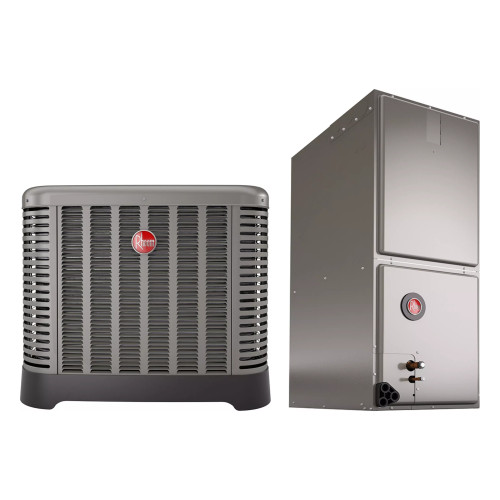
Specifying a Commercial Split System: Where to Start and Which Page You Need
A commercial split system puts the compressor and condenser coil outdoors and the evaporator coil and blower indoors, joined by a refrigerant line set and control wiring. That basic idea is the same as a house, but the job is not. Commercial work brings three-phase power, larger airflow against higher static pressure, energy-code efficiency floors measured in different metrics, and buildings where the indoor section might sit in a mechanical room, above a corridor ceiling, or on a mezzanine platform. This section is built to help contractors, mechanical engineers, and facility managers move from the job conditions to the right part numbers without guessing.
Everything on this page and its subcategories is three-phase split equipment from Rheem and Daikin in roughly 3 to 20 tons, offered in 208/230V 3-phase and 460V 3-phase versions, plus a small group of coastal protection coatings. Ductless and mini split equipment for commercial spaces lives on its own page, Commercial Ductless & VRV Systems, under the Commercial HVAC section.
How This Section Is Organized
Pick your page by what you are replacing or building:
- Commercial AC Condensing Units – cooling-only outdoor sections. Rheem RA14AY, RA15AY, and WA14AY in 3 to 5 tons; Rheem Commercial Classic RACY in 6.5 to 20 tons; Daikin DC3SEA (3 to 5 tons) and DC6TE (7.5 and 10 tons) on R-32; plus several earlier Daikin DX and DZ models.
- Commercial Heat Pump Condensers – outdoor sections that heat and cool. Rheem RP14AY and RP15AY in 3 to 5 tons, Rheem RPCY in 7.5 and 10 tons, Daikin DH4SEA (3 to 5 tons) and DH6TE (7.5 and 10 tons).
- Commercial Air Handlers – indoor sections. Rheem RHCYA belt-drive VFD air handlers for cooling systems from 7.5 to 20 tons, RHCYP belt-drive VFD heat pump air handlers in 7.5 and 10 tons, and RH2TY multi-position constant-torque ECM air handlers for 3 to 5 tons.
- Commercial AC Split System Bundles – a Rheem condenser and its matched Rheem air handler sold together under one listing, 3 to 20 tons.
- Commercial Heat Pump Split System Bundles – a Rheem heat pump and matched air handler together, 3 to 10 tons.
If you are replacing only one failed section and the other is staying, shop the component pages. If both sections are being replaced, or the existing indoor coil uses a different refrigerant than the new outdoor unit, a bundle is usually the cleaner path because the pair is already matched for its published rating.
Split System, Packaged Rooftop, or Ductless?
The first decision on a lot of jobs is not which split system, but whether a split is the right tool at all. The answer usually comes down to where the equipment can physically go and what the building already has.
| Building condition | Usually points toward | Why |
|---|
| Existing indoor air handler in a mechanical room or closet, outdoor unit on grade or roof | Split system | Ductwork, return path, and indoor location are already set up; you are matching what is there. |
| Roof cannot take the weight or a new curb penetration | Split system | Only the condenser goes outside, and it can sit on grade, on a wall bracket stand, or on a roof rail or dunnage. |
| Wide-open single-story building, ducts on the roof deck, existing curbs | Packaged rooftop unit | One piece of equipment, no indoor footprint, and gas heat or economizer packages come built in. |
| Multi-story building where the tenant space is mid-floor | Split system or ductless | A rooftop unit would need long vertical duct risers; a split places the air handler on the floor it serves. |
| Small office, server closet, or addition without ductwork | Ductless | No duct system to build; individual indoor heads serve individual rooms. |
| Noise-sensitive space such as a clinic or studio | Split system | The compressor is outside and away from the occupied space. |
Splits also make sense where the indoor unit needs protection from weather, where a facility wants service access indoors, or where a historic or architectural review board will not allow visible rooftop equipment. Rooftop units still win on simplicity when the building was designed around them.
The Five Questions to Answer Before Ordering
- What is the building power? Read the existing nameplate and the panel schedule. A 208/230V 3-phase unit will not run on 460V, and a 460V unit will not run on 208V. Every condenser and air handler in this section lists its voltage in the product name. Some 3 to 5 ton bundles pair a three-phase condenser with a single-phase air handler, which means two different circuits.
- What is the cooling load, and has it changed? Tenant improvements, added occupancy, new lighting, or a kitchen or server area all change the load. Matching the old tonnage is not the same as sizing the space. When in doubt, run or request a commercial load calculation.
- Where does the indoor section go, and in which orientation? Measure the space, the service clearance, and the duct connections. The RH2TY air handlers are multi-position cabinets for smaller systems; the RHCYA and RHCYP belt-drive units are larger cabinets that need floor or platform space and room to pull the blower and filters.
- How will the space be heated? Cooling-only systems need a separate heat source or an electric heat accessory where one is approved for the air handler. Heat pump systems heat with the refrigerant circuit and usually need supplemental heat in colder climates.
- What does the local energy code require? Efficiency minimums, economizer requirements, and ventilation are set by the adopted code (commonly based on ASHRAE 90.1 or the IECC) and by the local jurisdiction. A split system does not automatically exempt a job from economizer or outdoor-air requirements, so check with the engineer of record or the building department.
Voltage and Phase at a Glance
| Power supply | Where you typically find it | How it appears in this section |
|---|
| 208/230V 3-phase | Strip centers, offices, restaurants, and other buildings on 208Y/120V or 240V three-phase service | Rheem part numbers with a C voltage code (for example RACY2120CAZ); Daikin part numbers ending in 3 or 30 |
| 460V 3-phase | Larger commercial and industrial buildings on 480Y/277V service | Rheem part numbers with a D voltage code (for example RACY2120DAZ); Daikin part numbers ending in 4 or 40 |
| 208/230V 1-phase | Air handlers in some 3 to 5 ton bundles | Called out in the bundle name next to the air handler |
No 575V equipment is currently listed in this section. If your site is on 575V 3-phase service, reach out before ordering so we can confirm availability rather than substituting a transformer after the fact.
Efficiency Ratings: Which Number Applies
Federal test procedures split commercial-style equipment by capacity. Three-phase systems below 65,000 Btu/h (roughly 3 to 5 tons) are rated in SEER2 and EER2, the same metrics used on residential equipment. Systems at 65,000 Btu/h and above are rated in EER for full-load efficiency and IEER for part-load efficiency, which weighs how the unit performs at reduced capacity across the year. That is why a 5-ton listing here shows SEER2 and a 7.5-ton listing shows IEER or EER. The two families of numbers are not interchangeable, so compare like with like. For an exact rating on a specific pairing, use the AHRI certificate for that condenser and air handler combination.
Refrigerants: R-454B and R-32
The current Rheem equipment in this section uses R-454B, and the current Daikin DC3SEA, DC6TE, DH4SEA, and DH6TE equipment uses R-32. Both are A2L refrigerants, a classification for lower-flammability refrigerants. In practical terms, technicians need recovery machines, vacuum pumps, and leak detectors rated for A2L use, and the installation must follow the manufacturer’s instructions and the applicable safety standards, which can include refrigerant detection sensors and mitigation controls at the indoor unit depending on charge and room size. Do not mix refrigerants, and do not connect an A2L outdoor unit to an indoor coil that is not listed for that refrigerant. Some earlier Daikin DX and DZ models in this section are listed with older SEER ratings; check the spec sheet for refrigerant type before matching them to existing equipment.
Coastal and Corrosive Sites
Salt air, pool chemicals, and industrial exhaust shorten coil life. This section includes Surfsil SeaCoast coating options for 7.5 and 10 ton condenser coils and air handler cabinets. Factory or pre-ship coatings are worth pricing on any job within sight of salt water or near a cooling tower drift path, because recoating a failed coil in the field is never as good as protecting it before it corrodes.
Ordering and Delivery Tips
- Order the condenser and air handler with the same voltage code unless the listing deliberately pairs different power supplies, and confirm both against the panel before the truck is booked.
- Larger condensers and belt-drive air handlers ship by freight. Plan for a forklift or liftgate delivery, have someone on site who can inspect the crate, and note any visible damage on the delivery receipt before signing.
- If the condenser is going on a roof, line up the crane or lift before the equipment arrives so it is not sitting in a parking lot.
- Order line set, disconnects, pads or roof supports, condensate materials, filters, and the thermostat or controller separately unless the listing says they are included.
- Download the installation manual and spec sheet from the product page and confirm line-set sizing and maximum length and lift for your layout before you rough in.
Frequently Asked Questions
Should I buy a bundle or separate components?
Buy a bundle when both the condenser and air handler are being replaced, because the pair is already matched. Buy components when one section is staying and you have confirmed the new piece is approved to pair with it.
Can a 460V condenser be paired with a 208/230V air handler?
Yes, as long as the two are an approved refrigerant match. Each section is powered by its own circuit, so the voltages do not have to match, but each one must match the power available where it is installed.
What size range does this section cover?
Currently about 3 to 20 tons. Rheem RACY condensers and RHCYA air handlers reach 20 tons; Daikin DC6TE and DH6TE top out at 10 tons on these pages.
Do I need an economizer on a split system?
Possibly. Economizer requirements depend on system capacity, climate zone, and the energy code your jurisdiction has adopted. On a split system the economizer is typically added at the air handler or in the ductwork, so confirm the requirement during design.
Why do some listings show SEER2 and others show IEER?
Units under 65,000 Btu/h are rated in SEER2 and EER2. Units at 65,000 Btu/h and above are rated in EER and IEER. It is a difference in test procedure, not a sign that one product is better.
Are thermostats included with these systems?
Not unless the listing says so. Larger two-stage systems need a controller that can stage cooling correctly, so confirm compatibility in the installation manual before choosing one.